The Cosmic Potter: How Rotation and Magnetic Fields Shape a Black Hole ✛
On November 23, 2023, the LIGO, Virgo, and KAGRA detectors caught a gravitational wave from the merger of two black holes with masses of 137 and 103 solar masses. Both fall into the pair-instability mass gap, the range from 69 to 139 solar masses where ordinary stellar evolution leaves behind nothing but expanding gas. The spins of these black holes turned out to be suspiciously high: 0.9 and 0.8 of the maximum possible value. Where such a pair came from is a puzzle that has been troubling astrophysicists.
The answer came from an unexpected direction: the cosmic potter. The star's rotation and its magnetic field shape the nascent black hole, just as a master's hands shape clay. A field too weak, and the hole swallows almost the entire star, becoming too massive. A field too strong, and jets sweep out so much matter that the hole remains light and slow. But a moderate field works like a precise tool: it trims just enough mass for the hole to land in the gap, while simultaneously spinning it up to a high spin.
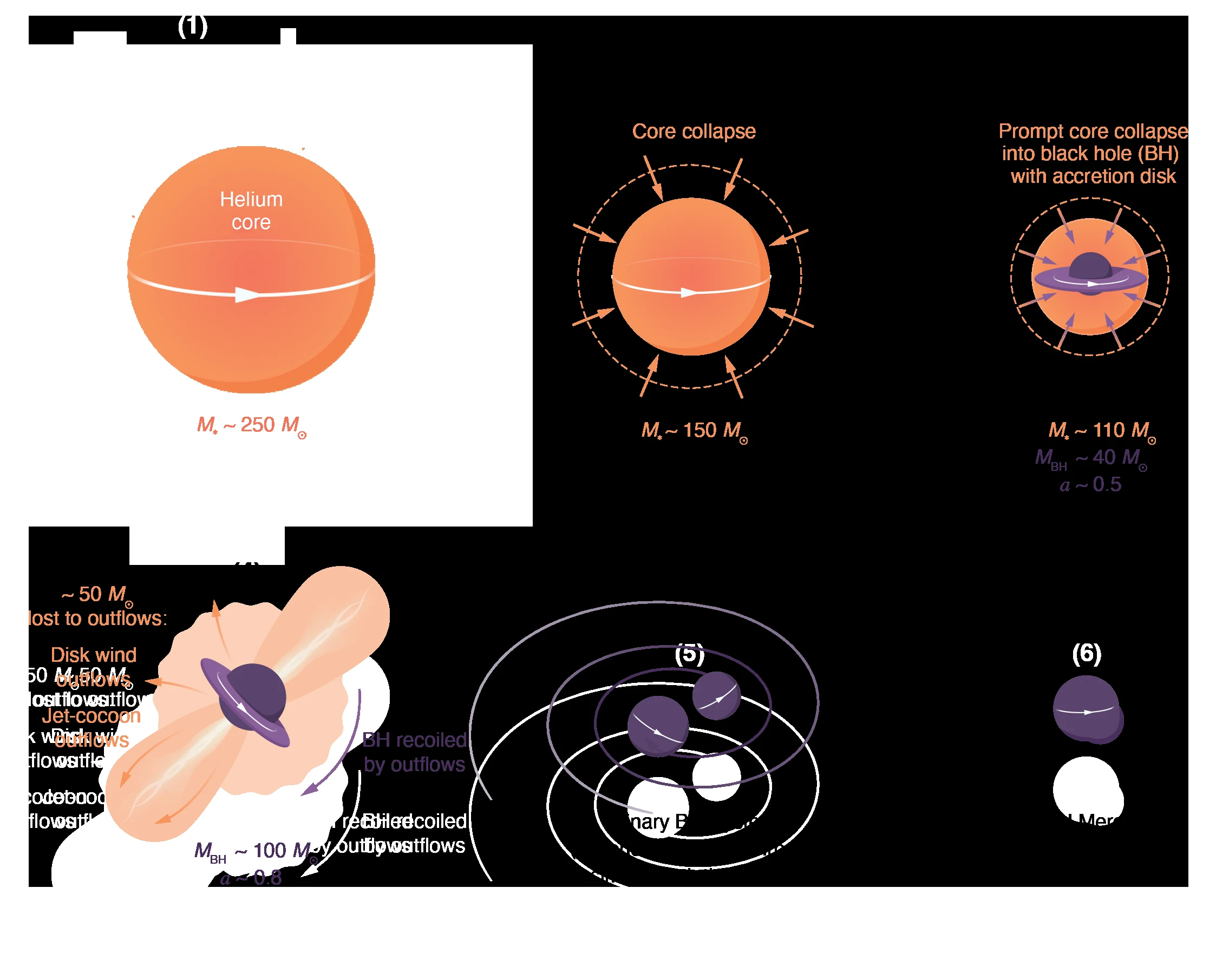
The authors traced the fate of a helium core of 250.75 solar masses. First, the star evolved and lost mass through stellar winds; by the time of collapse, its mass had decreased to 149 solar masses. The collapse took 4.29 seconds and produced a black hole of 40 solar masses with a spin of 0.5. Then the race began: the accretion rate immediately after formation exceeded 100 solar masses per second, then stabilized at 10–40 solar masses per second. The entire star was swallowed in about one second.
The outcome depended on the magnetic field, just as a sculpture's fate depends on the strength of the master's hands. With a weak field, no jets formed, and the hole accreted almost the entire star, reaching a mass of about 140 solar masses and a near-maximal spin close to 1. With a strong field, the magnetic flux saturated, jets extracted rotational energy with a power up to $10^{54}$ erg/s, and the hole slowed down, even to retrograde rotation in the most extreme model. A moderate field gave the perfect balance: a mass of about 100 solar masses and a spin of 0.8, exactly matching the secondary component of GW231123. The primary component, with a mass of 137 solar masses and a spin of 0.9, is reproduced by the weak-field model.
This work removes the main objection to the direct collapse channel for forming black holes in the pair-instability mass gap. Previously, it was thought that an isolated star collapsing would produce a hole with the mass of the core, that is, above the gap. Now it is shown that rotation and magnetic fields can naturally trim the mass down to the required range and spin up the hole. The new correlation between mass and spin, depending on the progenitor's magnetic field strength, becomes a diagnostic tool for population studies. And the powerful jets predict bright electromagnetic transients comparable to the most energetic gamma-ray bursts, opening the door to multimessenger astronomy.
The cosmic potter continues its work. Future simulations should include the dynamical evolution of the black hole spin and the calculation of kicks, which can tilt spins and alter orbits in binary systems. A wider range of progenitor masses and rotation profiles will allow a complete picture of massive black hole formation. And observational searches for electromagnetic counterparts to such collapses in the early universe will help test the model's predictions. Rotation and magnetic fields are the invisible hands that shape the most enigmatic objects in the universe.
In the moderate-field model, the black hole loses about 40 solar masses through jets and winds, comparable to the mass of an entire star. Jets in the most powerful model reach an isotropic power of $10^{56}$ erg/s, orders of magnitude brighter than the most energetic known gamma-ray bursts.
The scenario of direct collapse of a massive star producing a rapidly spinning black hole and powerful jets echoes the description of black hole formation in Greg Egan's novel "The Light of Distant Stars," where the collapse of first-generation stars gives rise to extreme objects.