Spinning into the Gap: Direct Collapse as the Source of GW231123 ✛
Context
GW231123, detected on 23 November 2023 by the LIGO-Virgo-KAGRA collaboration, is the most massive black hole binary system observed: component masses of 137 and 103 solar masses, and dimensionless spins of 0.9 and 0.8. Both black holes fall within the pair-instability gap (mass range from 69 to 139 solar masses), where standard stellar evolution predicts no black holes. Hierarchical mergers in dense clusters can produce such masses, but they rarely yield high spins due to random orientation. Isolated evolution of massive stars faces a problem: direct collapse of a core above the gap typically leads to a black hole with a mass equal to the core mass, that is, above the gap. This work joins a series of studies on the formation of massive black holes in binary systems, but unlike neighboring works that consider dynamical scenarios or evolution without magnetic fields, here the entire path from helium core to black hole is modeled for the first time, including rotation and magnetic fields.
Methods
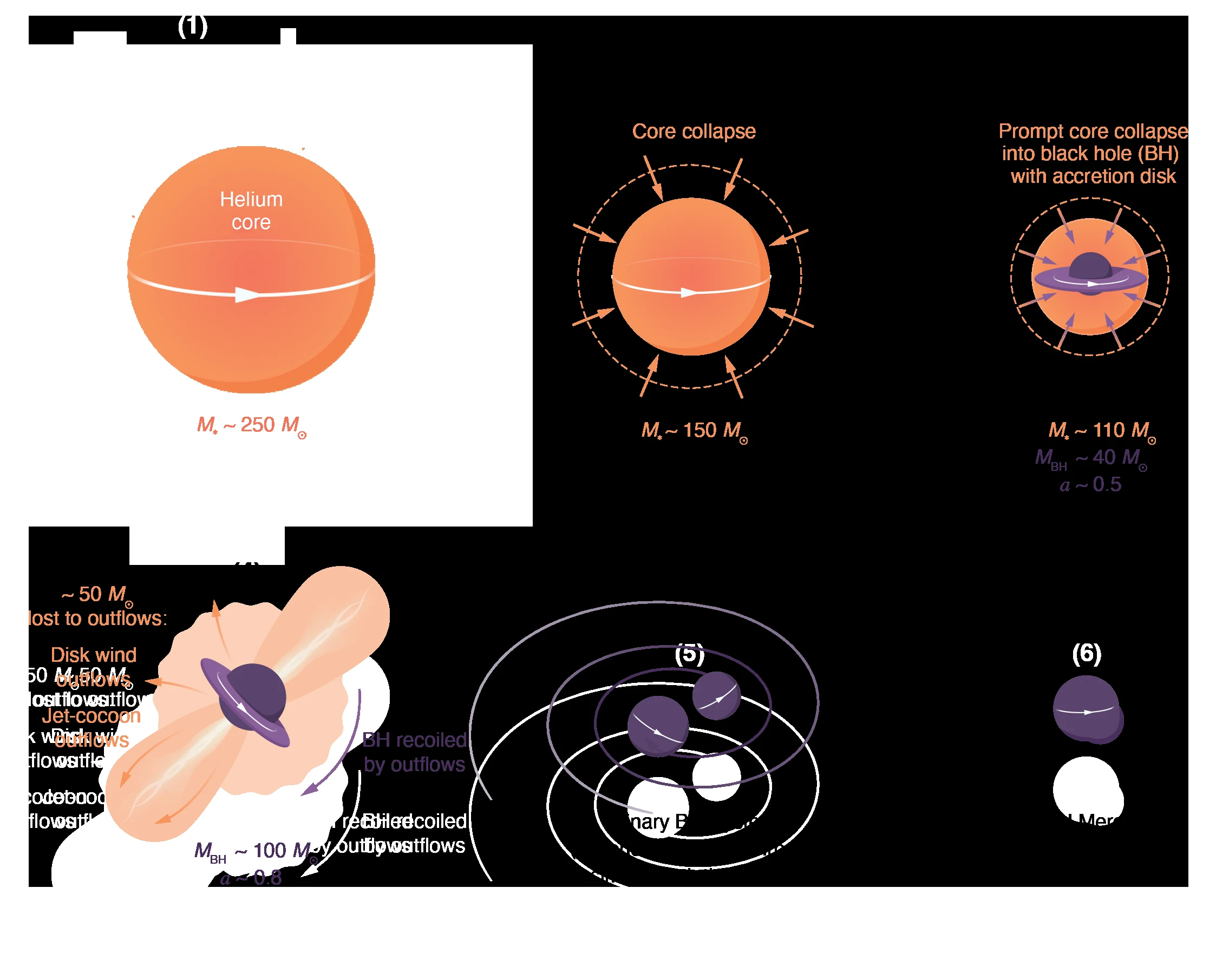
The authors started with a helium core model of 250.75 solar masses and metallicity Z=0.001, whose evolution was calculated with the MESA code up to the moment of collapse, when the core mass had decreased to 149 solar masses due to stellar winds. The collapse to black hole formation was modeled with the one-dimensional general relativistic hydrodynamics code GR1D using the LS220 equation of state; a black hole of 40 solar masses formed 4.29 seconds after the onset of collapse. The density and velocity profiles were then transferred to the three-dimensional general relativistic magnetohydrodynamics code H-AMR, which evolved the system after black hole formation with a fixed mass and spin a=0.5. Rotation was set by a profile obtained by averaging over 125 massive stars with chemically homogeneous evolution, and the magnetic field was initialized as an axisymmetric configuration with varying strength: from very weak (Bw) to very strong (Bvs), with field strengths at a radius of 100 gravitational radii ranging from $10^{11}$.6 to $10^{15}$.5 G. The grid had up to three levels of adaptive mesh refinement, with resolution up to 6144×6144×8192 cells for the weak field, ensuring resolution of the magnetorotational instability with quality parameter Q>10.
Results
The simulations showed that immediately after black hole formation, the accretion rate reaches extreme values exceeding 100 solar masses per second, then stabilizes at 10–40 solar masses per second until the bulk of the star is exhausted in about 1 second. In models with strong and very strong magnetic fields (Bs and Bvs), the dimensionless magnetic flux saturates at about 50, indicating a magnetically arrested state and efficient extraction of the black hole's rotational energy, producing jets with powers up to $10^{54}$ erg/s. In the weak field model (Bw), no jets form, and the black hole accretes nearly the entire star, reaching a mass of about 140 solar masses and a maximum spin of a≈1. In the moderate field model (Bm), jets appear late, when the accretion rate drops, and the black hole stabilizes at a mass of about 100 solar masses and spin a≈0.8. In models with strong fields, the spin decreases to equilibrium values, down to retrograde a≈-0.1 in the Bvs model due to stochastic accretion with opposite angular momentum. The final mass-spin correlation shows that weak fields produce massive, rapidly spinning holes; strong fields produce less massive, slowly spinning ones; and moderate fields fall into the mass gap with high spin, consistent with GW231123's parameters: the secondary hole corresponds to the Bm model, and the primary to the Bw model.
Implications
This work demonstrates for the first time that direct collapse of a massive, rotating, magnetized star can naturally produce black holes in the pair-instability gap with high spins, removing the main objection to this formation channel for GW231123. Unlike neighboring works that either consider dynamical scenarios with low spins or use semi-analytic models without magnetic fields, here a self-consistent end-to-end approach from star to black hole with three-dimensional magnetohydrodynamics is applied. This establishes a new correlation between black hole mass and spin depending on the progenitor's magnetic field strength, which can serve as a diagnostic for population studies. Furthermore, the model predicts powerful electromagnetic transients comparable to the most energetic gamma-ray bursts, opening the possibility of multimessenger observations.
Future development
Future studies should include dynamic evolution of the black hole's mass and spin in simulations, as well as radiative transfer and neutrino cooling to better determine jet properties and outflows. A wider range of progenitor masses and rotation profiles needs to be explored to build a complete picture of massive black hole formation. It is also important to calculate the detailed dynamics of kicks, which can lead to spin misalignment and orbital changes in binary systems. Observational searches for electromagnetic counterparts from such events in the early universe will help test the model's predictions.
Impact
The results will affect the interpretation of gravitational-wave observatory data, especially for massive events in the mass gap, and models of binary black hole population synthesis. They also stimulate searches for transients associated with massive star collapse in optical and gamma-ray bands.
Next steps
Plans include simulations with self-consistent evolution of the black hole spin and inclusion of kick calculations to determine the fate of the binary system. The influence of different equations of state and initial magnetic configurations will also be investigated.
Key open problems
This work directly addresses the problem of the origin of black holes in the pair-instability gap, which remains one of the main mysteries in compact object astrophysics. It also links uncertainties in rotation profiles and magnetic fields of massive stars to the final properties of black holes, emphasizing the need for improved stellar evolution models.
The knowledge machine's view
This section is addressed to the author of the paper and their colleagues. Neighbouring works were found by meaning-based search across our archive, not by word overlap. We do not review: we show the field around the work.
What the work does
The authors modeled the evolution of a helium core with a mass of 250.75 solar masses from collapse to black hole formation using three-dimensional general relativistic magnetohydrodynamics, for the first time including rotation and magnetic fields. They showed that disk winds and jets, regulated by the magnetic field, allow black holes to form in the pair-instability mass gap with high spins, reproducing the masses and spins of GW231123 and consistent with GW190521.
Where its strength is
End-to-end modeling from core evolution to collapse and accretion, including magnetic fields, is a new step in understanding the formation of massive black holes in isolated systems, providing a natural explanation for high spins.
Where it could go next
- It might be interesting to compare the obtained scenario with the analysis of the GW231123 signal as a possible manifestation of nonstandard physics, such as domain walls, to assess how sensitive the model is to alternative interpretations.based on: Gravitational Phantoms: Domain Walls Instead of Black Holes arXiv:2606.06478v1
- A related work considers GW231123 as a lensed signal, which could impose additional constraints on source parameters; comparing it with your predictions of masses and spins could clarify which scenario is more likely.based on: Cosmic Funhouse Mirror: The Mystery of Signal GW231123 arXiv:2607.21834v1
- Since your mechanism yields high spins, it would be useful to check how such systems appear in population synthesis, considering hierarchical mergers in dense clusters, where spins are typically lower.based on: Black Hole Dances in Globular Clusters arXiv:2604.18709
Worth trying
- Test whether high spins are preserved when varying the initial rotation profile and magnetic flux.
- Assess how often such a scenario occurs in the population of massive stars, accounting for metallicity.
- Compare the predicted event rates with those observed by LIGO-Virgo-KAGRA for masses in the gap.
Nearby works in our archive
- Primordial Black Holes in Giant Costumessimilarity 0.64
- The Collapsar's Gravitational Boomerang: Cracking the GW190814 Anomalysimilarity 0.61
- Black Hole Dances in Globular Clusterssimilarity 0.60
- Cosmic Scales: How Black Holes Swap Rolessimilarity 0.58
- Cosmic Funhouse Mirror: The Mystery of Signal GW231123similarity 0.57
- A Gravitational Census of Invisible Giantssimilarity 0.57
- Gravitational Phantoms: Domain Walls Instead of Black Holessimilarity 0.56
The closest work in the archive sits at 0.64 by meaning — the usual level for our corpus.
In the moderate magnetic field model, the black hole loses about 40 solar masses through jets and winds, comparable to the mass of an entire star. The jets in the most powerful model reach an isotropic power of $10^{56}$ erg/s, orders of magnitude brighter than the most energetic known gamma-ray bursts.
The scenario of direct collapse of a massive star forming a rapidly spinning black hole and powerful jets echoes the description of black hole formation in Greg Egan's novel "The Light of Distant Stars," where the collapse of first-generation stars gives rise to extreme objects.
Key numbers
- helium core mass: 250.75 solar masses
- black hole mass at formation: 40 solar masses
- accretion rate immediately after formation: >100 solar masses per second
- black hole spin in the Bm model: 0.8
- black hole mass in the Bm model: about 100 solar masses