A Dark Dwarf Plunging Through the Milky Way's Disk ✛
Context
This work sits on the fringe: nearby in the archive lie studies of the Milky Way's dark halo, traces of black holes in spiral galaxies, rotation curves, and galaxies without dark matter. All of them concern large-scale structures or global effects. Here, however, we deal with a local perturbation: a vertical anomaly in stellar velocities measuring 200 by 50 parsecs, coinciding with gas structures already interpreted as the trail of a dark subhalo impact. This is the first attempt to see the impact itself in the stars, not just in the gas.
Methods
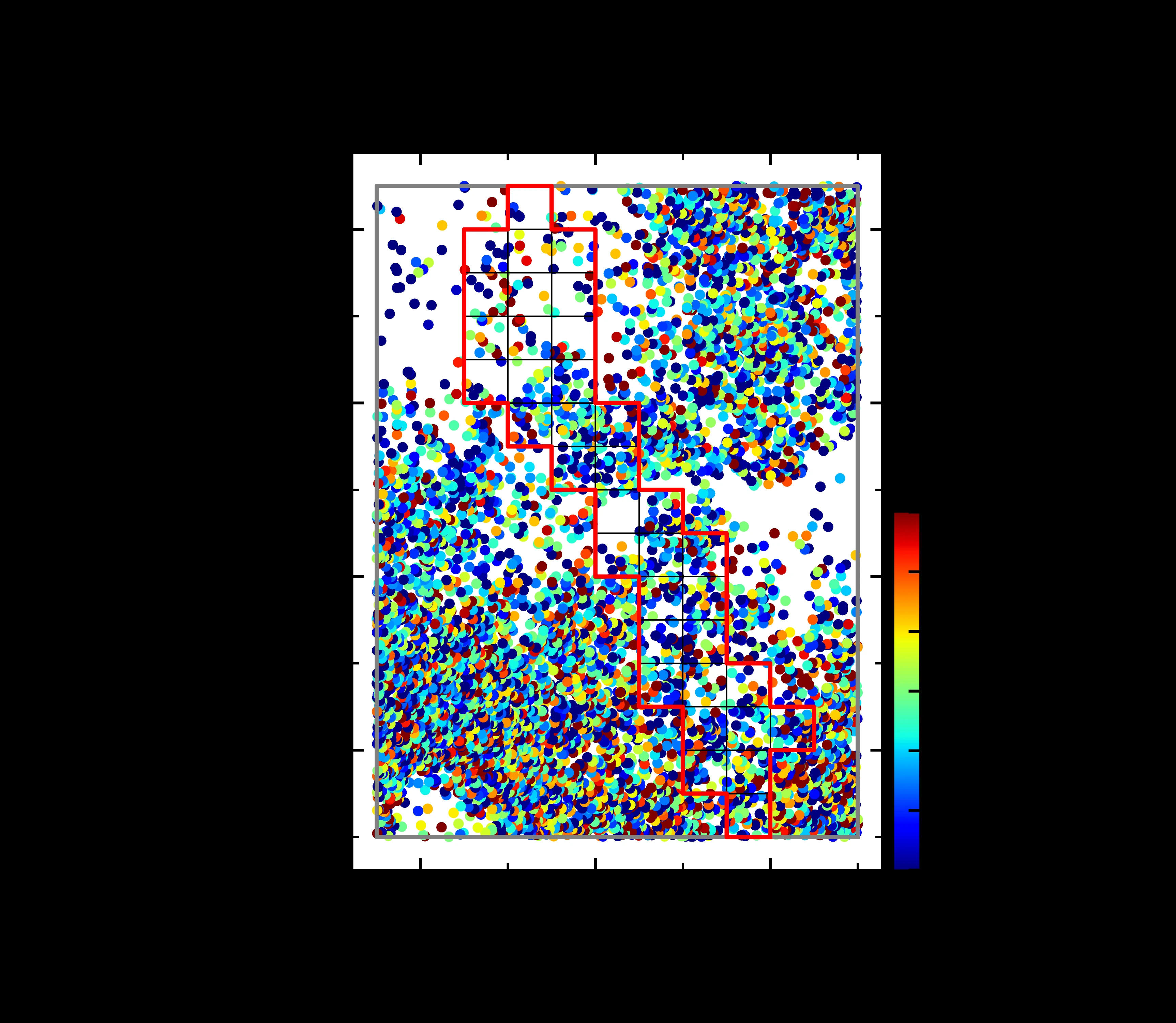
We used Gaia DR2 astrometry: 1,015,747 stars in the region +13° ≤ l ≤ +20°, −8° ≤ b ≤ +5°, at distances of 3.5–4.5 kpc. We transformed coordinates and proper motions into the Galactic system, subtracted the disk rotation using a model with parameters (R0, Θ0, α) = (8.27 kpc, 248 km/s, 0.05). Then we averaged the vertical velocities of stars in voxels of 0.25° × 0.25° × 0.1 kpc and constructed a map of mean values.
Results
We detected a vertical velocity anomaly (VVA) at coordinates (l, b, D) ≈ (15.8°, −0.5°, 3.9–4.0 kpc). The mean vertical velocity of stars within it is 7 km/s lower than in the surroundings. The deviation is statistically significant at the 6σ level. The anomaly is elongated: 200 pc long and 50 pc wide. It coincides with the center of a void in atomic hydrogen and overlaps with the molecular shell CO 16.134–0.553. Horizontal velocities remain unchanged, meaning the stars are moving predominantly downward.
Implications
Unlike neighboring works that study global halo properties or individual galaxies, this paper provides direct kinematic evidence of a local impact: the stars in the disk responded to the passage of a compact dark object. This is not a simulation or an indirect interpretation of gas, but a measurement of the motion of millions of stars. This approach opens a new observational channel for finding low-mass subhalos that are otherwise invisible.
Future development
One can search for similar anomalies across the entire disk: gas filaments, voids, shells, and corresponding dips in vertical stellar velocities. Statistical modeling of the stellar distribution, for instance using spatial point process methods, could help refine the structure of the anomaly. A detailed study of the stellar population in the VVA region may reveal the nature of the impactor.
Impact
The result will affect small-scale cosmology and galaxy formation models, as well as the search for dark matter through stellar dynamics.
Next steps
A systematic survey of the disk to identify similar kinematic and gas anomalies; identification of member stars of the VVA.
Key open problems
This work is directly related to the missing satellites problem in the ΛCDM model: low-mass subhalos are predicted but rarely observed. Here, a candidate for such a subhalo has been found, and without a stellar component, which further sharpens the question of the nature of dark structures.
The knowledge machine's view
This section is addressed to the author of the paper and their colleagues. Neighbouring works were found by meaning-based search across our archive, not by word overlap. We do not review: we show the field around the work.
What the work does
The paper reports the detection of a vertical stellar velocity anomaly in the Milky Way disk, spanning 200×50 pc, coinciding with gas structures previously linked to the impact of a dark subhalo. Using Gaia DR2 data for about 1 million stars in the region l≈16°, b≈−0.5°, D≈3.9–4.0 kpc, the mean vertical velocity deviation is measured at 7 km/s with a significance of 6σ, while horizontal velocities remain unchanged.
Where its strength is
A strong point is the direct measurement of the kinematic response of disk stars to a local perturbation, providing a new observational channel to search for low-mass subhalos that are invisible in radiation.
Where it could go next
- It might be interesting to compare the detected anomaly with global models of the Milky Way rotation curve and dark halo distribution to assess how often such local impacts may occur and how they fit into the hierarchy of substructures.based on: The Milky Way's Rotation Curve: The Dark Halo Puzzle arXiv:2608.10189v1
- A related approach links stellar and gas dynamics to the influence of massive objects: in one study, the giant wake of a black hole in a spiral galaxy is revealed by disk perturbations. It may be worth examining what observational signatures are expected from a dark subhalo passing through the disk and whether they can be sought in other galaxies.based on: Galactic Contrail: A Dark Object Carved a Path Through NGC 3627 arXiv:2509.20832
- The archive contains a study of gravitational interactions between black holes and dark matter, showing how compact objects can 'boost' dark matter particles. This may suggest how a subhalo passage affects the dark matter distribution near the disk and what additional effects to look for.based on: Gravitational Slingshot: How Black Holes Accelerate Dark Matter arXiv:2606.30724
Worth trying
- Check whether there is a correlation between the vertical velocity anomaly and an excess of dark matter in this region, using data from stellar streams or lensing.
- Search for similar anomalies in other parts of the disk using Gaia DR3 and larger stellar samples.
- Compare the observed anomaly with simulations of a subhalo passage through the disk to estimate the mass and orbital parameters of the object.
Why this may matter
If confirmed that vertical stellar velocity anomalies are caused by dark subhalo passages, this would open a systematic way to map dark matter substructures in the Milky Way and test predictions from cosmological models.
Nearby works in our archive
- The Milky Way's Rotation Curve: The Dark Halo Puzzlesimilarity 0.56
- Galactic Contrail: A Dark Object Carved a Path Through NGC 3627similarity 0.55
- The Cloud That Falls Into Itselfsimilarity 0.55
- Galactic Wind: How Stars Blow Gas Out of a Galaxysimilarity 0.54
- Winds from Black Holessimilarity 0.53
- Where Stars End and the Invisible Beginssimilarity 0.53
- Gravitational Slingshot: How Black Holes Accelerate Dark Mattersimilarity 0.52
The archive is sparse around this work: the closest review is only 0.56, against a usual 0.64. It looks like few have drilled nearby.
The mass estimate of the impactor from the Hoyle-Lyttleton radius gives about 50 million solar masses, comparable to the mass of a globular cluster, yet the object is invisible in radio, infrared, and X-ray bands.
Key numbers
- anomaly size: 200 × 50 pc
- vertical velocity shift: 7 km/s
- statistical significance: 6σ
- subhalo mass estimate: 5 × 10⁷ M⊙
- distance to anomaly: 3.9–4.0 kpc