A Tabletop Light Maze Captures Gravity express
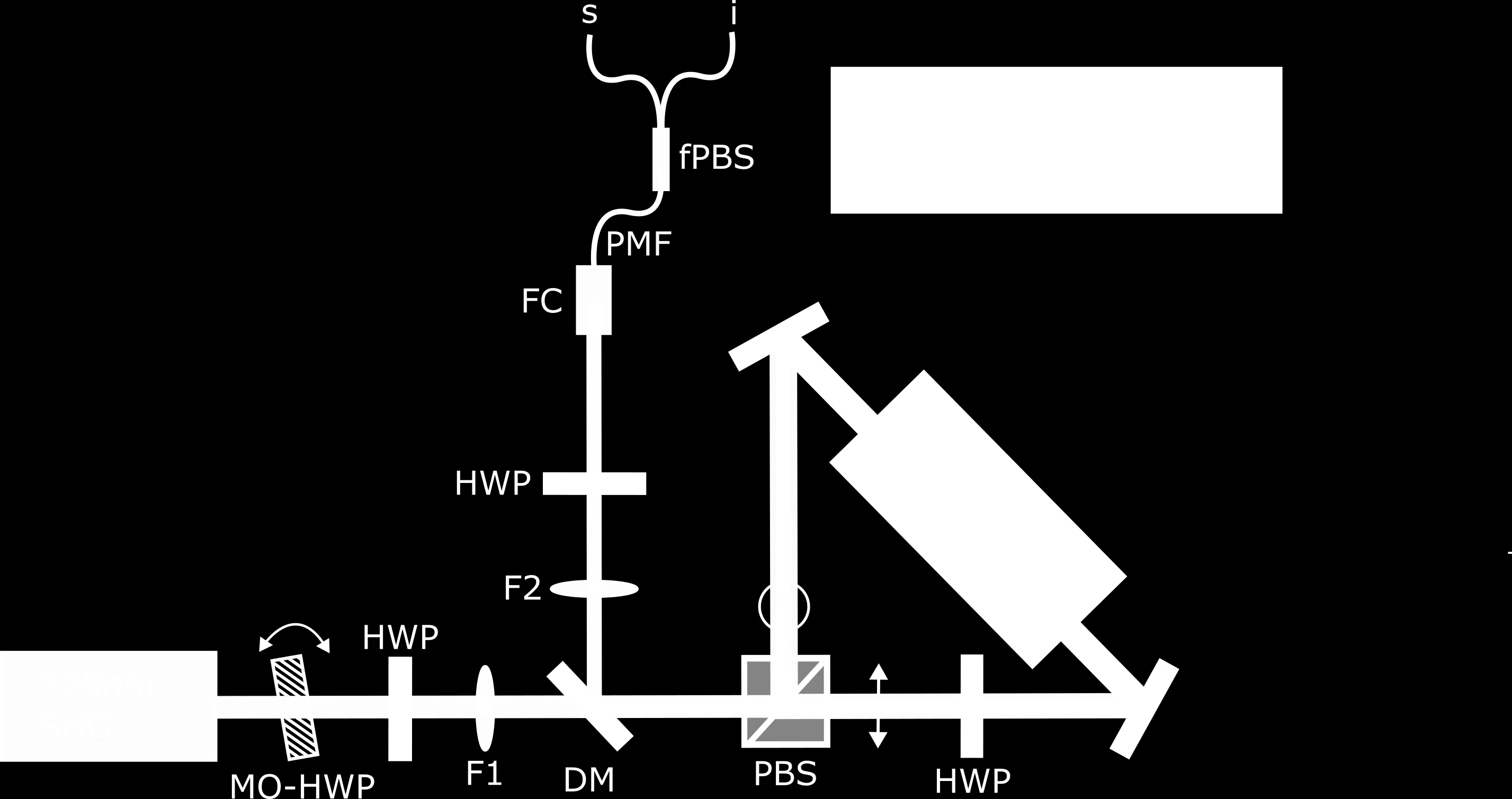
The theory of gravity by Einstein — general relativity — rarely intersects with quantum physics in direct experiments. Here, scientists built a 50-kilometer glass labyrinth on a table and sent single photons through it. Gravity slightly bends the space inside this maze, and on the way out the light's wave rhythm changes — a tiny delay appears, as if one corridor had imperceptibly lengthened.
To avoid confusing gravity with Earth's tremors, the table was suspended on shock absorbers — even a distant train would have ruined the experiment. The device compared two halves of the photon wave and caught a split of millionths of a radian. Thus, for the first time in a lab, they captured gravitational redshift for individual light quanta. This breakthrough will allow testing how quantum particles feel curved space. One day, such tabletop detectors might even hear gravitational waves at the microscale.
Original abstract
as written by the authors arXiv:2511.17022
Quantum mechanics and general relativity are the foundational pillars of modern physics, yet experimental tests that combine the two frameworks remain rare. Measuring optical phase shifts of massless photons in a gravitational potential provides a unique quantum platform to probe gravity beyond Newtonian descriptions, but laboratory-based interferometers have not yet reached the sensitivity needed to access this regime. Here, we report the realization of a 50-km table-top Mach-Zehnder fiber interferometer operating at the single-photon level, achieving a phase sensitivity of $$4.42\times10^{-6}$$ rad root-mean-square (RMS) within the frequency range of 0.01 Hz to 5 Hz. We demonstrate that this sensitivity is sufficient to resolve a phase-shift signal of $$(6.18 \pm 0.44)\times10^{-5}$$ rad RMS at 0.1 Hz, associated with a modulated gravity-induced signal. Our results establish a milestone for quantum sensing with large-scale optical interferometry, demonstrating the capability to detect gravitational redshifts in a local laboratory, thereby paving the way for testing quantum phenomena within general relativistic frameworks.
Gravity affects light so weakly that rising just one meter changes its frequency by only $10^{-16}$. In this experiment, they caught a phase shift of 0.06 milliradians, like noticing a wheel turn by the width of a hair.
In Interstellar, characters sent signals through gravity. Real tabletop light labyrinths already show how quantum particles get tangled in curved space.