Light Splits Itself: Laser in a Ring Breaks Symmetry express
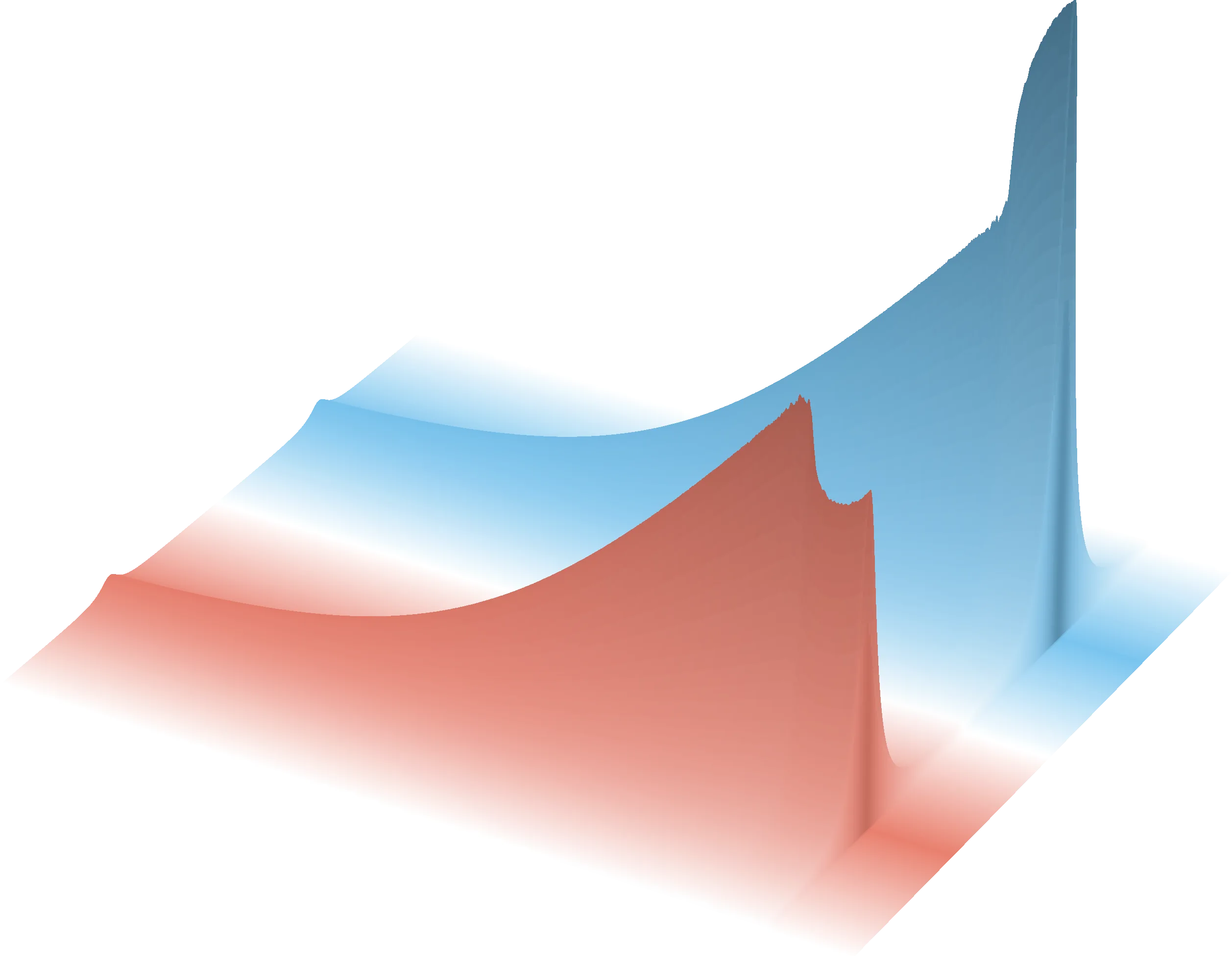
Two beams of light, red and blue, enter a tiny ring made of silicon nitride. The ring is smaller than the thickness of a human hair. At the input, both beams are equally bright. But inside the ring, one of them suddenly starts to outshine the other, like two equally matched people in a debate where one unexpectedly gains the upper hand.
This is the first time such spontaneous color separation has been seen in a micro-ring. Light changes the material it passes through: the bright beam slightly stretches the crystal lattice, which then begins to transmit different colors differently. A feedback loop emerges: one color gets stronger, the other weaker. The threshold at which this begins is just 19 milliwatts — less than what a laser pointer needs.
This behavior of light resembles the workings of a neuron: a weak signal doesn't pass, a strong one does, and in between there's a smooth transition. The scientists showed that the ring can produce three different responses to an input signal, like three different personalities. This means that such rings could be assembled into entire computing circuits where light flows instead of electricity.
The light in the ring chooses on its own which color to favor. This whimsy can be tamed and made to work for us, like a river that chooses its own course, and we build a mill on it.
Original abstract
as written by the authors arXiv:2601.00792
Spontaneous symmetry breaking leads to diverse phenomena across the natural sciences, from the Higgs mechanism in particle physics to superconductors and collective animal behavior. In photonic systems, the symmetry of light states can be broken when two optical fields interact through the Kerr nonlinearity, as shown in early demonstrations with counterpropagating and cross-polarized modes. Here, we report the first observation of color symmetry breaking in an integrated silicon nitride microring, where spontaneous power imbalance arises between optical mode at different wavelengths, mediated by the Kerr effect. The threshold power for this effect is as low as 19 mW. By examining the system's homogeneous states, we further demonstrate a Kerr-based nonlinear activation-function generator that produces sigmoid-, quadratic-, and leaky-ReLU-like responses. These findings reveal previously unexplored nonlinear dynamics in dual-pumped Kerr resonators and establish new pathways towards compact, all-optical neuromorphic circuits.
The threshold for the effect is 19 milliwatts — less than the power of a laser pointer used to point at a screen during a presentation.
In the series 'Westworld', neural networks control robot hosts. Here, light itself plays the role of a neuron, but without a single transistor.