Harmonics are frequency components that appear at integer multiples of a system's fundamental operating frequency. If a device operates at 60 Hz, its harmonics appear at 120 Hz, 180 Hz, 240 Hz, and so on. They are ubiquitous in physics and engineering, arising whenever a system behaves nonlinearly — that is, when its response is not strictly proportional to the input. In power systems, harmonics distort the ideal sinusoidal voltage and current, causing inefficiencies and overheating. In optics, harmonics are generated when intense light passes through certain crystals, producing new colors at multiples of the original frequency.
History
The concept of harmonics in vibrating strings was known to Pythagoras in ancient Greece, but the mathematical treatment of harmonics as integer multiples of a fundamental frequency was formalized by Joseph Fourier in the early 19th century.
How it works
Harmonics emerge from nonlinearity. A linear system, like a simple pendulum at small angles, responds at exactly the driving frequency. But when the response becomes nonlinear — for example, a spring that stiffens as it stretches, or an electronic amplifier that clips peaks — the output contains components at multiples of the input frequency. Mathematically, this is described by a Fourier series: any periodic, distorted waveform can be decomposed into a sum of sine waves at the fundamental frequency and its integer multiples. The relative amplitudes of these harmonics determine the shape of the distorted wave.
In practice
Harmonics are exploited in laser physics to generate new wavelengths: a crystal like potassium titanyl phosphate doubles the frequency of an infrared laser to produce green light, a technique used in laser pointers and scientific instruments.
Fun fact
In power grids, the third harmonic (150 Hz in Europe, 180 Hz in the US) is particularly problematic because it adds up in the neutral wire of three-phase systems, potentially causing overheating even when each phase is balanced.
A gas target is like a funnel: the steeper its walls, the stronger the flow. But in this funnel, it is not water that flows, but ultraviolet light, born when a powerful laser pulse passes through a cloud of argon. The efficiency of this conversion is usually minuscule, about 0.001%: out of a thousand laser photons, only one turns into useful ultraviolet.
Fatty liver disease often goes unnoticed, but over time it can lead to serious problems. To avoid taking a tissue sample, doctors use ultrasound: sound waves pass through the tissue and attenuate differently depending on fat content. This parameter, the attenuation coefficient, shows how "fat" the liver is.
But the method has a flaw.
A light field, like a neat waffle iron, presses a regular pattern of bright and dark regions into space. Atoms get stuck in the brightest spots as if in tiny dimples: that's an optical lattice. It's a favorite tool for physicists who want to study quantum behavior of matter in its pure form.
For over a century, astronomers puzzled over the capricious behavior of RR Lyrae stars: their brightness periodically waxed and waned with unpredictable amplitude, like a lighthouse with a faulty mechanism. The Blazhko effect, discovered in 1907, taunted scientists for decades.
Light from an ordinary bulb seems utterly chaotic: its waves oscillate out of sync, like a crowd where everyone walks in their own direction. Such light is called incoherent. For a long time, it was believed that elegant topological structures (knots, rings, links) could only be created in coherent laser light, where all waves march in step.
In the basements of four European institutes stood seven devices: each can be compared to a tuning fork of unimaginable precision. But instead of sound, they emit 'ticks' made of light: oscillations of a laser locked to a specific frequency by atoms of strontium, ytterbium, or mercury.
Imagine a long corridor with an uneven floor: bumps here, pits there. If you roll a toy car along it, it will get stuck in the deepest pit, not where you gave it a push. That's roughly how sound behaves in a phononic crystal — a material made of periodically arranged elements that controls the propagation of elastic waves.
Immediately after the Big Bang, the Universe underwent ultra-fast expansion, an idea proposed by Alan Guth and developed by Andrei Linde. When the expansion stopped, the field-energy began to oscillate like a giant swing.
A laser beam hits an atom, and an electron is knocked loose. It accelerates, returns, and, crashing into the atom, emits a flash of light — a harmonic. If there are two light beams and they are crossed like an intersection, the electron can choose different routes. In the new experiment, the two beams had comparable strength and were directed at right angles.
A laser strikes the crystal, and it responds with flashes of light, like a bell ringing after a blow. But if the bell is warm, its sound wavers and fades. Same here: the crystal's atoms constantly jitter from heat, and this jitter disrupts the electrons' smooth flight, making the light dim and blurry.
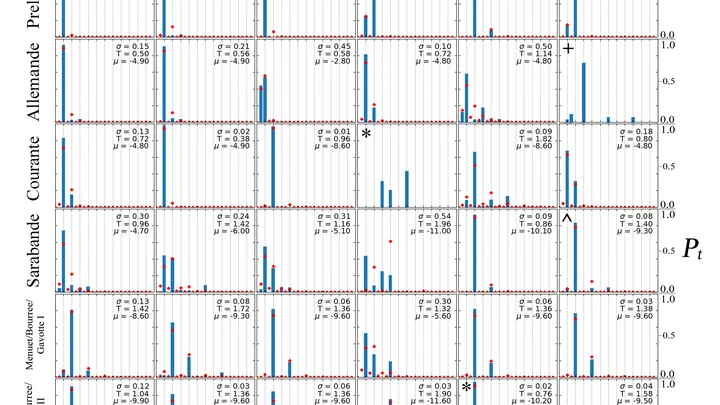
Music relies on repetition: we expect the beat to return, like a chorus coming back. But if you repeat the same thing for too long, it gets boring. The composer seems to walk a tightrope between the familiar and the unexpected.
Scientists translated this balance into the language of physics.
The edge of a magnet works like a guitar fret: a string pressed near the edge sounds different, with a richer set of overtones. Magnetic waves in a thin strip of nickel and iron behave in much the same way.
A laser beam hits a transparent crystal, and the crystal answers with a whole rainbow — from infrared to invisible ultraviolet. This isn't a trick with mirrors; it's the work of a nonlinear crystal, which can add light frequencies the way a musician plays not just the fundamental note on a string but also its overtones.
Two clocks in different rooms need to tick in unison. Usually, this is done by sending bright pulses or pairs of photons that arrive one right after the other. But the signal can be so weak that photons barely make it through. In this work, clocks were synchronized with light a billion times dimmer than usual.
An ordinary free-electron laser is like a musical instrument with a single string: it can play only one note until you change its design. To get a different wavelength, you have to retune magnets or accelerate electrons harder. That's expensive and bulky.
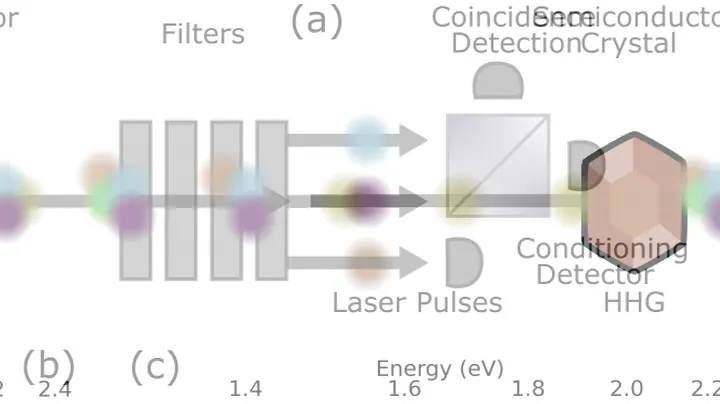
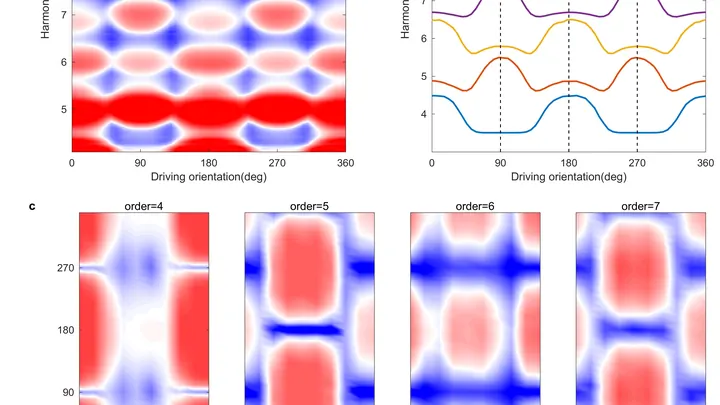
A powerful laser strikes a semiconductor, and it responds with light at many frequencies, like a string sounding a chorus of overtones. Previously, this was used in spectroscopy to observe ultrafast processes. But now physicists have noticed: the overtones are not independent; they behave as if connected by invisible threads.
When you pluck a guitar string hard, it doesn't sound a single note but several at once — the fundamental tone and overtones. Physicists have pulled a similar trick with light: they aimed an infrared laser at a crystal, and the crystal lit up with sixteen colors at once, from invisible heat to hard ultraviolet.
Two beams of light, red and blue, enter a tiny ring made of silicon nitride. The ring is smaller than the thickness of a human hair. At the input, both beams are equally bright. But inside the ring, one of them suddenly starts to outshine the other, like two equally matched people in a debate where one unexpectedly gains the upper hand.