Dark Energy as a Falling Pencil express
Modern telescopes see distant galaxies flying apart faster and faster. The cause is called dark energy, but its nature has been a mystery. On top of that, calculations of the expansion rate in the early and late Universe don't match. The answer might lie in an event much like a falling pencil.
In the first moments, the Universe had perfect equilibrium — a large-scale symmetry. Then it spontaneously broke, like a pencil balanced on its tip falling in a random direction. That fall gave birth to a new field — the dilaton field. It creates a weak but constant repulsion, making the cosmos expand ever faster.
Calculations that include this field astonishingly match the observed expansion and even link the strength of dark energy to the curvature of spacetime predicted by Einstein. This takes us beyond the Standard Model of physics. An amazing fact: although this energy accelerates galaxies, within the volume of a room there's barely enough for a feeble finger snap.
Original abstract
as written by the authors arXiv:2601.01938v1
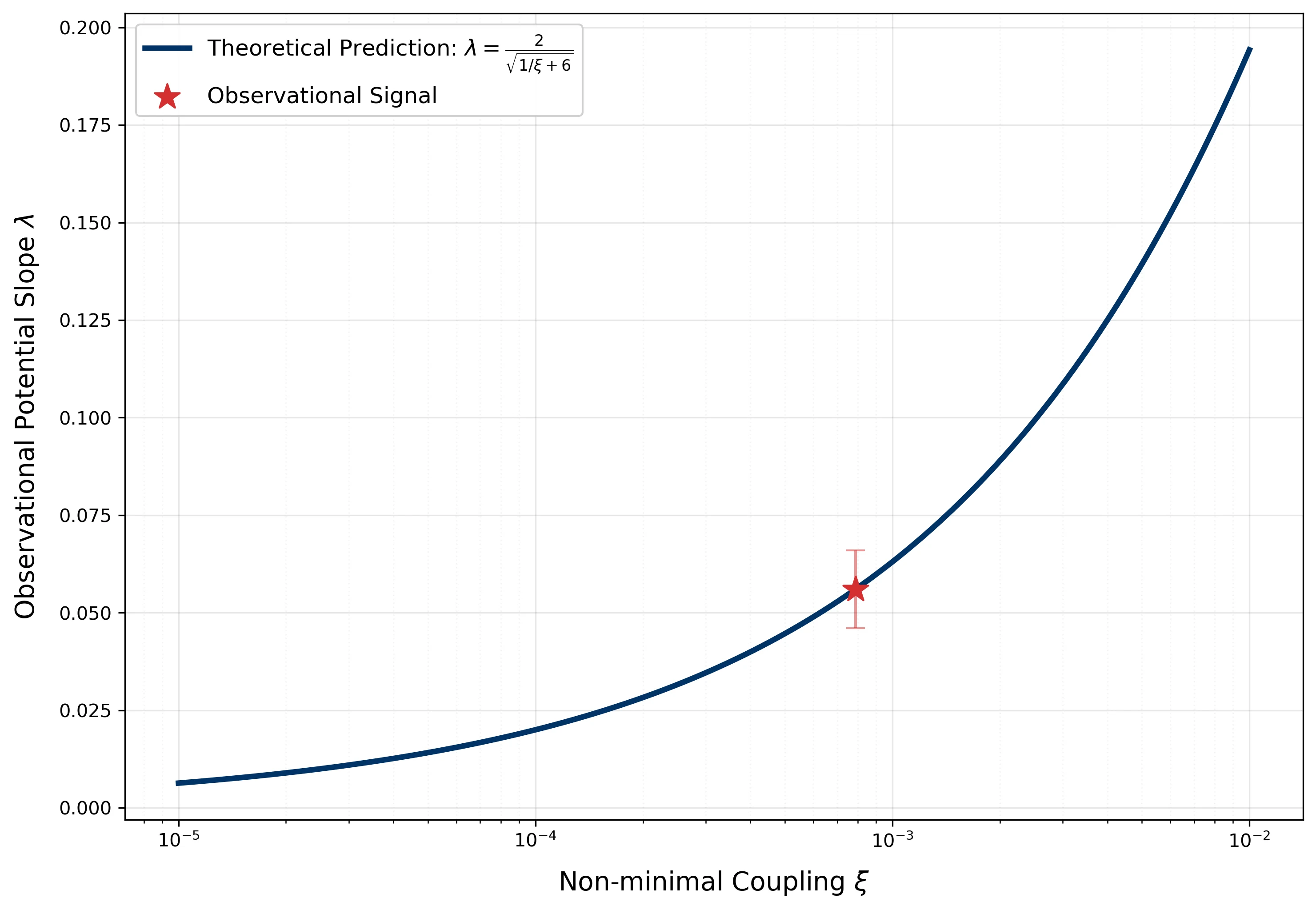
The statistical tension between early and late universe measurements of the Hubble constant ($$H_0$$) suggests that the dark sector is dynamical rather than static. We propose that this dynamics arises from a fundamental symmetry principle: the Spontaneous Breaking of Scale Invariance. We introduce the Dilaton ($$\chi$$), a Pseudo-Nambu-Goldstone Boson (PNGB) associated with dilatation symmetry breaking. We demonstrate that a simple quadratic mass term in the fundamental theory transforms, via conformal coupling to gravity, into a ''thawing'' exponential potential $$V(\phi) \propto e^{-\lambda\phi}$$ in the Einstein frame. Using recent Bayesian reconstructions of dark energy dynamics from Planck, Pantheon+, and SH0ES data, we constrain the potential slope to be $$\lambda \approx 0.056$$. We show that this observational value is not arbitrary but corresponds to a fundamental non-minimal coupling strength of $$\xi \approx 7.8 \times 10^{-4}$$. The Dilaton mechanism naturally generates the late-time equation of state evolution ($$w_0 \approx -0.85$$) required to alleviate the Hubble tension while protecting the field mass $$m \sim H_0$$ through approximate shift symmetry.
The name 'dilaton' comes from the Latin dilatare — 'to expand' — and perfectly captures its cosmic role: it makes the Universe grow.