Albert Einstein is the physicist who developed the theory of relativity, which fundamentally changed our understanding of space, time, gravity, and the universe. His general theory of relativity, published in 1915, describes gravity not as a force between masses, but as the curvature of spacetime caused by mass and energy. This framework is essential for explaining phenomena ranging from the bending of light around massive objects to the behavior of black holes and gravitational waves.
History
Albert Einstein introduced special relativity in 1905 and general relativity in 1915, building on earlier work by Lorentz, Poincaré, and others. His predictions were confirmed by observations such as the bending of starlight during the 1919 solar eclipse, catapulting him to global fame.
How it works
In Einstein's view, massive objects like stars and planets warp the fabric of spacetime around them. Other objects moving through this curved spacetime follow paths that appear to be curved, which we perceive as gravitational attraction. The theory also predicts that accelerating masses produce ripples in spacetime called gravitational waves, which travel at the speed of light. In the quantum context, Einstein's equations provide the classical backdrop against which quantum effects are studied, such as in attempts to understand how gravity might entangle particles or behave at the smallest scales.
In practice
Einstein's relativity is essential for the Global Positioning System (GPS), where relativistic corrections are needed for accurate positioning, and for modern astrophysics, including the detection of gravitational waves by observatories like LIGO.
Fun fact
Einstein's famous equation E=mc² implies that a single gram of mass contains about 90 trillion joules of energy, equivalent to the energy released by a small nuclear bomb.
Newton gave us a world where bodies move in a void and clocks tick the same for everyone. For three centuries, this picture worked flawlessly. But it relies on many invisible props: absolute position, the 'up-down' direction, and a single rhythm of time for the entire universe. We have never measured these directly — only through the relations between objects.
A scale that weighs not a body, but the very space around it. That's how Einstein's equations work in general relativity: they link the curvature of spacetime to what resides within it.
In the quiet of the quantum world, there is no emptiness. Particles are intertwined by invisible threads — entanglement. The authors of the work proposed that the very fabric of spacetime is woven from these threads. This is not just a metaphor: they built a mathematical framework where the distance between points is determined by how much shared information they hold.
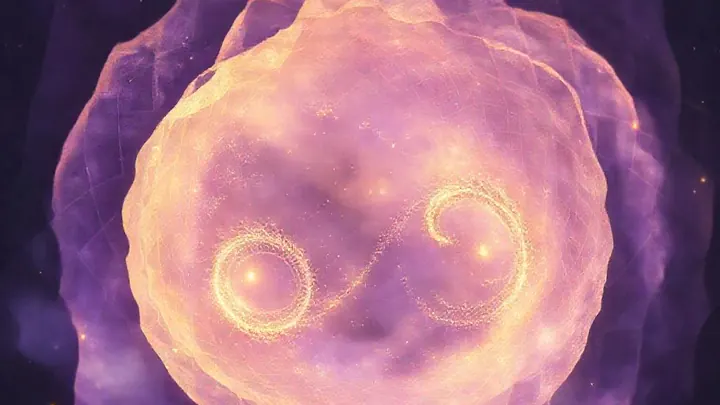
A pair of black holes circles in a dance, gradually drawing closer. They lose energy and spin — a process known as angular momentum radiation. In standard Einstein theory, only gravitational waves carry away angular momentum.
A black hole usually hides its singularity behind an event horizon — an invisible boundary from which not even light can escape. But sometimes this 'cloak' is absent, and the singularity, a point where familiar physics breaks down, is exposed to an outside observer.
In cricket, there's a special delivery — the googly. The ball spins in a way that deceives the batsman. Physics had its own googly: for nearly half a century, mathematicians couldn't make twistor theory work with real gravity. It described 'nice' fields perfectly, where everything twists in one direction. But as soon as an 'awkward' component appeared, the machinery broke down.
In the ocean, a whirlpool pulls everything into a closed loop, just as a gravitational wave in empty space twists time into a loop. Gravitational wave — a ripple in the fabric of spacetime, and its special shape can turn the usual flow of events into a closed cycle. In such a zone, an object can return to its own past without violating the laws of physics.
The space we live in appears three-dimensional. But when physicists try to reconcile gravity with quantum mechanics, familiar dimensions start behaving strangely. In a new study, scientists showed that to describe a massive particle while accounting for quantum gravitational effects, it is natural to add two more dimensions.
An object cannot be a point. At least, not in Einstein's gravity. The equations of general relativity require that the source of the field, matter, be smeared out in space, not concentrated in an infinitesimal volume. Otherwise, infinities appear in the formulas, and a smooth spacetime cannot be constructed.
The early universe was a restless place. Space trembled with gravitational waves — ripples in the very fabric of reality. In this churning cauldron, dark matter is thought to have been born. But the newborn particles had no mass: it had to come from somewhere.
Usually, the Higgs field is responsible for mass.
In the early 20th century, Einstein showed that gravity is the curvature of space and time. A bit earlier, Maxwell had unified electricity and magnetism into a single theory.
At the very beginning of the universe, when all of space was compressed into a point, the laws of physics break down. This point is called a singularity — an edge where our equations lose meaning. But what if it's not an end, but a special type of boundary?
The authors of this work propose viewing the singularity as a free boundary.
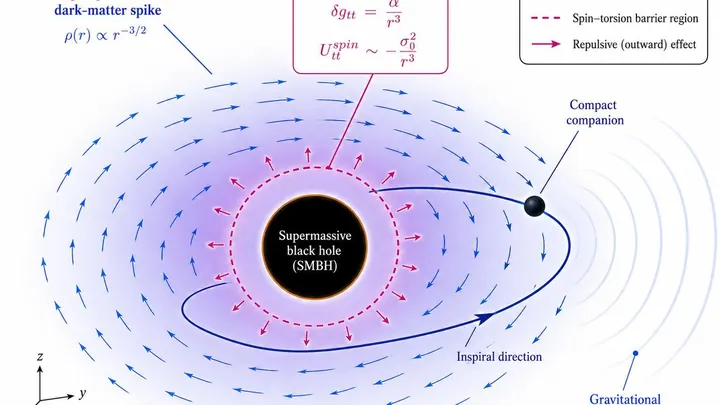
A supermassive black hole drifts through a cloud of dark matter. In the usual picture, this invisible substance just adds mass and barely interacts with ordinary matter. But dark matter particles could have intrinsic rotation — spin.
A black hole is not just a dark spot in space. It is a region where gravity compresses matter so intensely that even light cannot escape. Among all possible black holes, one stands out — the rotating Kerr black hole. Its description was long thought to be tied to Einstein's equations, like a recipe tied to a specific cookbook.
Gravity seems simple: it keeps us on the ground and makes planets orbit. But if it were classical (described by Einstein's equations as the curvature of spacetime, while all matter follows the quantum laws of the Standard Model) then an ordinary quantum bit (qubit) falling freely…
A dead star with a magnetic field billions of times stronger than Earth's is a magnetar. Its crust cracks, sending a powerful X-ray burst into space. But some of that light doesn't reach us in its usual form. In an ultra-strong field, photons can turn into gravitational waves — the trembling of space itself.
An orchestra plays out of tune, and the sound seems like chaos. But if you record all the notes and analyze them mathematically, you can reconstruct the shape of the concert hall — where the walls are, how high the ceiling is. Roughly in this way, physicists propose to derive gravity from quantum theory.
In everyday life, space and time are the stage on which events unfold.
A neutron star is the leftover core of an exploded giant, compressed to the size of a city. A teaspoon of its matter weighs a billion tons. Inside such a star, particles are packed so tightly that quantum effects start to show. One of them is the intrinsic rotation of particles, or spin.
Two massive spheres slowly drift apart in empty space. From the standpoint of ordinary mechanics, nothing special is happening. But Einstein's equations say otherwise: accelerating masses stir spacetime itself, and from them spread gravitational waves — ripples that stretch and squeeze everything in their path.
Tea in a cup cools quietly on the table. But if you zoom past at near-light speed, the thermometer will read higher — even though no one heated the tea. Calculations confirm: the needle will creep up.
A century ago, physicists split into three camps.
Two pebbles drop into water, and the ripples on the surface intersect, blending their patterns. Neutrinos behave much the same way: light particles that pierce us by the billions every second. They can transform from one type to another, like an actor changing masks. Physicists call this dance oscillations.
A taut sheet wrinkles. If you tug a corner, a smooth wave runs across; if you sharply bunch the fabric, a sharp crease forms. Space and time in Einstein's equations behave much the same way. Gravitational waves resemble the gentle ripples of the sheet, while shock fronts are like stiff folds where matter's properties change abruptly.
A soap bubble hangs in the air, and its shape already contains everything needed to calculate the internal tension. A similar principle worked in a new study on quantum gravity. Physicists took a closed surface, an analog of such a bubble, and specified a few numbers on it: for example, the electric field strength and the curvature.
Gravity is the curvature of spacetime, not just an attraction, as Einstein showed. On such a curved "dance floor", even the hypothetical carriers of gravity — gravitons — move oddly.
The deepest equations of physics, like the Wheeler–DeWitt equation, contain no time. Past and future are scrambled within them, like frames on a film reel with no arrow indicating which way to play it. This symmetry is not a flaw but a feature.
A tightrope walker steps along a taut wire. Each step is a search for balance, an instant calculation of forces. In much the same way, Einstein's equations describe how matter and energy cause spacetime to curve.
A stone falls to the ground along the most economical route — the one that expends the least time and energy. This principle of least action governs all of classical physics. But in the microworld, everything jitters: fields fluctuate, and you can't say precisely where anything is.
A distant orchestra plays a symphony, but the recording is full of noise. The melody is written for two instruments, yet a third voice seems to break through the static — quiet and unfamiliar. This is how astrophysicists listen to gravitational waves, trying to catch the slightest deviations from Einstein's predictions.
Picture two choirs in soundproof rooms on a wobbly stage. They sing, but can't hear each other — the air doesn't carry the tune. Yet if the stage trembles, its vibrations link their songs. That's the idea behind a new test for quantum gravity.
According to Einstein, spacetime is a flexible fabric, curved by matter. But in the quantum world, everything is different: particles are smeared over a probability cloud, governed by a rigid rule discovered by Max Born.
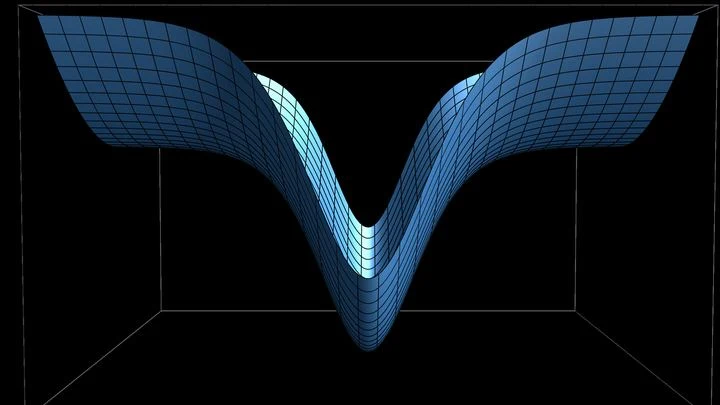
Einstein's general relativity describes gravity as the curvature of spacetime — much like a heavy weight pressing down on a stretched elastic sheet. Black holes are regions where this curvature reaches extreme values, the deepest "funnels" in the fabric of the universe.
Stars on the outskirts of galaxies rotate unexpectedly fast. According to Newton, the farther from the center, the slower the motion should be, like in a round dance, where the outer dancers move more slowly. But in reality, stellar outskirts race along almost as fast as the core, resembling a giant carousel: on it, the outer horses fly faster so as not to fall behind the inner ones.
In everyday life, time flows on its own, like a river past its banks. But in quantum gravity, things are different: time does not flow; it emerges from relations between objects, like a pattern in a carpet that is only visible when viewed from a certain spot.
For a long time, cosmologists could not peer beyond the starting point — the infinitely dense singularity of the Big Bang, where the equations of general relativity by Einstein lose their predictive power.
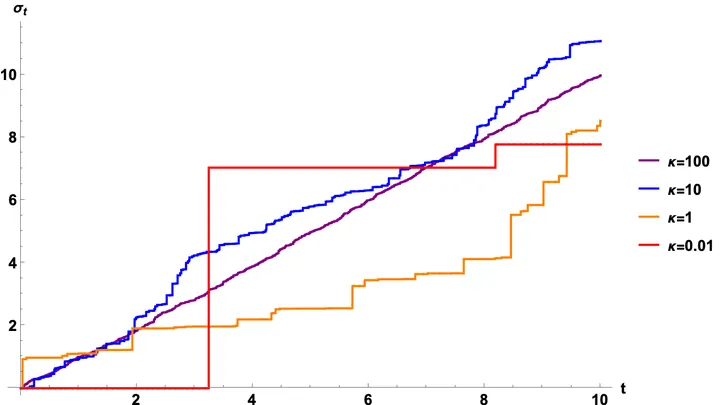
A regular wall clock runs smoothly, but quantum clocks are a different story. They tick at random moments, and each tick can have a different duration. On average, if you watch such a clock for a long time, it will show the correct time. But at any given moment, its hand might jump forward by an unexpected amount.
A quantum particle, an inhabitant of the elementary particle world, resembles a coin spinning in the air: neither heads nor tails, but a blend of possibilities. Yet when it lands on the table, the outcome becomes definite. What serves as the table in a measurement?
Two particles can become linked so that a nudge on one instantly reverberates in the other, even if they are separated by galaxies. Einstein called it "spooky action at a distance." Physicists wondered: can gravity itself, a simple mutual attraction, create such a connection?
In 1935, Einstein, Podolsky, and Rosen proposed a thought experiment that, in their view, exposed the incompleteness of quantum mechanics. Two particles fly apart after interacting, and measuring the momentum of one instantly gives exact knowledge of the other's momentum.
When entropy reaches its maximum, the play is over. The curtain falls, the actors leave, the scenery freezes. But the stage remains. So it is with time: the heat death of the universe erases the direction 'past—future', but not time itself.
Imagine a city drawn on a sheet of paper. The streets are the same, the intersections are in place, but the distances between blocks have suddenly changed.