Betelgeuse Is Not Alone: A Stellar Companion Found express
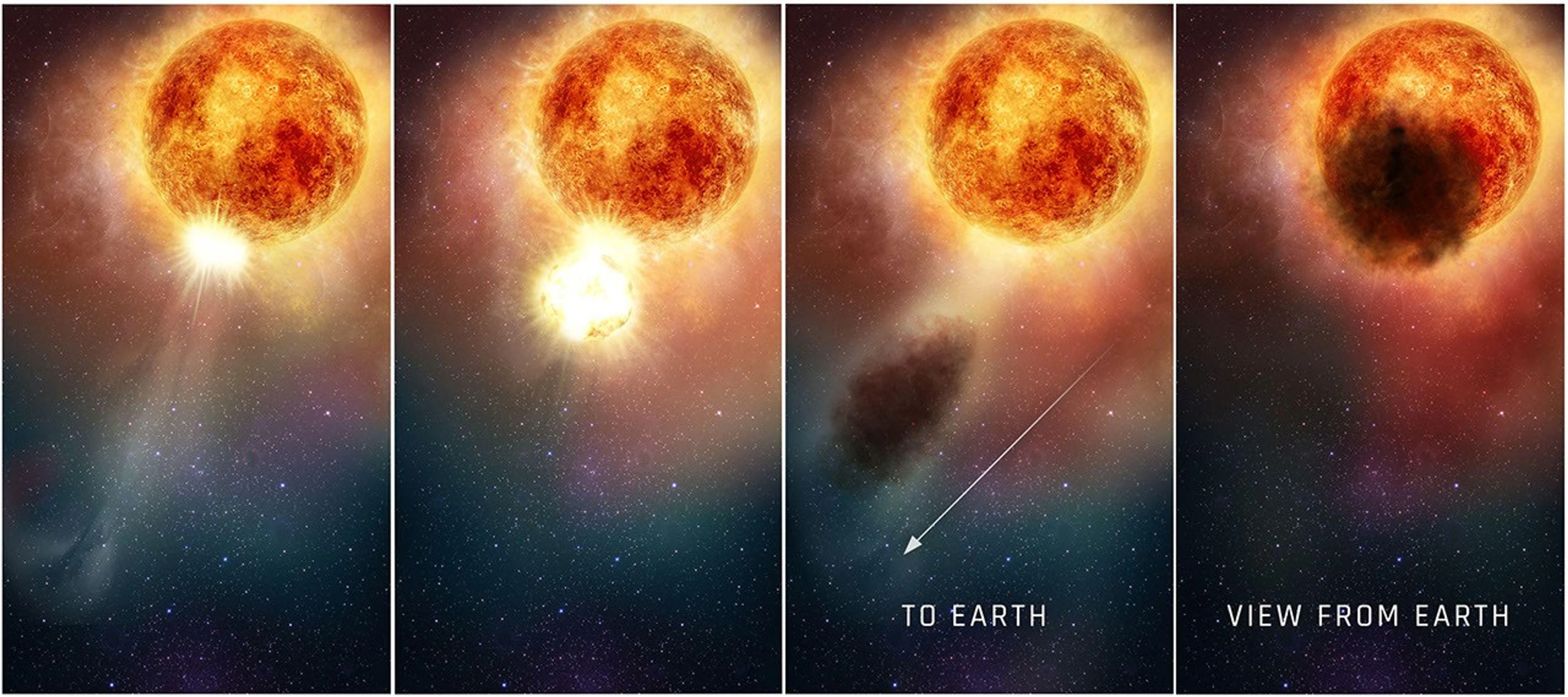
In 2019, Betelgeuse suddenly dimmed, sparking rumors of an imminent explosion. But clouds of cosmic dust turned out to be the culprit. Now, the Gemini North telescope has discerned a minuscule companion star in its dazzling glare, just as calculations had predicted.
Betelgeuse is like a stadium floodlight, and its companion is a firefly flickering right in the beam. It’s 250 times fainter, but astronomers managed to measure its position and the difference in brightness. The match with theory was impressive.
The proximity explains long-standing oddities of the giant. Crucially, the companion orbits Betelgeuse in just a few years. This swift dance not only pushes back a possible supernova explosion, but also gives us a chance to keep tracking the pair. The next observation is set for November 2027.
Original abstract
as written by the authors arXiv:2601.02012v2
In the past six years, Betelgeuse has been in the news and drawn significant public interest. Starting in October 2019, Betelgeuse underwent a striking dimming event, fading from magnitude 0.5 to 1.7 by mid February 2020 a threefold decrease in brightness This gave rise to a number of speculative debates that the star was on the verge of a supernova, a moment of eerie quiet before the cosmic outburst. In a previous article, the author discussed the most accepted explanation to the dimming caused by episodic mass loss that released large dust grains, which obscured Betelgeuse's light and made it appear fainter. This interpretation suggested that the dimming was not a precursor to a supernova, as Betelgeuse is likely still far from reaching that stage. On 21 July 2025, the existence of the companion star was confirmed with direct imaging, for the first time, by the alopeke instrument on the 8.1 m Gemini North telescope. The companion is 6 magnitudes fainter than Betelgeuse and orbits close to Betelgeuse itself, within the supergiant star's extended outer atmosphere. The stellar companion was detected at an angular separation of 52 mas and a position angle of 115 deg east of north. These measurements, along with its brightness, being roughly 6 magnitudes fainter than Betelgeuse at 466 nm, are in excellent agreement with dynamical predictions. Although this was only a 1.5 sigma detection, the agreement in the companion's appearance, separation, position angle, magnitude difference, and estimated mass is reasonable, making the result tentatively acceptable. The next optimum period for observations is November 2027, when we hope to get better observations. This article describes the interesting twists and turns of this study and what lies in the future for Betelgeuse and its companion, Betelbuddy or Siwarha.
Unofficial names for the companion are Betelbuddy or Siwarha. Its full orbit around Betelgeuse takes just a few years — by cosmic standards, a very brisk dance.