First Stars: Fireworks Seen by Webb express
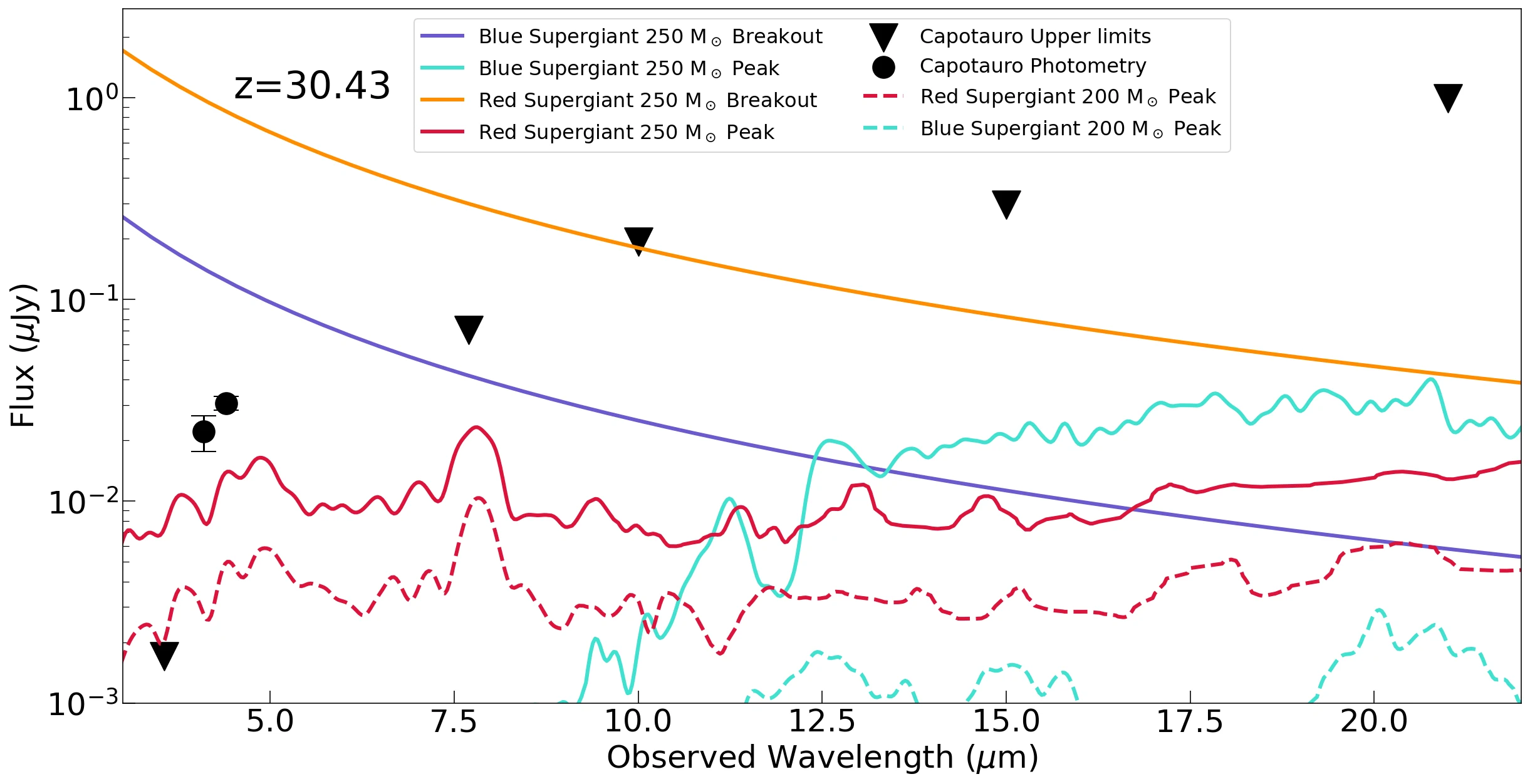
The James Webb Space Telescope spotted bright points of light from an era just 100–300 million years after the Big Bang. At first they were taken for distant galaxies, but now a hypothesis suggests they might be lone fireworks — explosions of the very first stars. Due to the expansion of the Universe, their light is heavily stretched, but Webb can catch it.
Such explosions are called pair-instability supernovae. In the core of a giant star, made almost entirely of hydrogen and helium, light turned into particles and antiparticles, instantly destroying the star. Events like these are extremely rare — roughly one firework per enormous volume of space. But if Webb captures even a single such flash, it will be the first direct observation of stars being born in the Universe.
Original abstract
as written by the authors arXiv:2601.02469v2
The James Webb Space Telescope (JWST) has spectroscopically confirmed galaxies up to $$z\sim14$$, 300 Myr after the Big Bang, and several candidates have been discovered at $$z\sim15-25$$, with one candidate as high as $$z\sim30$$, only 100 Myr after the Big Bang. Such objects are unexpected, since theoretical studies have not predicted the existence of detectable galaxies at $$z\sim30$$. While any $$z\sim30$$ candidates may be contaminants at lower redshifts, we explore whether such extreme redshift sources could be consistent with hyper-energetic transient events linked to the formation of the first, metal-free, stars. Specifically, we consider pair-instability supernovae (PISNe), a predicted class of extreme thermonuclear explosions that leave no remnant behind. Using cosmological simulations, we investigate an overdense cosmic region, where star formation and subsequent PISNe occur at $$z\sim30-40$$, even within standard cosmology. Assessing the likelihood of such a region, the corresponding number of PISNe at $$z\gtrsim20$$, and their observed flux, we find that JWST has a non-negligible chance to detect a PISN event at extremely high redshifts. If a transient event were confirmed at $$z\sim30$$, this would provide a direct glimpse into the epoch of first star formation, dramatically extending the empirical reach of astronomy.
Pair-instability supernovae happen only in stars 130–250 times more massive than the Sun. The result: the star is entirely converted into radiation, leaving no neutron star or black hole behind.
These first fireworks are reminiscent of the 'Moment of Creation' from science fiction: they flared up, lit the primordial darkness, and vanished, paving the way for future galaxies and life.