First Stars: Fireworks Seen by Webb express
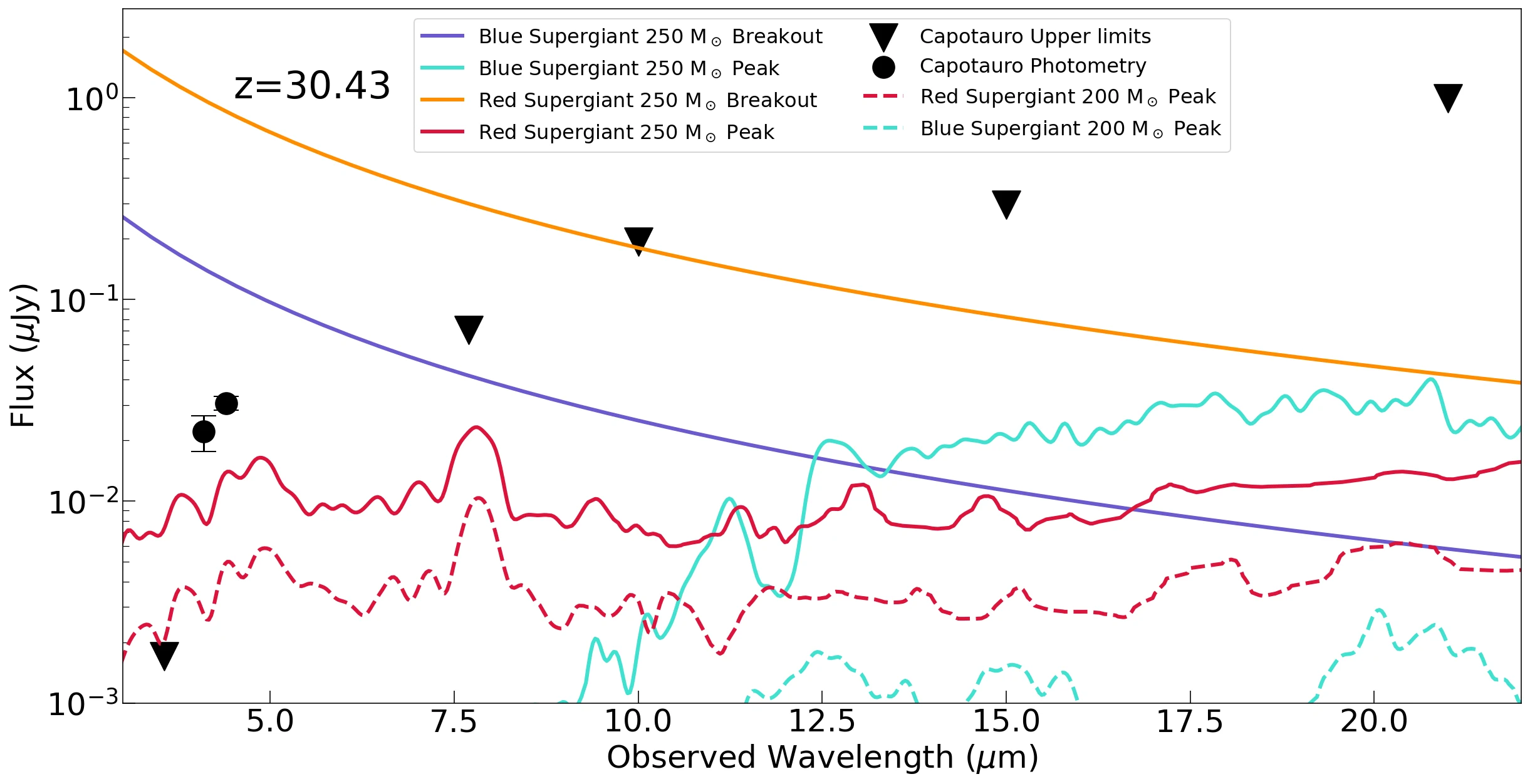
The James Webb Space Telescope spotted bright points of light from an era just 100–300 million years after the Big Bang. At first they were taken for distant galaxies, but now a hypothesis suggests they might be lone fireworks — explosions of the very first stars. Due to the expansion of the Universe, their light is heavily stretched, but Webb can catch it.
Such explosions are called pair-instability supernovae. In the core of a giant star, made almost entirely of hydrogen and helium, light turned into particles and antiparticles, instantly destroying the star. Events like these are extremely rare — roughly one firework per enormous volume of space. But if Webb captures even a single such flash, it will be the first direct observation of stars being born in the Universe.
Pair-instability supernovae happen only in stars 130–250 times more massive than the Sun. The result: the star is entirely converted into radiation, leaving no neutron star or black hole behind.
These first fireworks are reminiscent of the 'Moment of Creation' from science fiction: they flared up, lit the primordial darkness, and vanished, paving the way for future galaxies and life.