The Shadow of a Black Hole Changes Shape express
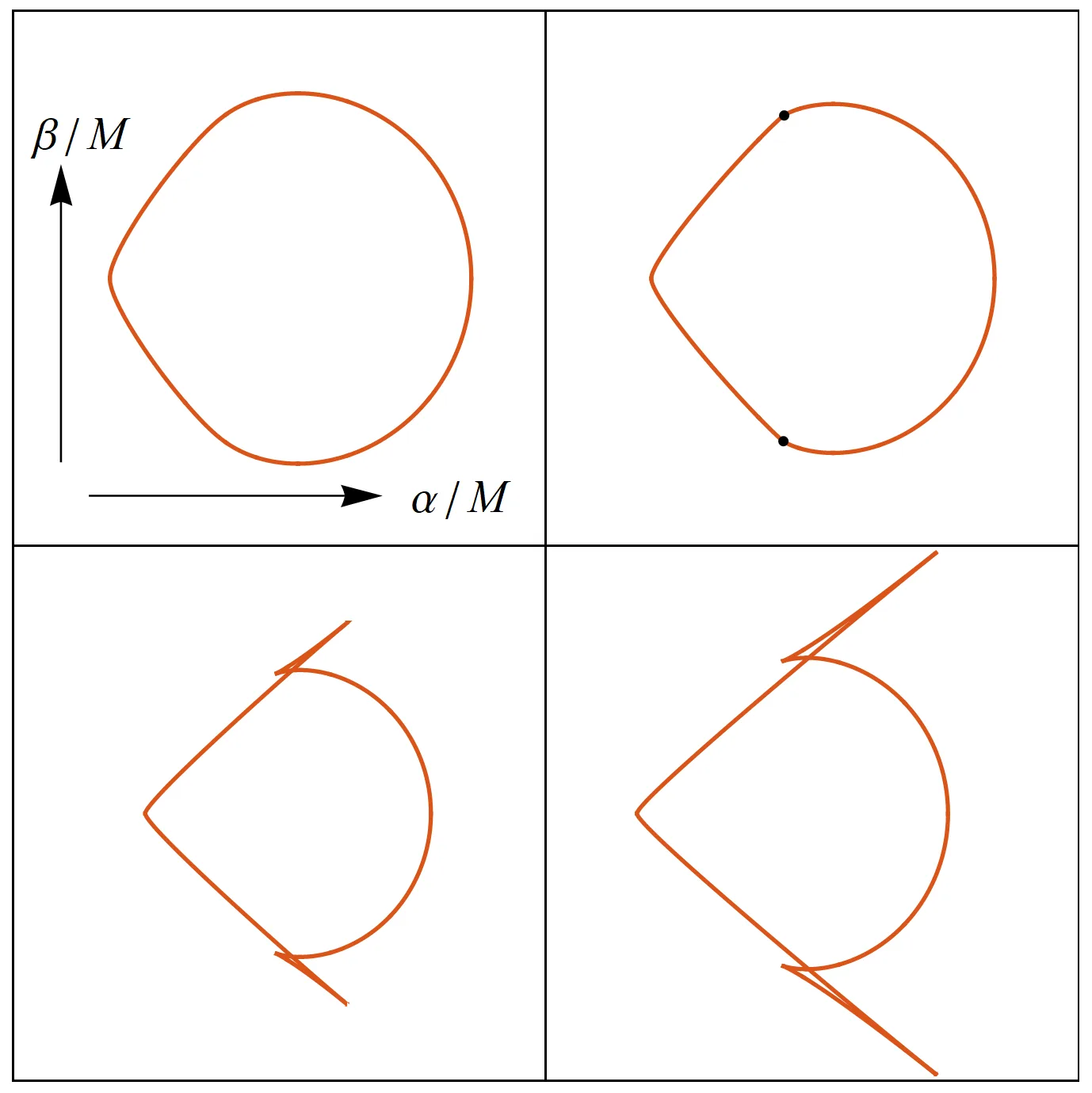
A black hole's shadow is a dark spot against the bright light bent by strong gravity. Usually, this spot is an almost perfect circle with a smooth edge. But if a black hole is not quite what Einstein's theory predicts, a sharp kink, like a corner on a crumpled piece of paper, can appear at the shadow's edge. Such a kink drastically changes the shadow's character: it transforms from one global structure into another.
The authors showed that the appearance of the kink can be described just like a phase transition — for example, water turning into steam. To do this, they introduced a rule similar to Maxwell's rule in thermodynamics: it determines under what conditions the kink appears. Just as water boils at a certain temperature and pressure, the kink appears for certain properties of the black hole. Near this critical point, the shadow's behavior becomes universal: it follows a power law with an exponent of 1/2.
This result is important for testing fundamental physics. Instead of looking for tiny deviations of the shadow's shape from a circle, one can deliberately hunt for the kink — a clear sign that the black hole does not obey standard theory. If such a kink is observed, it would point to new physics. Thus, the black hole's shadow becomes not just a picture but a tool for testing the deepest laws of nature.
Original abstract
as written by the authors arXiv:2601.15612
The formation of a cusp on a black hole shadow is a striking signature of physics beyond the Kerr paradigm. We demonstrate that this morphological change fundamentally alters the shadow's topology with the topological charge flipping from 1 to -1. To analyze this topological transition, we introduce a gravitational equal-area law, analogous to Maxwell's construction in thermodynamics, and identify a critical point for cusp formation. Near this point, we uncover universal behavior characterized by a critical exponent 1/2, which places this gravitational lensing system within the mean-field universality class. These results establish a new framework for testing fundamental physics of black hole shadows, reframing the search for deviations from general relativity as a targeted hunt for a distinct topological and critical phenomenon.
A black hole's shadow is not actually black; it is simply the region from which no light reaches us: it can be surrounded by a bright ring of bent light rays.