Yu-Xiao Liu

5 articles · 15 co-authors · latest: 2026-08-06
6 citations · h-index 1 · 6 papersData: Semantic Scholar

We have retold 5 papers by this author. most often about: black hole, Hawking radiation, event horizon. 15 co-authors across our retellings.

Links in the knowledge graph
General Relativity2026-01-222 minarXiv:2601.15612express
The Shadow of a Black Hole Changes Shape
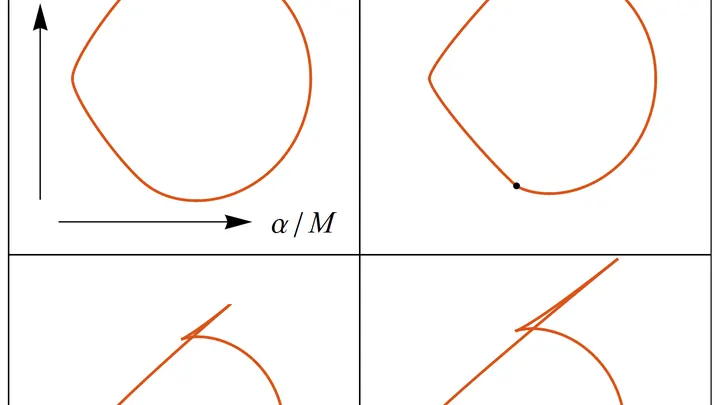
A black hole's shadow is a dark spot against the bright light bent by strong gravity. Usually, this spot is an almost perfect circle with a smooth edge. But if a black hole is not quite what Einstein's theory predicts, a sharp kink, like a corner on a crumpled piece of paper, can appear at the shadow's edge.
General Relativity2026-04-201 minarXiv:2604.18101express
A One-Way Black Hole: The Shadow That Changes Shape
Light usually behaves like a pedestrian on a two-way street: the path from a streetlamp to a camera matches the reverse path. But near a rotating black hole with broken spatial symmetry, this street becomes one-way. Swap the light source and observer, and the hole's shadow changes shape: from an oval resembling a rugby ball, it turns into a teardrop.
General Relativity2026-04-252 minarXiv:2604.23364express
The Spectral Butterfly Effect in Thick Branes
Gravitational wave detectors work like sensitive microphones, picking up the trembling of space from distant cosmic catastrophes. When two black holes merge into one, the newborn object rings like a bell, and that ringing is a unique 'voice' of gravity.
HEP Phenomenology2026-05-022 minarXiv:2605.02955express
How mass is born from geometry
Throw a stone into a pond — ripples spread out, changing the scale of the wave. The new theory works much the same way: it gives each particle its own "scale ripple," and it's this curvature of an invisible space that turns out to be the source of mass.
HEP Theory2026-08-062 minarXiv:2608.05913express
How Quantum Foam Gives Rise to Gravity
Quantum field theory is the language physicists use to describe elementary particles and their interactions. The authors of the work decided to slightly "tweak" this language: they introduced deformations, that is, small changes to the rules of the game.