Entanglement Born in Collisions express
In the quantum world, collisions don't destroy particles but weave them into an unbreakable knot: internal states and motions become entangled like threads. Scientists have developed a universal method to measure this entanglement directly from collision data.
Entanglement can be discrete (like knots on a rope), continuous (smooth loops), or hybrid — a multi-layered tangle reminiscent of Schrödinger's cat in a dozen boxes. To describe it, scientists used an approach proposed by John Wheeler for nuclear reactions.
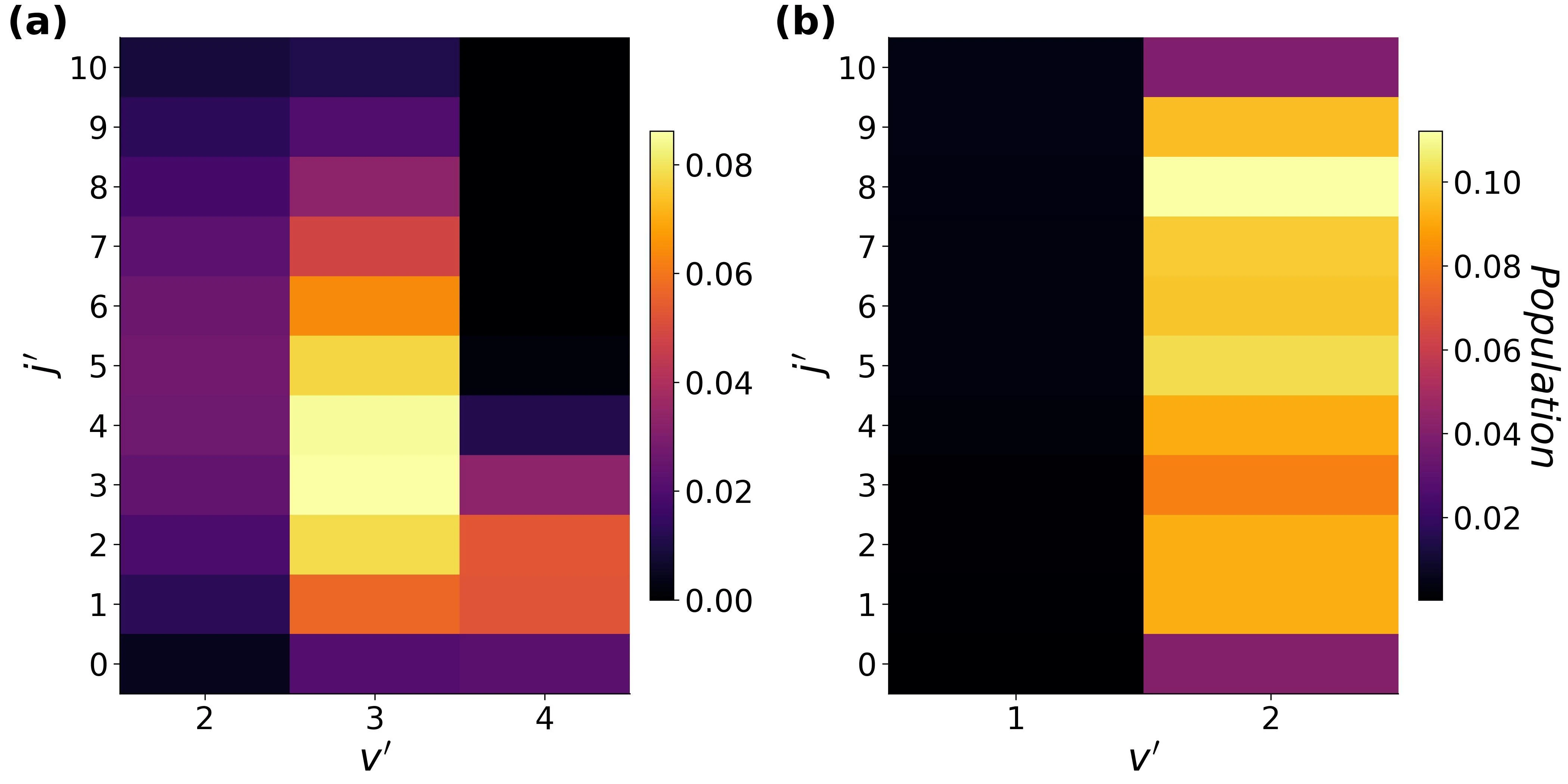
Using spectroscopy of magnetic resonances, researchers showed that a weak magnetic field can turn entanglement on and off in ultracold collisions (such as rubidium with strontium fluoride). Even in an ordinary reaction of fluorine with hydrogen, the products are born entangled. Chemical reactions become factories of quantum knots for future technologies.
Original abstract
as written by the authors arXiv:2601.17144
Entanglement, a defining feature of quantum mechanics, arises naturally from interactions between molecular systems. Yet the precise nature and quantification of entanglement in the products of molecular collisions and reactions remain largely unexplored. Here, we show that coupling between the external (motional) and internal degrees of freedom of the colliding molecules generates diverse forms of product-state entanglement: discrete-discrete, continuum-continuum, and hybrid discrete-continuum. We develop a general theoretical framework to quantify these entanglement forms directly from scattering S-matrix elements and identify a novel class of entangled states-multimode hybrid cat states, that exhibit multimode discrete-continuum entanglement. Although applicable at arbitrary collision energies, the formalism is illustrated in the ultracold and cold regimes for inelastic Rb+SrF and Rb+Sr$$^+$$ collisions, as well as the chemical reaction F+HD $$\rightarrow$$ HF+D, DF+H. We demonstrate that entanglement can be efficiently controlled near magnetic Feshbach resonances, paving the way for precise magnetic control of product-state entanglement generation in ultracold molecular collisions.
At ultralow temperatures, molecules move slower than a pedestrian, and a collision that births a quantum knot stretches over milliseconds, an eternity in the micro-world.
Controlled quantum knots are the foundation of fantastical technologies: from instant communication to teleportation, as in Star Trek.