Vortices in Liquid Helium: How Superfluidity Maps Out a Vortex Chart express
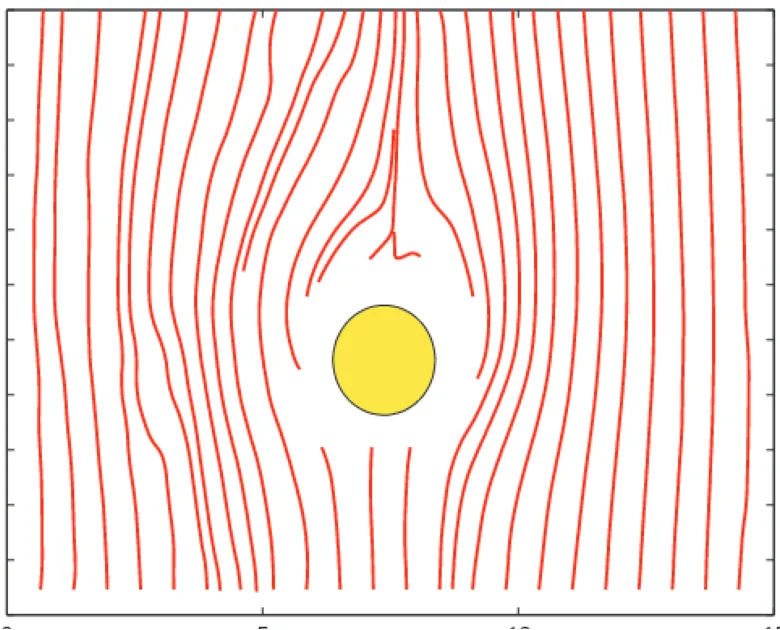
Liquid helium cooled to near absolute zero behaves like two fluids at once: a normal viscous part and a superfluid part that flows without friction. When such a flow hits a cylinder, vortices are born behind it. But sometimes vortices appear in front of the cylinder — where classical laws say they shouldn't be. For a long time, no one could explain why the wake is sometimes empty, sometimes with two, four, or even six vortices.
The authors of the new study reproduced this phenomenon on a computer by combining a two-fluid model with an equation for the density of vortex lines. It turned out that at the cylinder's 'shoulders'—where the flow bends around its sides — a zone of enhanced mutual friction arises between the normal and superfluid components. This zone acts like an invisible pad that changes the obstacle's shape: effectively, the cylinder becomes wider and differently contoured. This reshaped form makes the flow swirl upstream and also damps the natural oscillations of the wake in the normal fluid.
By constructing a phase diagram in the coordinates 'normal fluid velocity — coupling strength', the researchers identified regions where inertia dominates and where mutual friction dominates. The diagram accurately predicts how many vortices form under given conditions. Now the mysterious multiplicity has become a map that tells you in advance how the quantum fluid will behave.
The same mechanism, feedback through inter-component friction, may operate in other quantum fluids, such as superfluid helium-3 or Bose condensates. This provides a universal key to vortex control, important for understanding turbulence in quantum systems and possibly for devices where vortices serve as information carriers.
Original abstract
as written by the authors arXiv:2602.06281
Thermal counterflow of superfluid $$^4$$He past a cylinder produces quasi-steady eddies not only downstream but also anomalously upstream. However, the mechanism and organizing principles behind the observed multistable wake topologies (0-, 2-, 4-, and 6-vortex states) have remained unclear. We show that the full spectrum of reported normal-fluid wake states is captured numerically with a two-fluid model coupled to Vinen's vortex-line-density equation. Our simulations further reveal that the superfluid component can also develop anomalous upstream eddies, a feature not previously reported. We trace these behaviors to a self-organized zone of enhanced mutual-friction dissipation near the cylinder shoulders that reshapes the effective obstacle, drives upstream eddies in both components, and suppresses intrinsic wake oscillations in the normal fluid. Guided by this mechanism, we perform systematic parameter scans and construct a unified phase diagram in terms of the normal-fluid Reynolds number $$Re_n$$ and a dimensionless interaction number $$N$$, separating inertia- and mutual-friction-controlled transitions and delineating the parameter windows for the discrete wake topologies. These results turn a striking phenomenology into a predictive map and establish mutual-friction feedback as a robust route to unusual wake structures in quantum fluids.
Superfluid helium can seep through the tiniest pores, impenetrable to normal fluids, and even 'climb' up the walls of a container, defying gravity.
In Greg Egan's novel 'The Clockwork Rocket', characters use quantum fluids to create exotic matter where vortices behave like particles with unusual properties.