Black Hole Flare Returns Iron Echo express
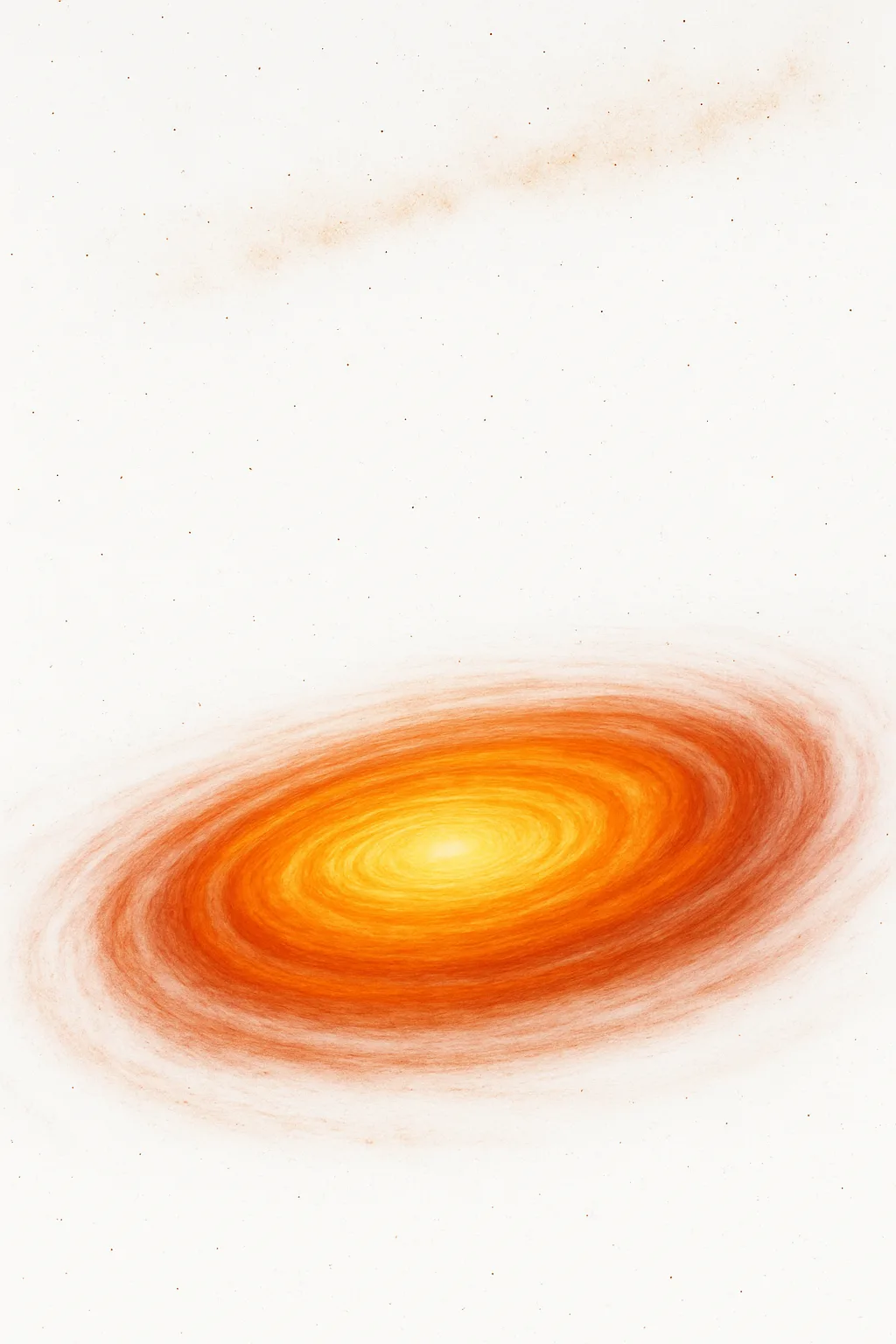
One night in 2008, something in the core of the distant galaxy J1047+5907 flared sharply in X-rays. That's how the neighborhood of a supermassive black hole sometimes behaves: a scorching cloud of gas above it suddenly blasts out a powerful stream of light. The black hole itself emits nothing, but its surroundings can light up like a neon sign.
21.5 days after the flare, telescopes caught a response signal — a narrow spectral line left by iron atoms. The iron didn't glow on its own: it was illuminated by that very flare, and the atoms re-emitted energy at a strictly defined wavelength. But the line was smeared out, like a photo of a fast-moving object. Gas in the disk around the black hole whirls at enormous speeds — up to 14,000 kilometers per second. Part of the disk flies toward us, part away, so light from different regions shifts differently. From the width of the blur, scientists calculated the speed and the distance to the black hole: from 5 to 41 light-days.
This is the first time such an iron line appeared right after a flare and after a predictable delay. Usually it's seen constantly — the disk is always illuminated. Here, the flare acted like a camera flash in a dark room: it briefly lit up the disk, and the disk responded. So the disk really does react to sudden illumination, rather than shining on its own. Such events are rare, but if we keep watching active galactic nuclei after strong flares, we could collect a whole series of disk 'echoes.' That would let us measure the mass and spin of black holes, as well as the disk's structure at various distances from the center — things that are nearly impossible to see any other way.
The flare has faded, but its echo keeps telling us how the engine at the galaxy's center works. The iron line is not just a spectral trace; it's a fingerprint of the moving disk, captured at the moment it was illuminated.
The gas speed in the disk—14,000 km/s — is 47 times faster than the International Space Station orbits Earth.
In the movie 'Interstellar,' the heroes travel to the supermassive black hole Gargantua; its disk glows from friction and gravity, and its distortions help the characters understand time.