A Century-Old Beam from a Black Hole express
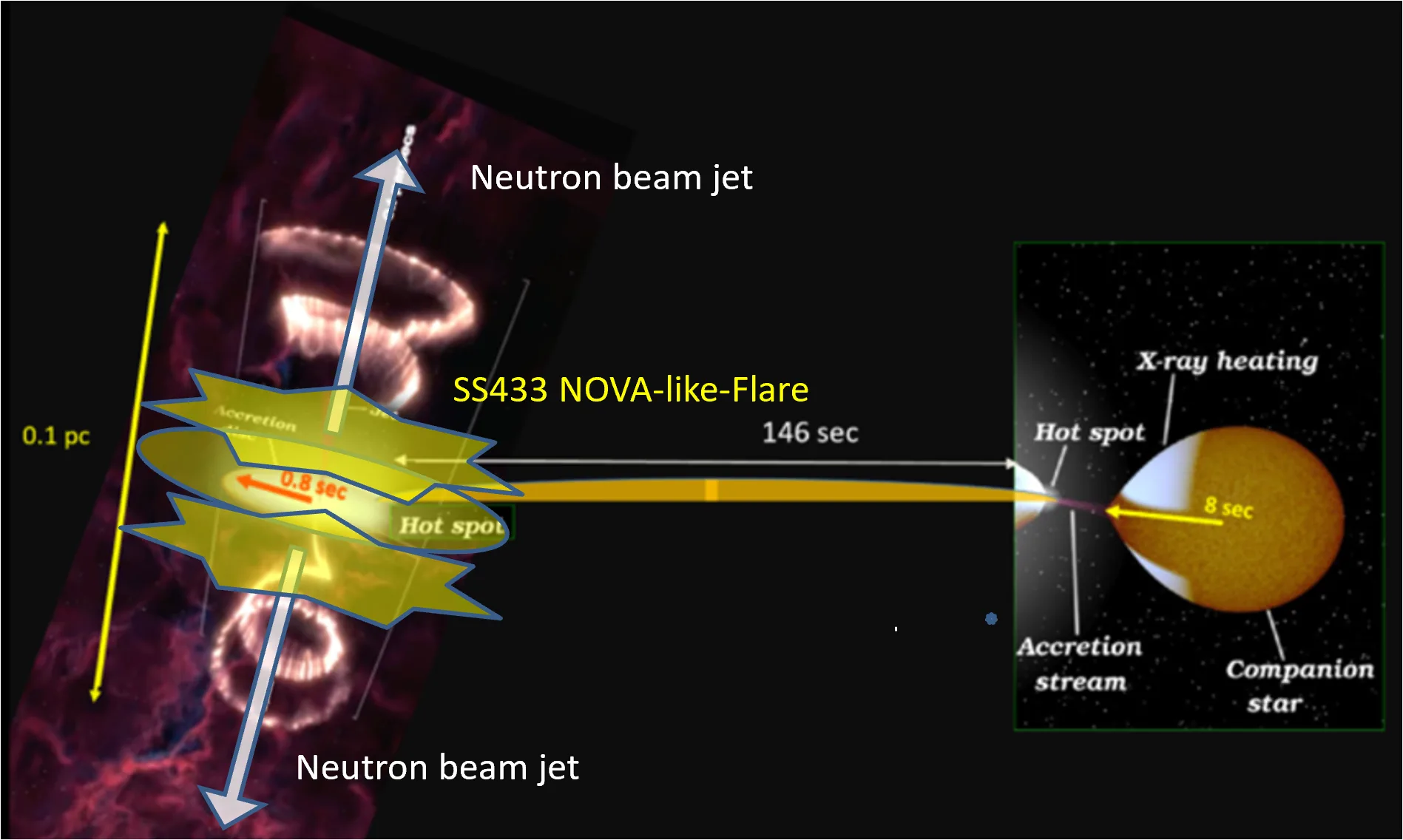
The binary system SS433 is known for its black hole stripping matter from a neighboring star. Some of the gas falls into the hole, while the rest is ejected in two narrow jets that wobble like a spinning top. These jets are visible in radio and X-rays.
Recently, the H.E.S.S., HAWC, and LHAASO telescopes detected gamma-ray emission not where expected: not right at the source, but a hundred light-years away. The photon energies are tens of teraelectronvolts, comparable to the fastest particles in accelerators.
The authors of the new study propose an explanation. About a century ago, the black hole briefly shot out two beams of neutrons with colossal energies — tens of petaelectronvolts. Neutrons are unstable: during their flight, they decayed into protons, neutrinos, and electrons. The electrons, accelerated to enormous speeds, collided with infrared photons in interstellar space and produced the very gamma-ray emission that telescopes see today.
So a distant gamma-ray patch in the sky turned out to be not a separate object but an echo of an old jet. The flare itself was brief, but its traces stretched over decades, like the smell of smoke lingering in a room after the candle has gone out.
Original abstract
as written by the authors arXiv:2602.14212
The SS433, a well-known binary system with an internal black hole, have shown since half a century, an inner (a few year light distances) twin precessing jets spirals. These beams are made by tidal forces while stripping mass from large stellar companion feeding an inner BH accretion disk and an orthogonal accelerating twin jet. From it, the radio, X gamma jet emission. A couple of years ago H.E.S.S telescope as well as HAWC and LHAASO array detectors, discovered also the surprising signature of an unexpected far twin separated gamma beam at tens TeV energy. At a hundred light years distances from its central source. We suggest that it is the legacy of a past rare eruption, a century ago, of tens PeV (10^16 eV) relativistic twin neutron beams. Their beta decay in flight at far distances, into proton, neutrino and in particular into tens TeV electrons, could feed the observed TeV gamma traces. They are originated by the same secondary tens TeV electrons emitting hard gamma, by Inverse Compton Scattering onto interstellar infrared photons.
A free-flying neutron lives on average about 15 minutes before decaying into a proton, an electron, and an antineutrino. In that time, a neutron beam can travel several light-years from its source.