A Century-Old Beam from a Black Hole express
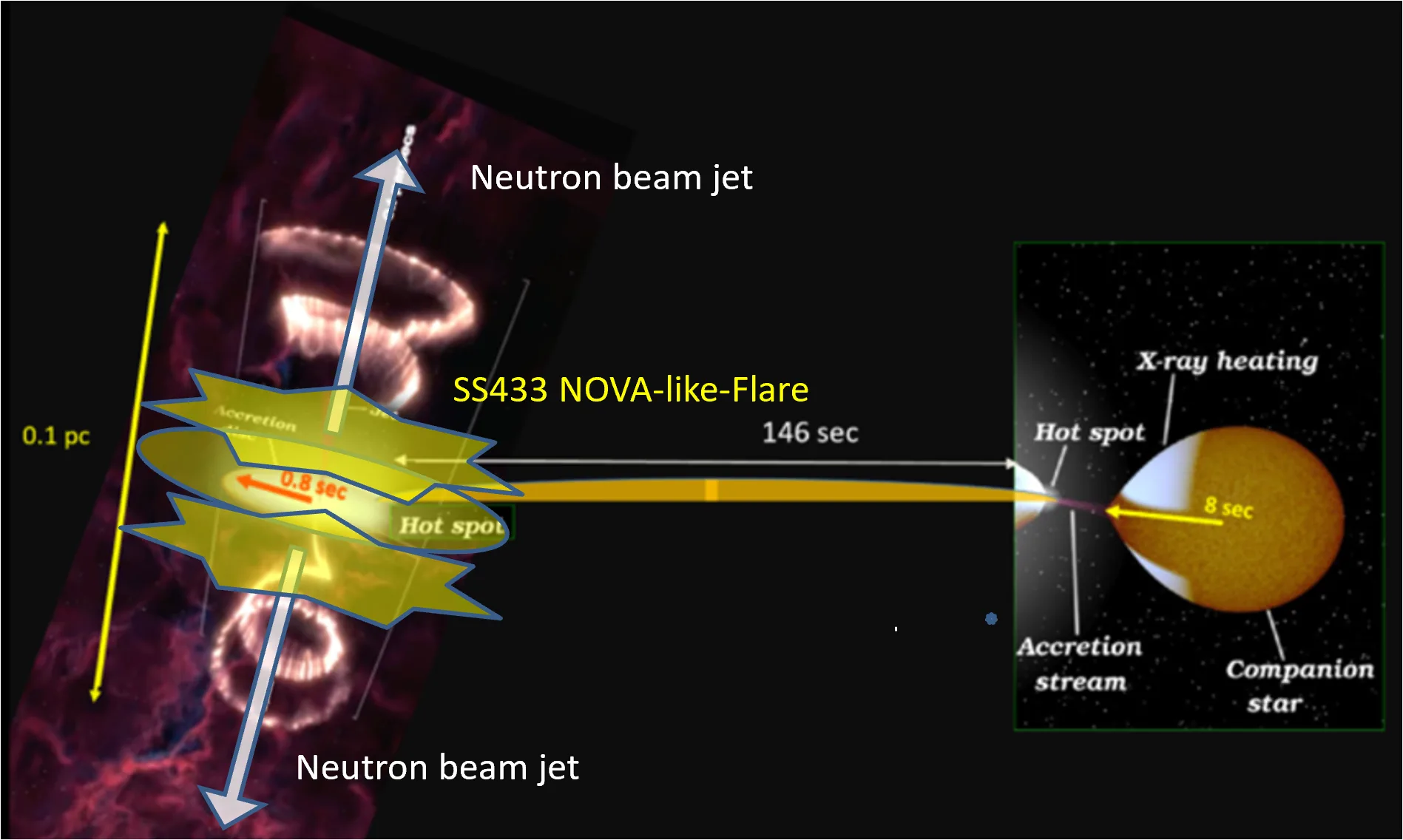
The binary system SS433 is known for its black hole stripping matter from a neighboring star. Some of the gas falls into the hole, while the rest is ejected in two narrow jets that wobble like a spinning top. These jets are visible in radio and X-rays.
Recently, the H.E.S.S., HAWC, and LHAASO telescopes detected gamma-ray emission not where expected: not right at the source, but a hundred light-years away. The photon energies are tens of teraelectronvolts, comparable to the fastest particles in accelerators.
The authors of the new study propose an explanation. About a century ago, the black hole briefly shot out two beams of neutrons with colossal energies — tens of petaelectronvolts. Neutrons are unstable: during their flight, they decayed into protons, neutrinos, and electrons. The electrons, accelerated to enormous speeds, collided with infrared photons in interstellar space and produced the very gamma-ray emission that telescopes see today.
So a distant gamma-ray patch in the sky turned out to be not a separate object but an echo of an old jet. The flare itself was brief, but its traces stretched over decades, like the smell of smoke lingering in a room after the candle has gone out.
A free-flying neutron lives on average about 15 minutes before decaying into a proton, an electron, and an antineutrino. In that time, a neutron beam can travel several light-years from its source.