The Zebra in the Heart of the Crab express
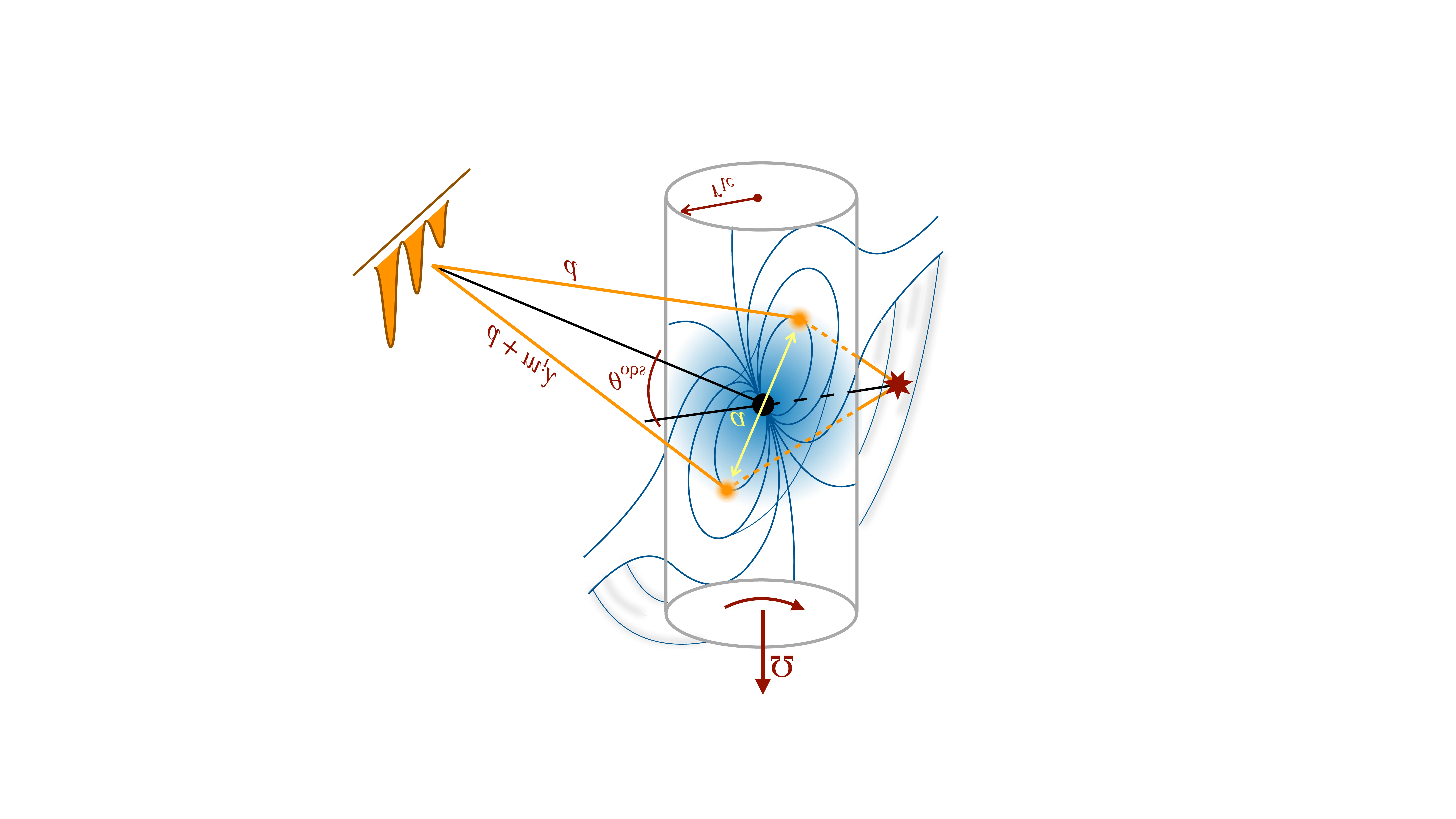
A radio telescope picks up a signal from the Crab Nebula, and instead of a smooth line, the screen shows bright and dark bands, like on a zebra's hide. This is the emission from the pulsar, a rapidly spinning neutron star left over from a supernova explosion. The bands appear because the radio waves don't travel to us along a single path but along several, and they interfere, like ripples from two stones dropped into water.
One path is bent by the pulsar's gravity, which acts like a lens, focusing the light. The second path is distorted by plasma — hot gas of charged particles around the star. This gas, in contrast, scatters the rays. When the two paths meet at our telescope, their waves alternately reinforce and cancel each other, creating the bands. The spacing between the bands reveals how much plasma lies along the ray's path.
The authors calculated that at higher frequencies, from 42 to 650 gigahertz, the banded pattern should change. These frequencies are accessible to the ALMA and SMA telescopes, and observations at these bands could peer into the very heart of the pulsar's magnetosphere. This is a rare opportunity to test how gravity works in the ultra-strong field near a neutron star.
Original abstract
as written by the authors arXiv:2602.16955
A theory of the spectral "zebra" pattern of the Crab pulsar's high-frequency interpulse (HFIP) radio emission is developed. The observed emission bands are interference maxima caused by multiple ray propagation through the pulsar magnetosphere. The high-contrast interference pattern is the combined effect of gravitational lensing and plasma de-lensing of light rays. The model enables space-resolved tomography of the pulsar magnetosphere, yielding a radial plasma density profile of $$n_{e}\propto r^{-3}$$, which agrees with theoretical insights. We predict the zebra pattern trend to change at a higher frequency when the ray separation becomes smaller than the pulsar size. This frequency is predicted to be in the range between 42 GHz and 650 GHz, which is within the reach of existing facilities like ALMA and SMA. These observations hold significant importance and would contribute to our understanding of the magnetosphere. Furthermore, they offer the potential to investigate gravity in the strong field regime near the star's surface.
The Crab pulsar spins about 30 times per second — faster than the blades of a kitchen blender.
In Stanisław Lem's novel 'Solaris', the planet's ocean creates intricate patterns on its surface — somewhat like the bands the pulsar paints for us.