Droplets of Light Catch Molecules express
Two liquid droplets hanging side by side begin to sing in unison. One droplet is like a string tuned to a certain pitch, and together they form a laser that shines with a single, pure color. That's how a new type of sensor, a liquid photonic molecule, works.
The secret is that the droplets are slightly different in size. Their light waves overlap like the teeth of two combs with different spacing: only some teeth align, leaving one bright beam. This allows the laser to operate with very low pumping, just 610 nanojoules per square millimeter, like lighting a match from the warmth of a palm.
But the main thing is sensitivity. When even a single molecule of the target substance enters the droplet, the laser's color shifts dramatically. It's like hearing one wrong note in an orchestra — immediately noticeable even though there are many musicians. The scientists achieved detection of 30 attomoles: that's 30 molecules per billion billion water molecules. For comparison, it's like finding one grain of sand in a mountain-sized pile of sand.
Such a sensor doesn't need staining or preparation: it glows on its own and reports its finding. In the future, similar droplets could work directly inside living tissues, tracking diseases at the earliest stage.
Original abstract
as written by the authors arXiv:2602.18704
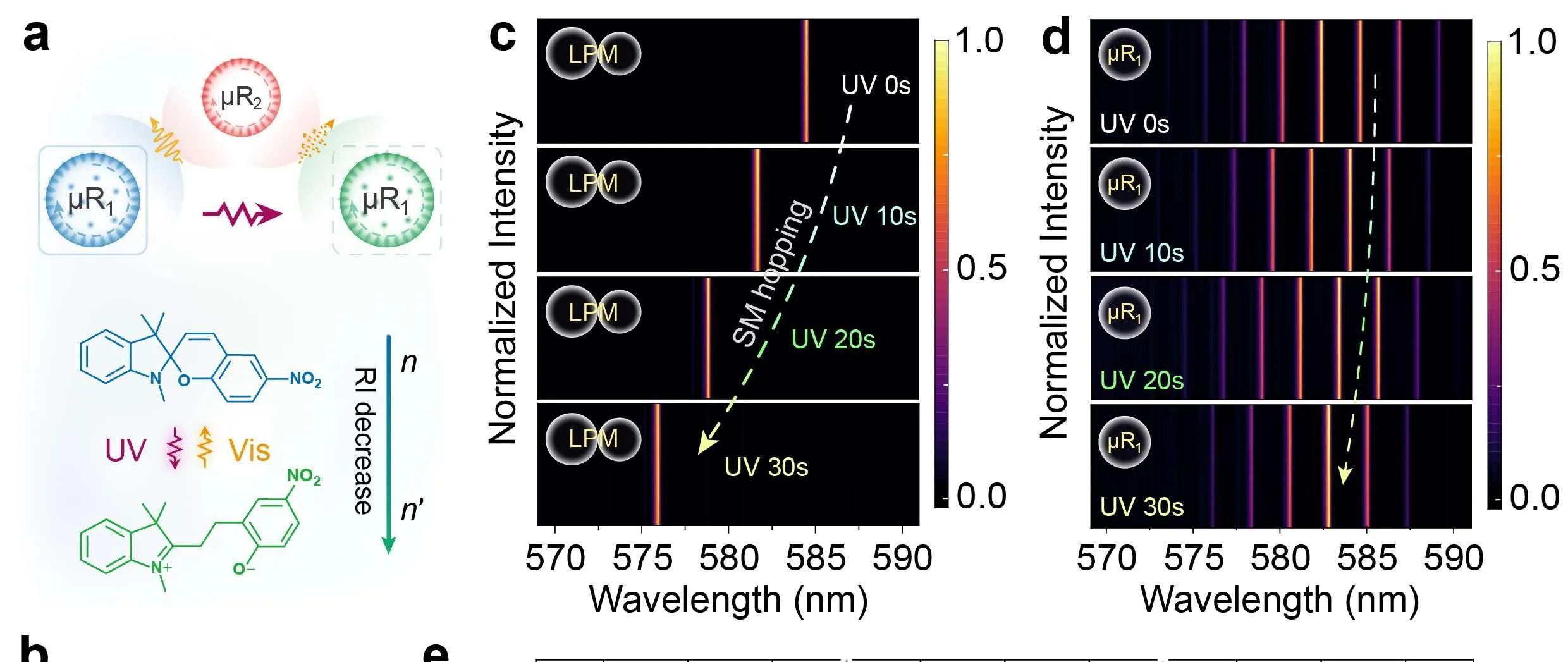
Droplet microlasers, as promising tools for biophotonics and biomedical sciences, have witnessed rapid advances due to their flexible reconfigurability, high sensitivity to stimuli, and label-free biosensing ability. However, designing these biosensors with simultaneously critical properties of low lasing threshold, high spectral purity, and ultimate sensitivity remains challenging. Here, we propose a versatile strategy to build liquid photonic molecules (LPMs) that combine all these features in a single device. We find that through tailoring the spectral Vernier overlap in size-mismatched droplets, this device enables single-mode lasing with a low threshold of ~610 nJ mm-2. The LPM lasers are engineered for dynamic tunability using a molecular isomerization strategy, which induces spectral mode hopping and thus yields a nearly ten-fold enhancement in spectral sensitivity over single droplets. Moreover, by leveraging the self-referenced intensity response of the LPM lasing modes, we demonstrate a three-orders-of-magnitude enhancement in biomolecular sensing, with a detection limit of 30 aM and a dynamic range spanning nine orders of magnitude. Our work offers exciting prospects for bio-integrated liquid sensors in diverse applications.
30 attomoles is roughly 18,000 molecules. If a molecule were the size of a pea, 18,000 peas would fill just a small glass.
In the series 'Star Trek,' the medical tricorder instantly diagnoses diseases from a drop of blood — liquid photonic molecules are a first step toward such a device.