Chemistry Around Galaxies: What Their Outskirts Breathe express
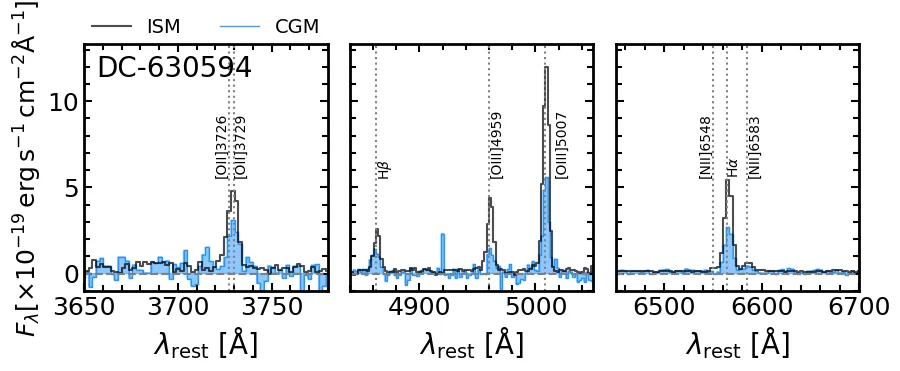
The kitchen of a distant galaxy isn't limited to its bright disk. Around every star system, there's an invisible cloud of gas, like steam above a pot of soup. Astronomers peeked into this steam around galaxies that appear as they were just one and a half billion years after the Big Bang.
Using the James Webb Space Telescope and the ALMA radio telescopes, they measured how much oxygen, nitrogen, and other heavy elements (astronomers call them metals, even if they're not iron) are there. It turned out that in this gaseous halo, there's about as much metal as inside the galaxy itself. That means stars that are born and die in the galaxy manage to fling their chemical stash far out — tens of thousands of light-years.
But one detail surprised them. There's less nitrogen in the halo than oxygen, even though they usually go hand in hand. Oxygen is born quickly, in massive stars, while nitrogen is slower, in lighter stars. It seems nitrogen just hasn't had time to reach the outskirts. And another thing: the gas in the halo glows differently than inside the galaxy. That's a hint that it was stirred up by galaxy collisions or powerful outflows from supernova explosions.
Original abstract
as written by the authors arXiv:2602.20241
Gaseous halos around galaxies play an important role in galaxy evolution. The exchange of metals from the interstellar medium (ISM) to the circumgalactic medium (CGM) are caused by the formation, feedback, and/or merging history of galaxies. We study the variation in chemical composition between the ISM ($$\lesssim3\,$$kpc) and CGM ($$\sim5-10\,$$kpc) for a sample of $$M_{\star}>10^{9.5}\,M_{\odot}$$ main-sequence galaxies at $$4
The oxygen we breathe was once flung by stellar explosions far beyond the borders of their home galaxies.
In Carl Sagan's novel Contact, the heroine travels through a network of wormholes left by an ancient civilization. Maybe someday we'll find a way to use galactic halos as cosmic 'storage depots' for resources.