Yuan Li

7 articles · 30 co-authors · latest: 2026-09-09
10 citations · h-index 2 · 6 papersData: Semantic Scholar

We have retold 7 papers by this author. 4 of them with a full read. most often about: wave-particle duality, quantum_imaging, interstellar medium. 30 co-authors across our retellings.

Links in the knowledge graph
The Sun as a Free Quantum Pump
Sunlight collected by a Fresnel lens and passed through 20 meters of plastic fiber had a power of just 3 microwatts, a million times less than a typical laser pointer. That was enough to generate photon pairs correlated in position inside a nonlinear crystal. One photon from each pair passed through the object, the second was scanned by a detector, and coincidences built up the image.
Galaxies2026-02-231 minarXiv:2602.20241express
Chemistry Around Galaxies: What Their Outskirts Breathe
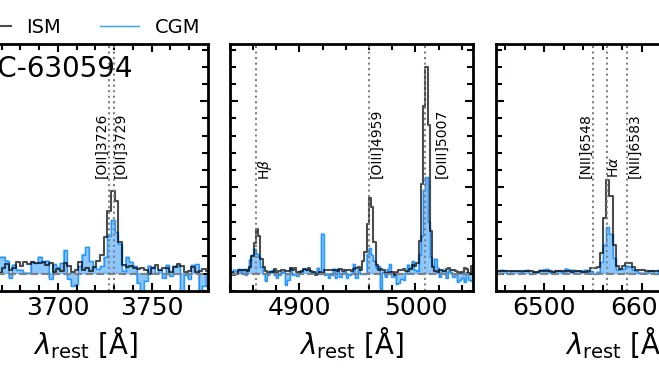
The kitchen of a distant galaxy isn't limited to its bright disk. Around every star system, there's an invisible cloud of gas, like steam above a pot of soup. Astronomers peeked into this steam around galaxies that appear as they were just one and a half billion years after the Big Bang.
Nuclear Theory2026-03-081 minarXiv:2603.07597express
The Neutron Skin of Lead: What Collisions Reveal
When two lead nuclei collide at tremendous speed, they flatten and shatter into thousands of particles. The shape of this debris depends on how the nuclei were structured before the impact. Inside the nucleus, protons and neutrons are not distributed identically: neutrons stick out slightly beyond the edge: this is called the neutron skin.
Galaxies2026-05-312 minarXiv:2606.01496express
Why quasars flicker differently than we thought
A candle flame in a draft dances: now it flares up, now it almost goes out. Quasars behave much the same way — supermassive black holes in the centers of distant galaxies, surrounded by a scorching disk of infalling matter. Only they flicker not over seconds, but over months and years.
Galaxies2026-06-043 minarXiv:2606.06620
Roots of the Cosmic Banyan: How Black Holes Feed
Cosmic black holes at the centers of galaxies are like giant banyan trees: their aerial root‑filaments stretch for kiloparsecs to harvest nourishing matter. For decades astronomers have debated: how does cooling gas from cluster atmospheres fall into the sphere of influence of a supermassive hole?
Galaxies2026-06-053 minarXiv:2606.07741
Cosmic Latte: Why X-rays Are Three Times Brighter Than Hydrogen
In astrophysics, some numbers seem random yet recur with the persistence of a spell. One such number is the ratio of X-ray brightness to H-alpha hydrogen emission in turbulent gas tails. From galactic winds to ‘jellyfish’ slicing through clusters, this ratio steadily holds at around three.
Silence in a Noisy Room: Hunting a Decay Nobody Has Seen
Picture a room where hundreds of people are talking at once while you strain to hear a pin drop. That is essentially how physicists with the PandaX-4T collaboration listened for silence inside 3.7 tonnes of liquid xenon.