Layered crystal boosts light sevenfold express
An ordinary piece of semiconductor weakly changes the color of light passing through it. For decades, physicists worked around this limitation by placing the crystal in clever surroundings, but the material itself remained the same.
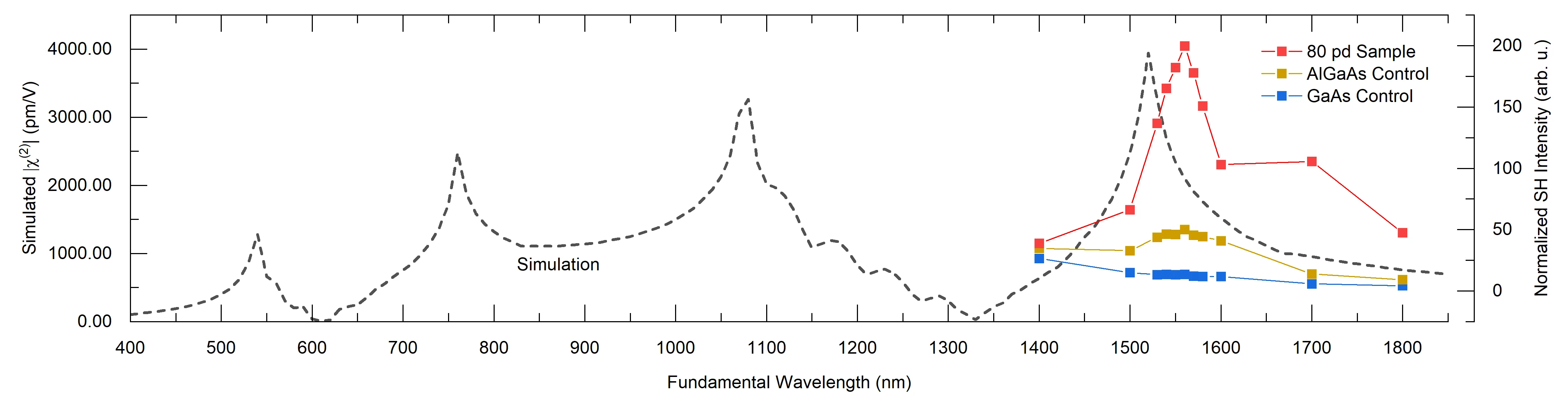
Now researchers have assembled a "sandwich" of alternating thin layers of gallium arsenide and aluminum gallium arsenide. When light enters such a layered crystal, it makes electrons jump between layers, and in response, a wave with doubled frequency is born. An infrared beam with a wavelength of 1550 nanometers turns into green light with a wavelength of 775 nanometers.
To make the layers perfectly flat, the scientists paused during crystal growth. Electron microscopy showed that the boundaries between layers became sharper, and efficiency increased. Calculations promise even more — up to 7 nanometers per volt for more complex structures.
Such a material could be useful in quantum communication: it can generate pairs of entangled photons at telecommunications wavelengths — exactly what is needed for secure data transmission.
The transition from infrared to green light is a frequency doubling. If sound doubled its frequency the same way, the note C would become the C of the next octave.
In the series "Star Trek," quantum entanglement is used for instantaneous communication; the layered crystals from this work could become a source of entangled photons for such a network.