How to Spin Up Atoms Without Cold or Magnets express
To align particle spins in one direction, physicists usually cool a substance to near absolute zero and place it in a strong magnetic field. That is expensive and bulky.
A new method resembles tuning many spinning tops with a gentle touch: mediator molecules temporarily bind to target atoms and pass on their order. The technique is called SABRE — signal amplification by reversible exchange. In it, hydrogen from a para-gas transfers magnetization to target molecules right in solution, at room temperature.
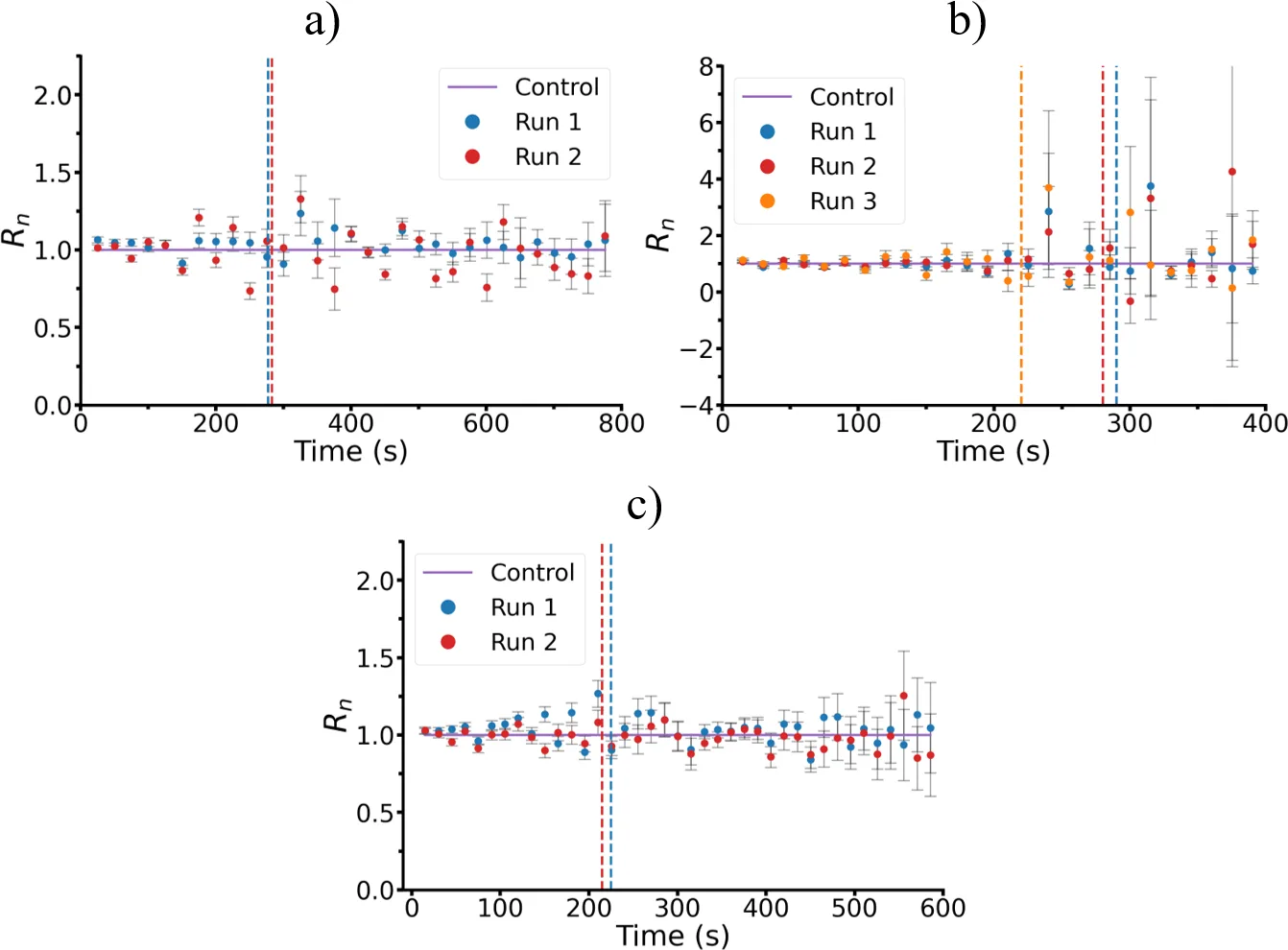
Such resilience matters for experiments where a target sits directly in the particle beam. If the material keeps its polarization under irradiation, it can serve as an active detector medium — for example, a scintillator or a Cherenkov radiator.
The tops keep spinning steadily even under a hail of hits. This means expensive cryostats and magnets might soon be replaced by a simple chemical process.
Original abstract
as written by the authors arXiv:2603.08750
Spin-polarized solid targets have underpinned many recent key advances in nuclear and particle physics, yet traditional methods to produce them face significant limitations due to the high cost and demanding cryogenic and magnetic field requirements. These factors constrain experimental geometries and present challenges in intense radiation environments where depolarization and materials damage can occur. We present the first results assessing the capabilities of the chemical hyperpolarization (ChHP) method Signal Amplification By Reversible Exchange (SABRE) to act as the polarization method to produce targets or active detector media. We show by using in-beam measurements that there is no depolarizing effect observed with the SABRE-polarized material in the A2 photon beam at the Mainzer Mikrotron (MAMI), as well as showing the resilience of such media to radioactive doses of up to \SI{3}{\kilo\gray}. We also illustrate the capabilities for using SABRE-polarized material as a scintillation or Cherenkov detector.
A dose of 3 kilogray is lethal to humans, but for a solution of polarized molecules it passes almost unnoticed.