Pressure Turns a Metal into a Magnet express
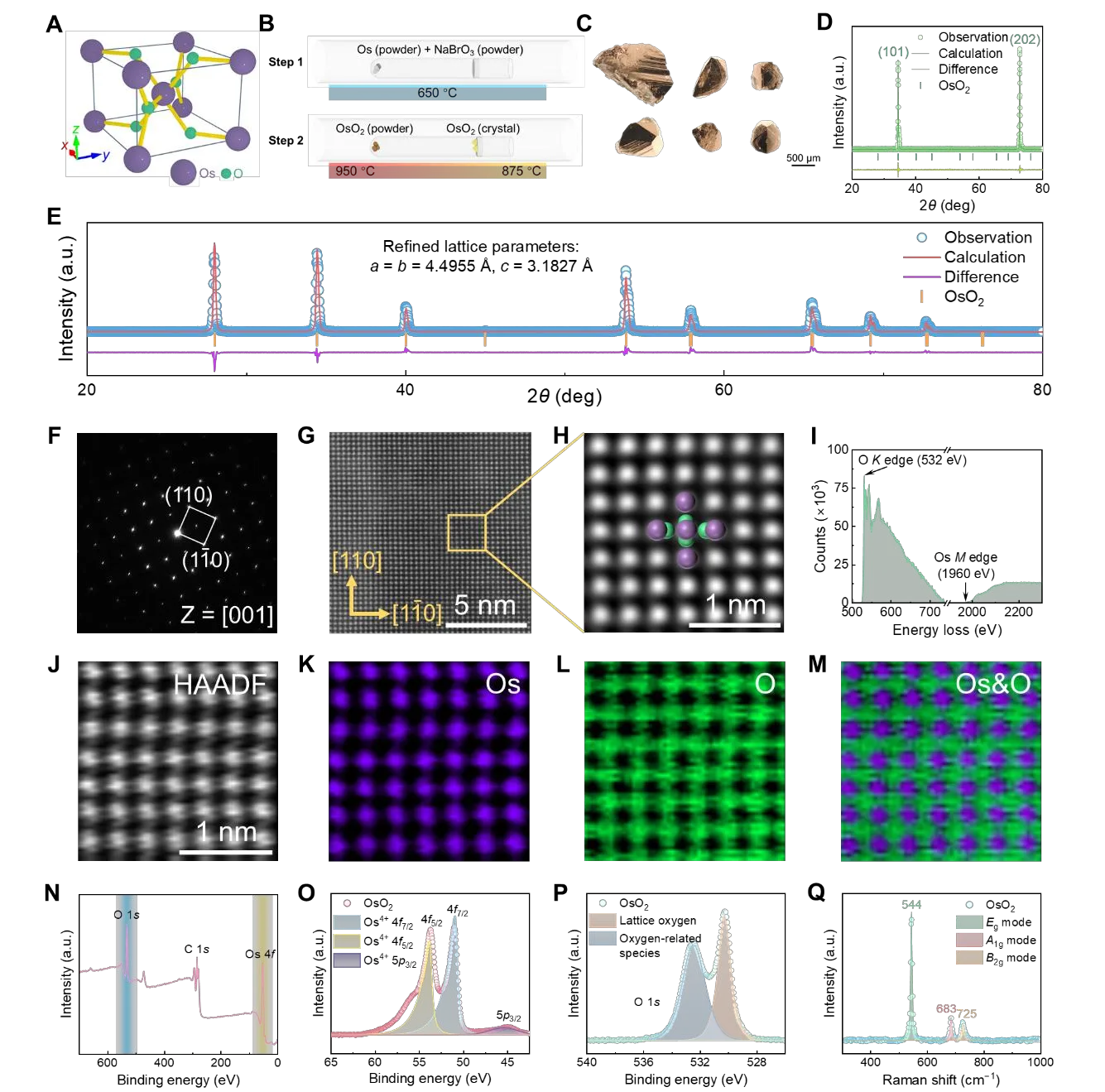
A crystal of osmium dioxide, OsO₂, is like a stubborn teenager: under ordinary conditions it behaves like a typical metal, but press hard enough and its character changes. Physicists grew this material as high-quality single crystals and found that at ambient pressure, OsO₂ is a good conductor with clear Fermi-liquid behavior, where electrons scatter strongly off each other, like a crowd in a narrow corridor.
Magnetic measurements showed that the crystals are isotropically paramagnetic: their magnetic moments are randomly oriented, like compass needles scattered on a table. But theoretical calculations predict that hidden inside the material is altermagnetism — a special state where electron spins are aligned antiparallel, yet due to the crystal symmetry, the energy of electrons with different spins splits, like twins taking different paths. Photoemission spectroscopy experiments have not yet seen this splitting in the bulk bands, but theory suggests that pressure is the key.
Calculations with hybrid functionals show that pressure enhances the Coulomb repulsion between electrons (the U parameter), and the material progresses from a paramagnetic metal to an altermagnetic metal, and then to an altermagnetic insulator. It's like tuning a guitar: turning the peg changes the pitch, and here, squeezing the crystal switches its magnetic state.
So far, the altermagnetic splitting has not been observed experimentally, but the calculations provide a clear roadmap. Further studies at high pressure may reveal this effect, paving the way to controlling magnetic properties of materials simply by squeezing them.
Original abstract
as written by the authors arXiv:2603.07008
Altermagnets with compensated spin structures and nonrelativistic spin splitting have emerged as a new class of magnetic materials. Rutile OsO2 has been theoretically predicted to be altermagnetic, but experimental studies have been limited by synthesis challenges. We have succeeded in synthesizing high-quality single crystals of rutile OsO2. Electrical transport studies reveal that OsO2 is highly conductive and exhibits clear Fermi liquid behavior, indicating strong electron-electron scattering. Magnetic measurements show that the crystals are isotropically paramagnetic. Density-functional theory calculations indicate that bulk OsO2 is semimetallic with coexisting electron and hole pockets, with its magnetic ground state strongly dependent on the on-site Coulomb correlation U. Angle-resolved photoemission spectroscopy studies unveil that the bulk bands do not yet show altermagnetic spin splitting. Interestingly, resistivity is rather pressure sensitive: at 44 GPa, a clear metal-insulator transition occurs. Hybrid functional calculations reveal that applying pressure significantly increases the Hubbard U value, driving a phase transition from a paramagnetic metal to an altermagnetic metal, and eventually to an altermagnetic insulator. These findings suggest that tuning external pressure effectively modulates the magnetic ground state of OsO2, providing a pathway to realize altermagnetism in this material.
The pressure of 44 GPa at which OsO₂ becomes an insulator is comparable to the pressure in Earth's mantle at a depth of about 1200 kilometers.
In Arthur C. Clarke's novel "Childhood's End," aliens control material properties through unknown fields — here, scientists do it with plain pressure.