An Hourglass in a Dark Cloud express
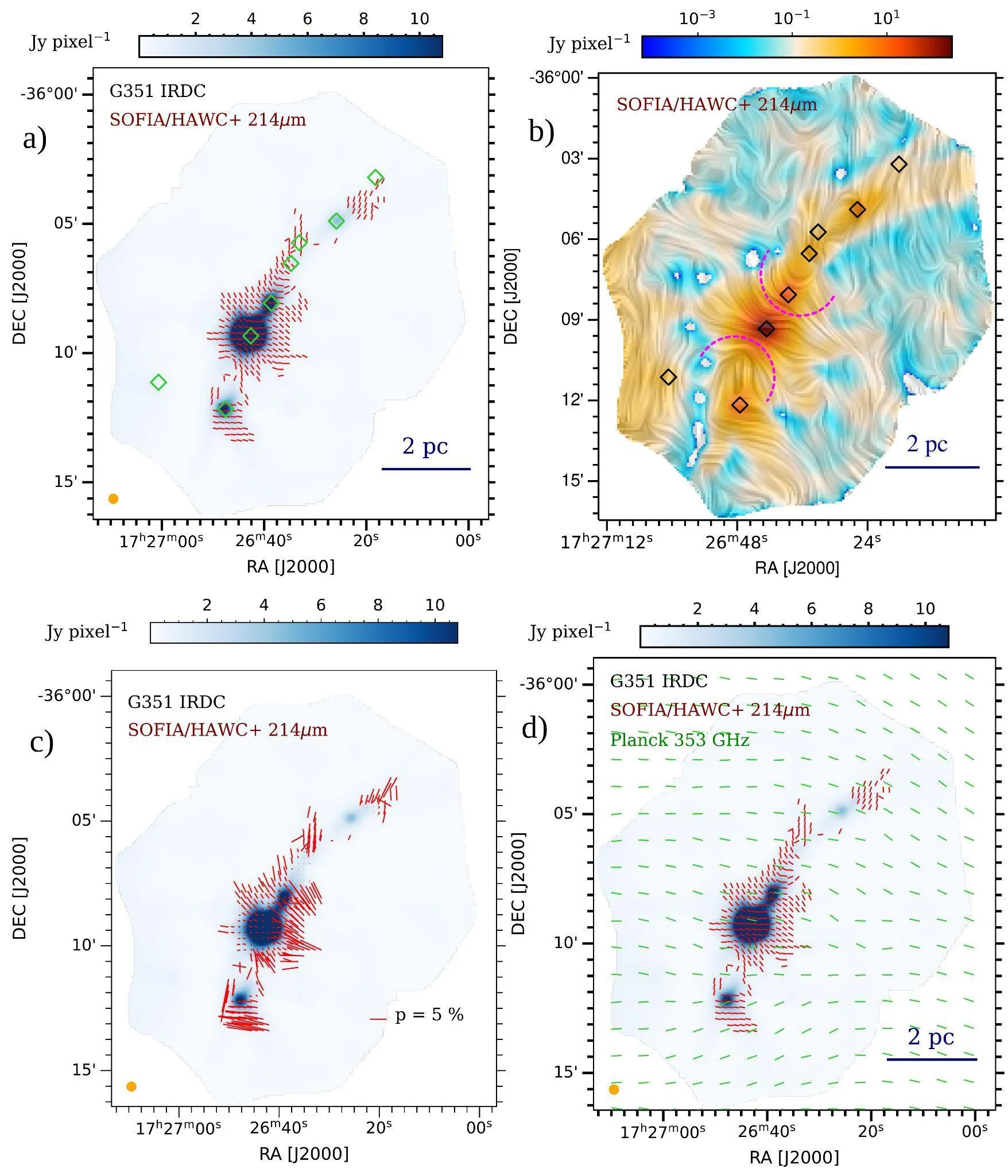
In the dark cloud G351, where new stars are about to emerge from gas and dust, the magnetic field has bent into an hourglass shape. Such a shape is a sign that the field is not just watching star birth from the sidelines but is actively taking part.
Scientists used the SOFIA telescope, mounted on an airplane, to see the dust in the cloud. Dust grains align along magnetic field lines, and by their glow one can infer the field's direction. It turned out that in one part of the cloud, the field is squeezed into a narrow "waist," while toward the edges it widens, like sand flowing in an hourglass. The field strength there reaches 0.8 milligauss — about 1000 times weaker than a refrigerator magnet, but for a gas cloud that's a lot.
Such a balance means the field can slow the cloud's collapse and influence how many stars are born and what masses they will have. If the field is stronger, it prevents the cloud from collapsing too quickly. If weaker, gravity wins, and stars form faster.
The study of G351 shows that magnetic fields are not passive spectators but key players in star formation. Without them, our Sun might never have ignited.
Original abstract
as written by the authors arXiv:2603.16425
We present the SOFIA/HAWC+ 214 $$\mu$$m polarimetric observations toward the infrared dark cloud G351.77-0.53 (hereafter G351), complemented by existing multi-wavelength data sets. Infrared excess from the embedded sources indicate ongoing star formation activity in the cloud. The G351 cloud hosts two prominent star-forming clumps, i.e., c1 and c2. The plane-of-the-sky magnetic field lines from Planck observations are predominantly oriented perpendicular to the filament's major axis. Magnetic field orientations from SOFIA/HAWC+ 214 $$\mu$$m observations reveal distinct hourglass-shaped field configuration toward c1, while the field lines remain perpendicular to the rest of the filament. Using the Davis-Chandrasekhar-Fermi method, we estimate a mean plane-of-the-sky magnetic field strength of $$\sim$$147 $$\pm$$ 60 $$\mu$$G in the G351 filament, with values reaching $$\sim$$0.8 mG toward c1. The mass-to-flux ratio analysis indicates that the filament is magnetically transcritical, where the gravitational and magnetic field energies are comparable. The hourglass-shaped magnetic field observed toward c1 could result from magnetically regulated gravitational collapse, the alignment of converging sub-filaments with the magnetic field, or a combination of both processes. The energy budget analysis further indicates that magnetic fields play an important role in governing the cloud's gas dynamics, followed by contributions from turbulence and gravity.
Cloud G351 is so dense that visible light cannot pass through it: that's why it's called an "infrared dark cloud." But in infrared rays, it reveals its secrets.
In the novel "The Three-Body Problem," magnetic fields play a key role in controlling particles — here, a field controls entire gas clouds.