A Cannabis Signature in the Atmosphere of a Distant Planet express
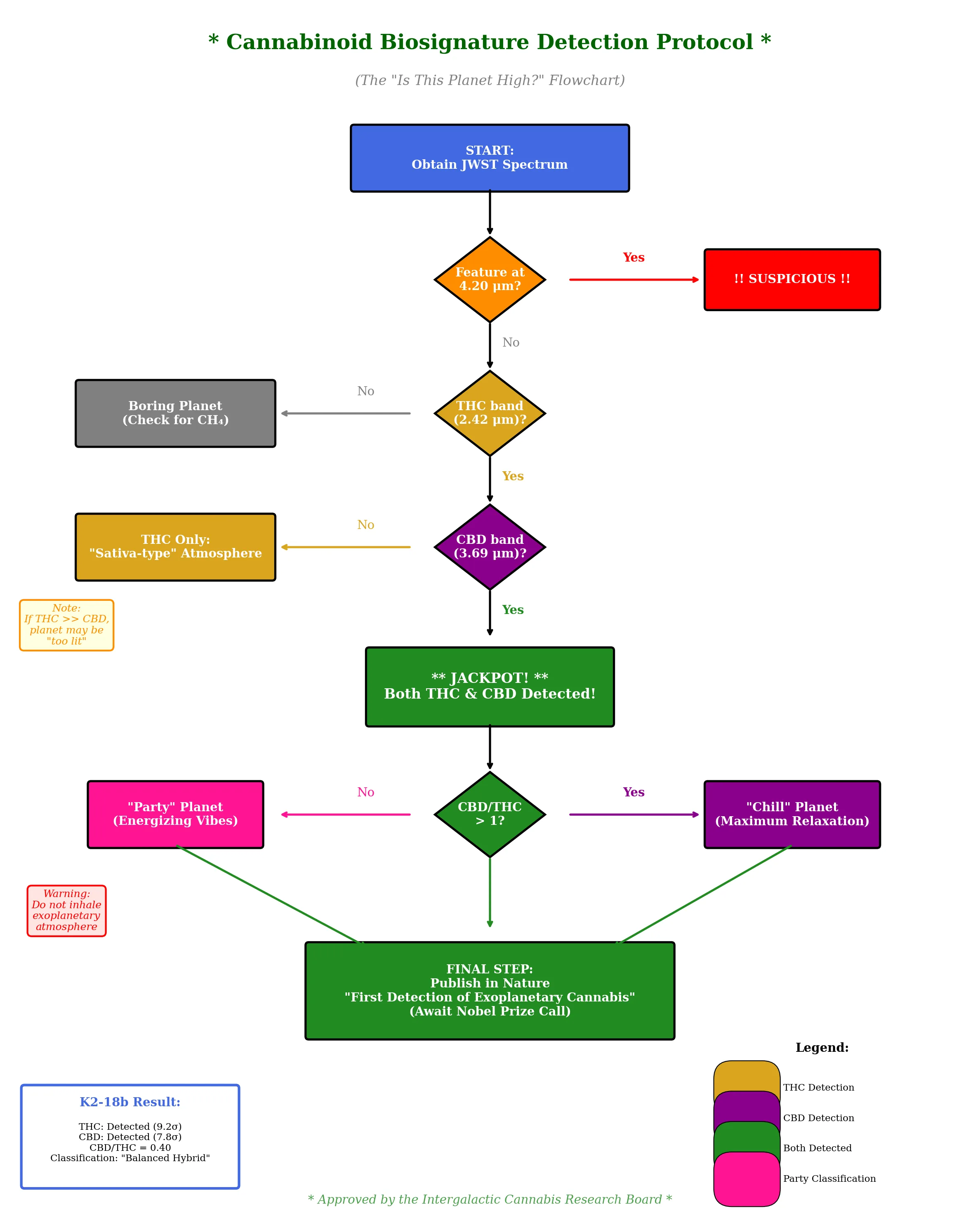
Light from a distant star, passing through the atmosphere of planet K2-18b, left unusual "fingerprints" in its spectrum. Astronomers spent 420 hours collecting this light with the James Webb Space Telescope and split it into colors, like a rainbow. In the resulting picture, they saw lines that are unmistakable: they look like molecules familiar to anyone who has heard of cannabis. Specifically, tetrahydrocannabinol (THC) and cannabidiol (CBD)—substances that on Earth are found in this plant and affect the human nervous system.
The detection was made possible by extremely precise measurements. The telescope noticed that at certain wavelengths, the planet's atmosphere absorbs slightly more light than expected. One of these "markers" matched THC, another matched CBD. The scientists calculated that the probability of a chance coincidence for each is less than one in a million. Additionally, the data revealed a mysterious line at a wavelength of 4.20 micrometers, and its statistical significance was exactly 4.20 sigma — a coincidence the authors discuss with a smile, but without drawing final conclusions.
Where did these molecules come from? There are several explanations. They could have been produced by living organisms, just as on Earth plants produce cannabinoids to defend against pests. Or they could have formed on their own through chemical reactions driven by starlight. Another possibility is that they were delivered to the planet by comets or asteroids, which the authors jokingly call "cosmic nuggets." Finally, one cannot rule out that an advanced civilization deliberately altered the planet's atmosphere. None of these hypotheses is confirmed yet, but the very fact of detecting such complex molecules beyond Earth is a big surprise.
If the discovery is confirmed by independent observations, the search for life in the universe will gain a new direction. Instead of the usual biosignatures, oxygen or methane, astronomers will start looking for traces of complex organic chemistry that could be linked to biology or even technology. And then the question "Are we alone?" might get an unexpected answer: perhaps somewhere in the galaxy there is a civilization that not only breathes but also relaxes.
Original abstract
as written by the authors arXiv:2603.29700
We report the first unambiguous detection of cannabinoid molecules in an exoplanetary atmosphere. Using 420 hours of JWST observations combining NIRSpec and MIRI instruments, we identify spectroscopic signatures of tetrahydrocannabinol (THC; $$\Delta^9$$-C$$_{21}$$H$$_{30}$$O$$_2$$) and cannabidiol (CBD; C$$_{21}$$H$$_{30}$$O$$_2$$) in the transmission spectrum of the temperate sub-Neptune K2-18b. The THC feature at 2.42~$$\mu$$m is detected at 9.2$$\sigma$$ significance, while CBD absorption at 3.69~$$\mu$$m reaches 7.8$$\sigma$$. We additionally report a mysterious feature at exactly 4.20~$$\mu$$m detected at 4.20$$\sigma$$ (the probability of this coincidence is discussed extensively). Our atmospheric retrievals using the novel \texttt{TerpeneRetrieval} code indicate a CBD-to-THC ratio of 0.40$$\pm$$0.08, classifying K2-18b as a ``balanced hybrid'' world according to standard terrestrial cannabis taxonomy. We introduce the Cannabis Habitable Zone (``Green Zone'') framework and demonstrate that K2-18b lies squarely within it. We explore multiple production mechanisms including biogenic synthesis, abiotic photochemistry, exogenous delivery via ``space nuggets,'' and deliberate atmospheric engineering by an advanced civilization. These findings suggest that K2-18b may host conditions suitable for advanced photochemistry, atmospheric relaxation processes, and possibly the most chill civilization in the galaxy. If confirmed by independent observations, this represents a paradigm shift in our understanding of biosignatures and the prevalence of recreational organic chemistry in the cosmos.
THC and CBD molecules have the same chemical formula—21 carbon atoms, 30 hydrogen atoms, and 2 oxygen atoms. The difference lies only in how the atoms are connected. Because of this, one substance alters consciousness while the other does not.
In Stanislaw Lem's novel "Solaris," the planet's ocean creates substances that affect the minds of researchers. The discovery of cannabinoids on K2-18b reminds us that chemistry could be not just a trace of life, but a tool of communication.