A Receiver That Picks Its Own Direction express
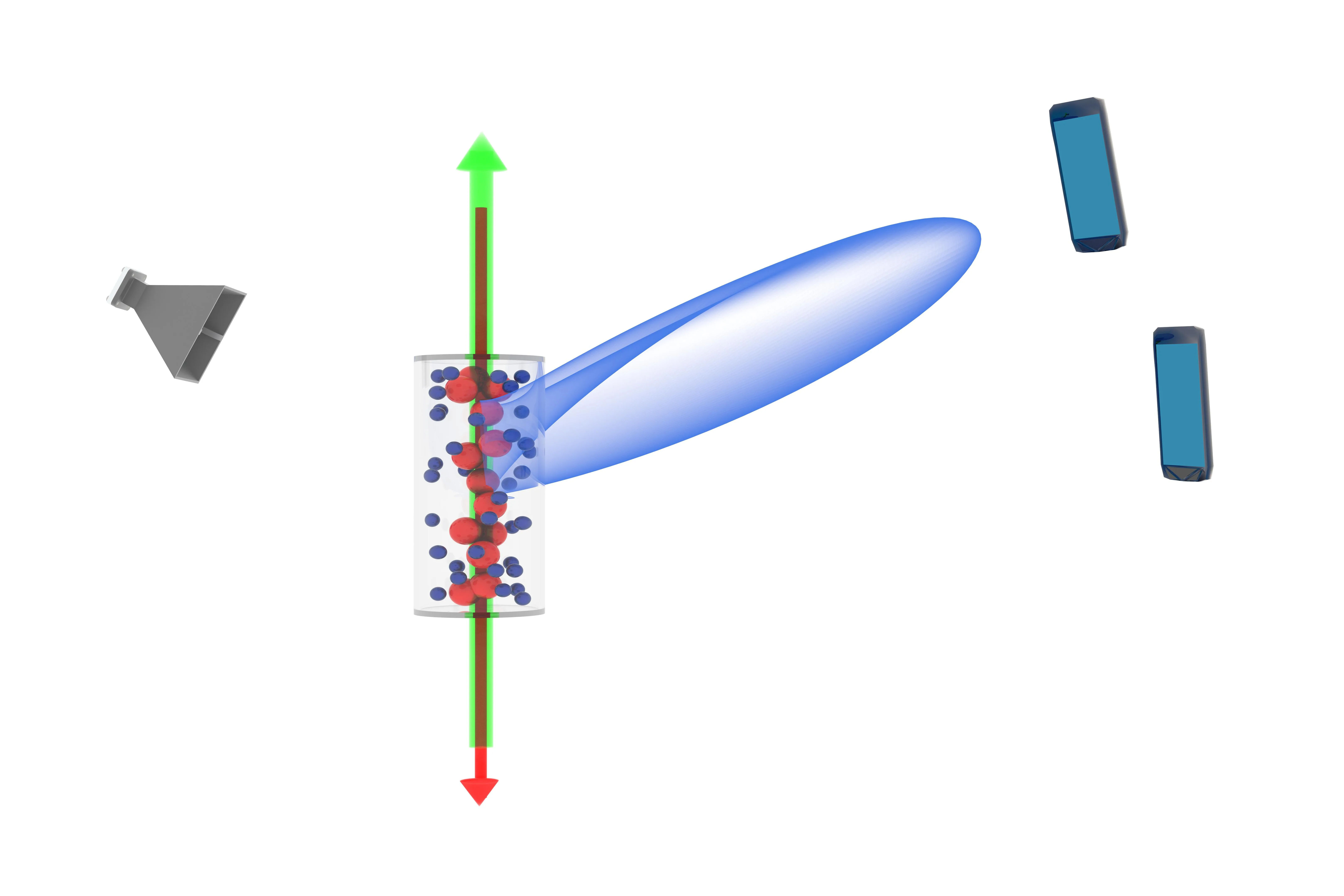
A conventional antenna array is like a choir: many voices singing in unison, with the sound amplified in only one direction. To catch a signal from another side, you have to rearrange the whole choir. Now imagine a single voice that can change its timbre so that the sound itself focuses in the desired direction. That's what physicists have done with a receiver based on rubidium vapor.
Inside a glass cell is a hot gas of rubidium atoms. A laser puts the atoms into a special state where they become highly sensitive to radio waves. But not all at once: the laser beam can be made non-uniform, so different points in the cell have different sensitivities. Waves arriving from different directions interact with these sensitivity zones in different ways. As a result, the cell itself picks out the signal from only one side, while suppressing interference from other directions.
The authors tested the idea with a prototype: by adjusting the laser, they could produce a single narrow beam, multiple beams at once, or reception on different frequencies simultaneously. With a single cell, they managed to suppress a strong interferer, receive signals from two transmitters, and even combine both modes. Previously, this would have required a bulky array of dozens of individual antennas.
Such a receiver can be reconfigured in software without touching the hardware. It is more compact, cheaper, and more flexible than traditional systems. Soon, it might appear in base stations, radar systems, and devices that need to hear only what they should.
The rubidium atoms in the cell are so sensitive that they can detect a radio wave whose energy is billions of times smaller than the energy of a falling snowflake.
In the series 'The Expanse', ships use phased array antennas for communication and scanning; the new technology could replace them with a single compact module.