Cosmic Lens Reveals the Anatomy of a Quasar express
A distant quasar appears as four points of light arranged in a cross. This is how the gravity of a galaxy lying along our line of sight distorts the view: it acts like imperfect glass, multiplying the image. Each point is the same object, but its light travels different paths. So when the quasar flares, the four images respond at different times and to different degrees.
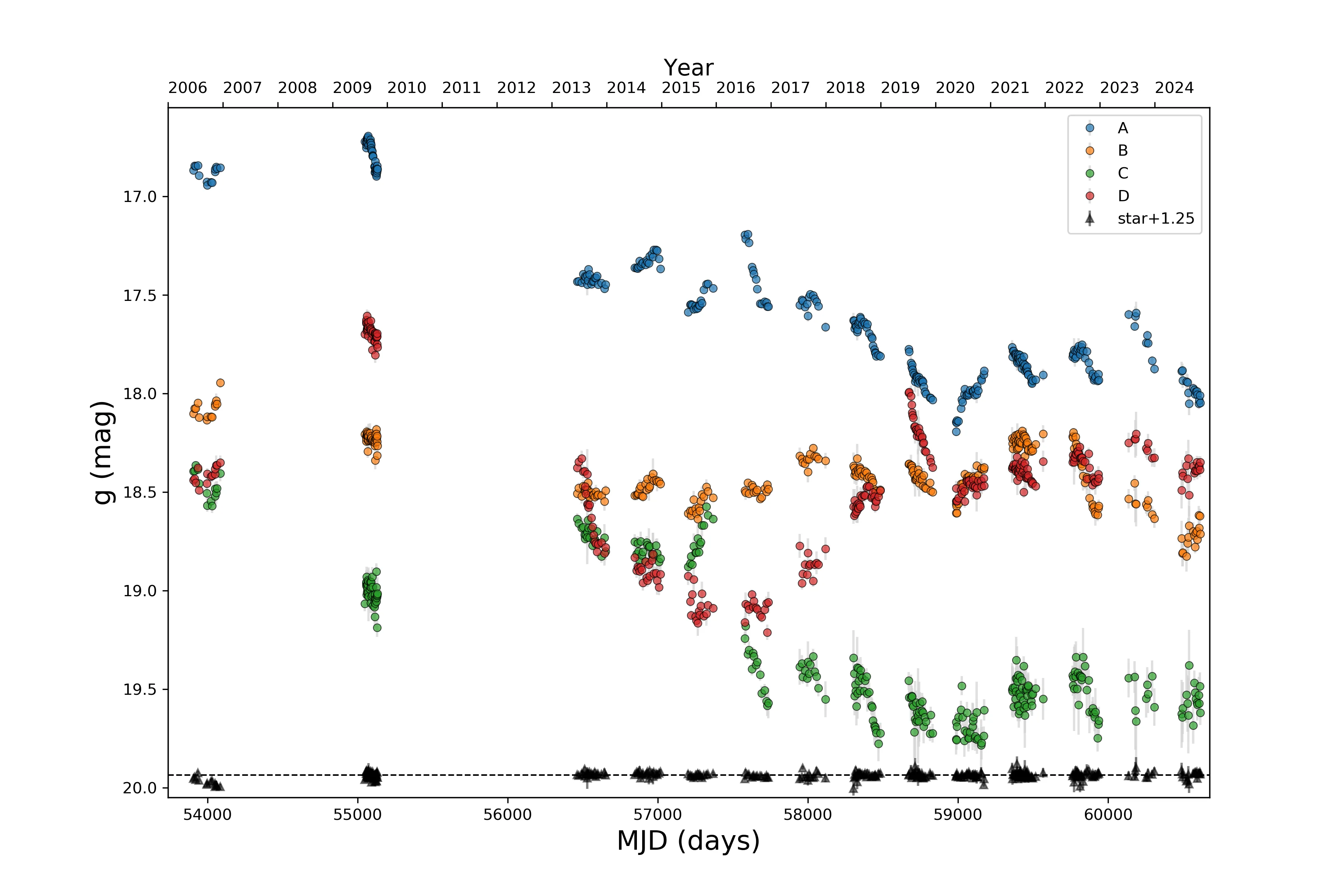
Astronomers gathered 25 years of observations from telescopes in both hemispheres. They devised a way to more accurately subtract the light from the lensing galaxy itself, so it wouldn't interfere. The result was very clean light curves for each of the four images. These curves show that the flickering is caused not only by the lens itself, but also by individual stars within it: they act as tiny additional lenses.
From this flickering, they extracted the key quantity: the size of the quasar's glowing region. In blue light, it spans about 10 light-days across — roughly the distance from the Sun to the Oort cloud. In red light, the region is noticeably larger. The longer the wavelength, the broader the source. The growth is nearly linear: the red source is about twice as large as the blue one.
This result is direct evidence that a quasar is not a point. It is a disk of incandescent gas surrounding a supermassive black hole. The inner, hotter parts of the disk shine in blue and ultraviolet, while the outer, cooler parts shine in red. Hence the size increases with wavelength. Now models describing quasar emission face a stringent test: they must reproduce exactly this size–wavelength relation.
Original abstract
as written by the authors arXiv:2604.09160
We present an extended optical monitoring of the quadruply-imaged gravitationally lensed quasar QSO 2237+0305, the Einstein Cross, including observations from different observatories in both hemispheres and using a new photometric technique. This technique uses a region far enough from the lens system to determine accurately the sky background level, and minimises contamination from the lensing galaxy by combining analytical and numerical modeling of its structure. The resulting light curves of the four quasar images describe variations across practically the entire optical spectrum and span about 9000 days in the $$VRI$$ bands. The multi-band microlensing variability is captured with an unprecedented level of detail, and a preliminary microlensing analysis reveals an almost linear scaling of source radius with wavelength, providing direct evidence for the wavelength-dependent structure of the region contributing to optical passband fluxes. Specifically, assuming a mean microlens mass $$\langle M \rangle$$ = 0.3 $$\rm{M_{\odot}}$$ and concentric Gaussian sources that move according to the velocity distribution peaks (speed and direction) reported in a previous microlensing analysis, we find that the half-light radius of the $$g$$-band source is 9.6 $$\pm$$ 2.7 lt-day and the size of the sources grows with wavelength with a power-law index of $$\alpha$$ = 0.94 $$\pm$$ 0.05. We conclude that these long-term light curves set stringent empirical constraints on models of quasar emission and microlensing physics.
The light from this quasar traveled about 8 billion years to reach us — more than half the age of the Universe.
In the movie Interstellar, the characters witness a similar phenomenon: the black hole Gargantua warps the light from its accretion disk, creating multiple images.