Electron sprinters break the rule express
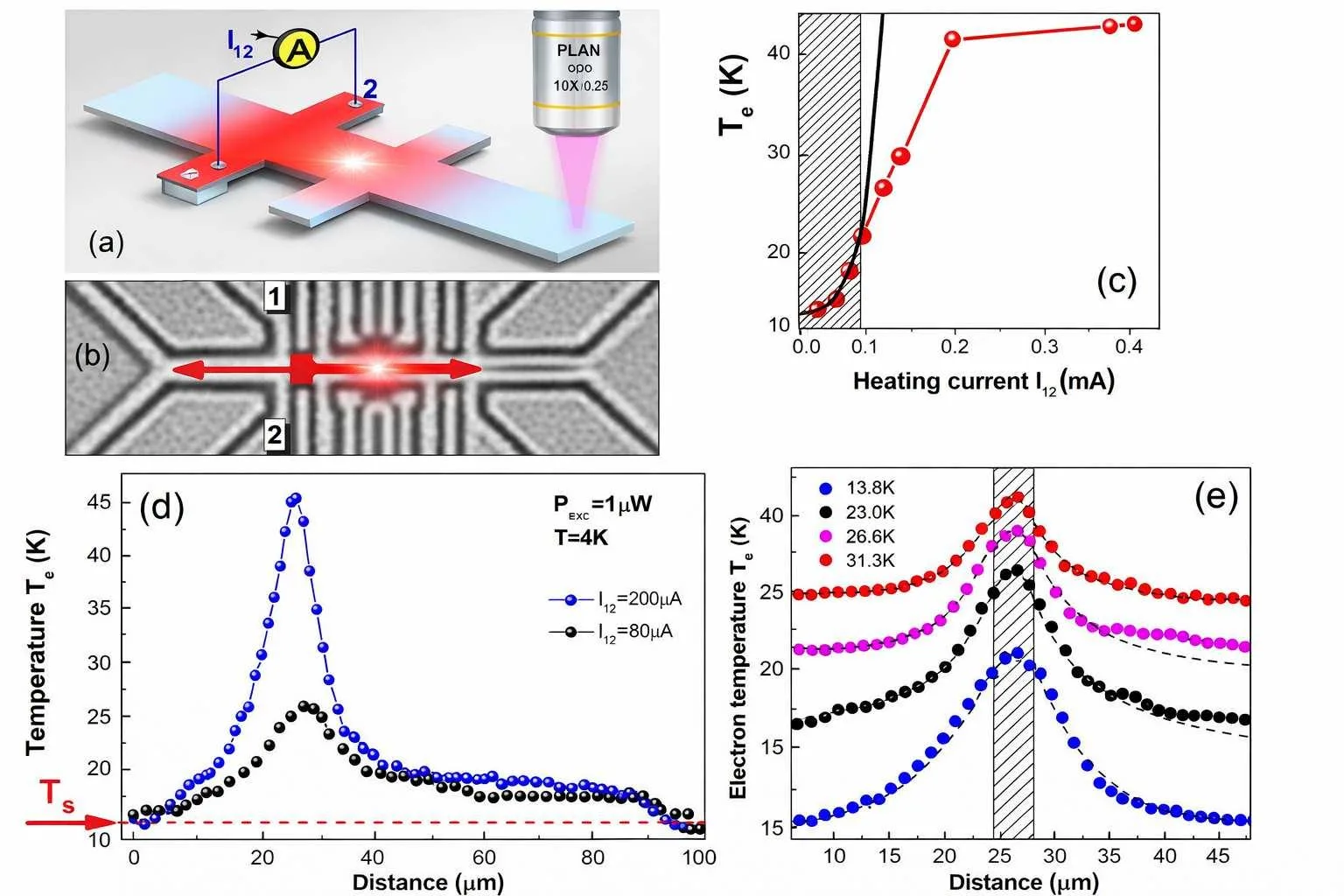
In a thin semiconductor channel, electrons behave not like lone runners but like a crowd at rush hour. They constantly bump into each other, and these collisions determine how easily heat and electric current pass through the material. Usually, these two flows go hand in hand: a good electrical conductor is also a good heat conductor. This rule is known as the Wiedemann–Franz law.
But in tiny devices, where dimensions are comparable to the electron mean free path, everything changes. The scientists heated a section of the channel with a laser and measured the temperature with micrometer precision by observing the material's glow. It turned out that thermal conductivity grows faster with temperature than electrical conductivity. This means that the ratio of these quantities, the Lorenz number, is no longer constant. The law is violated.
The effect is especially pronounced when the channel narrows. A constriction forces electrons to collide more often, and the heat flow starts to "lag behind" the electric current. This behavior was predicted by theorists for the regime where electrons interact like a fluid, but this is the first time it has been observed in a real experiment on gallium arsenide.
This discovery is important for future microelectronics. As transistors get even smaller, heat dissipation becomes critical. Understanding how heat and current diverge in narrow channels will help design chips that do not overheat.
In gallium arsenide, electrons can move faster than in silicon, which is why it is used in high-frequency devices — for example, in signal amplifiers for satellite dishes.