How Comets Revealed Dark Matter's Secret express
The Oort Cloud is a swarm of trillions of icy boulders at the very edge of the Solar System. They are nearly motionless until something disturbs them. Vera Rubin proved back in the 1970s that galaxies spin far too fast — as if wrapped in an invisible framework. This hidden mass was named dark matter. If it's made of ancient black holes roaming our Milky Way, then they, passing through the cloud, scatter comets like a bowling ball knocking down pins.
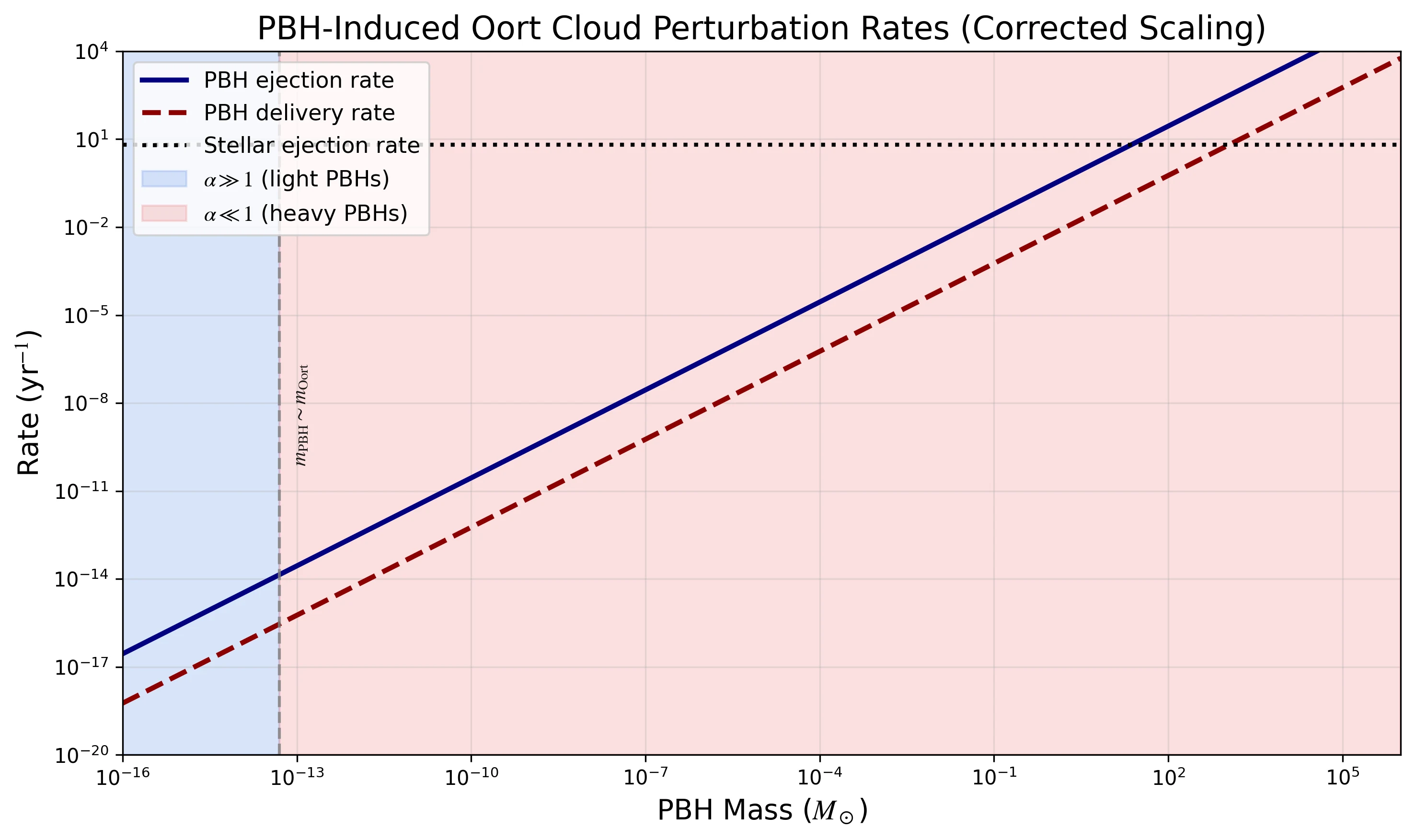
But astronomers don't see that many comets coming from the Oort Cloud. So massive black holes are only a tiny fraction of dark matter, no more than 0.2%. On the other hand, lightweight black holes with the mass of an asteroid leave almost no trace — they slip through the cloud unnoticed. So the invisible world might be teeming with such minnows, and we have no idea.
Original abstract
as written by the authors arXiv:2604.22961
Planetary systems can act as sensitive gravitational detectors for dark matter. We investigate the gravitational scattering of Oort cloud objects by primordial black holes (PBHs) as a potential component of the Galactic dark matter halo. Calculating the rates at which PBH encounters eject objects from the Oort cloud or inject them into Earth crossing orbits, we find a linear scaling $$\Gamma \propto m_{\mathrm{PBH}}$$ for $$m_{\mathrm{PBH}} \gtrsim 10^{-10} M_\odot$$. For $$m_{\mathrm{PBH}} \sim 10^3 M_\odot$$, PBHs constituting all local dark matter would eject $$\sim1.3\times10^{12}$$ objects over the Solar System's lifetime, comparable to the total Oort cloud population and inject $$\sim2.6\times10^{10}$$ objects into Earth-crossing orbits. Comparing these rates with observational constraints from long period comet fluxes and terrestrial impact records, we derive upper limits on the PBH dark matter fraction $$f_{\mathrm{PBH}}$$. Our most stringent constraints exclude $$f_{\mathrm{PBH}}=1$$ for $$10^2 M_\odot \lesssim m_{\mathrm{PBH}} \lesssim 10^5 M_\odot$$, with $$f_{\mathrm{PBH}} \lesssim 0.002$$ at $$m_{\mathrm{PBH}} = 10^3 M_\odot$$. For the asteroid mass window ($$10^{17}$$-$$10^{23}$$ g), scattering rates are far too low to produce observable effects. These Solar System-based constraints complement existing astrophysical probes and demonstrate that planetary systems can serve as sensitive gravitational detectors for compact dark matter.
The outer edge of the Oort Cloud lies about one light-year from the Sun — a quarter of the distance to the nearest star, Proxima Centauri.