How Oort Cloud Comets Constrained the Share of Massive Black Holes in Dark Matter express
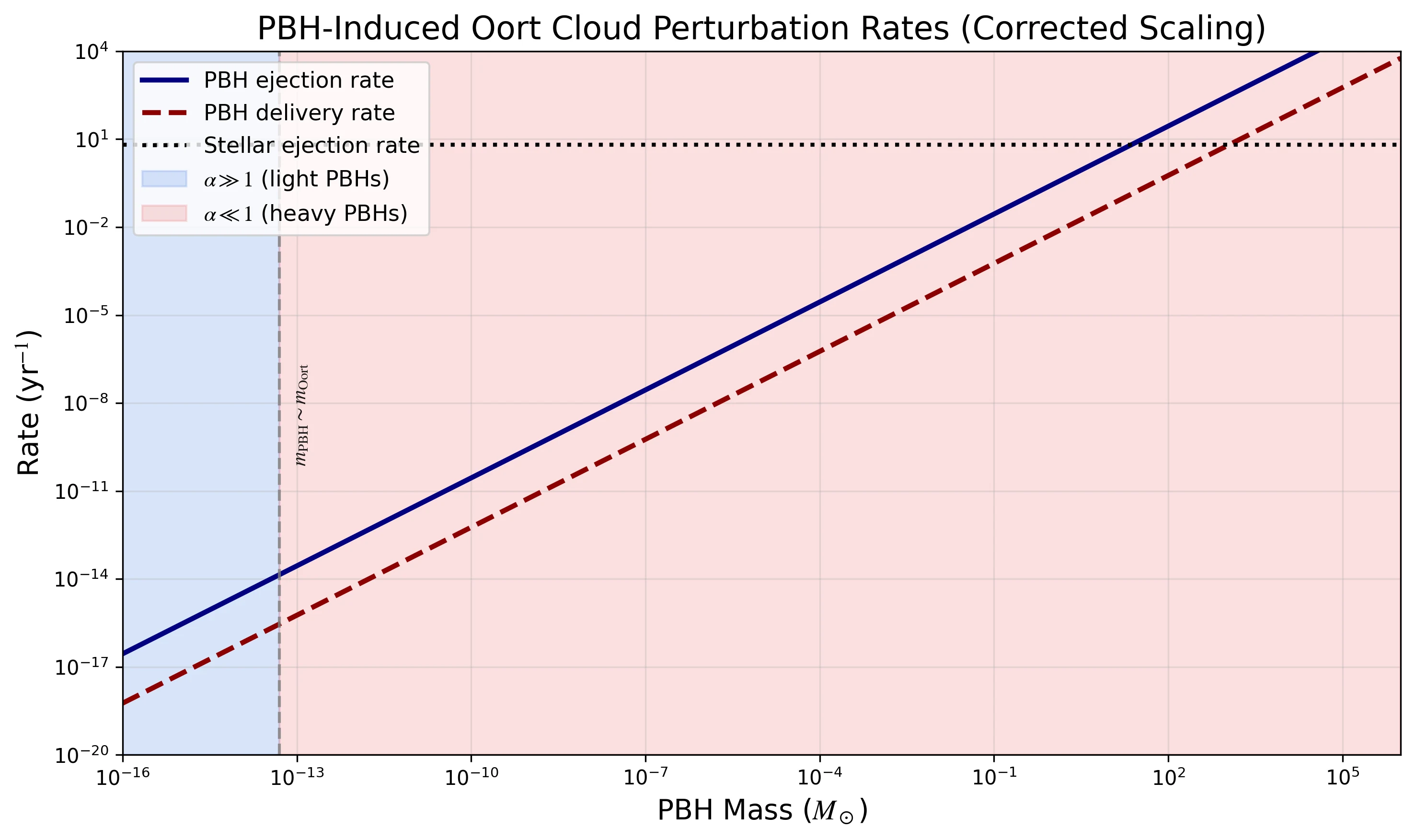
The Oort Cloud is a spherical swarm of trillions of icy bodies at the very edge of the Solar System, about a light-year from the Sun. These objects are almost motionless relative to one another until some gravitational disturbance breaks their calm. Vera Rubin showed back in the 1970s, by analyzing galaxy rotation curves, that stars at the periphery move too fast, as if an invisible gravitational scaffold holds galaxies together. This hidden mass was dubbed dark matter — a form of matter that emits no electromagnetic radiation and reveals itself only through gravity. One hypothesis suggests that dark matter could consist of primordial black holes — objects with gravity so strong that even light cannot escape their bounds, wandering through our Milky Way. If such black holes pass through the Oort Cloud, they act like bowling balls, gravitationally knocking out comet pins and sending them into the inner Solar System.
However, when astronomers observe the actual influx of long-period comets, they do not see such an abundance of objects coming from the Oort Cloud. This discrepancy between expected and observed comet counts imposes a strict limit: massive black holes, those comparable to or heavier than stars, can make up only a tiny fraction of dark matter, no more than 0.2%. In other words, if dark matter were mostly such heavy objects, the Oort Cloud would have been depleted long ago, and we would see far more comets. Light black holes, on the other hand, with masses on the order of an asteroid, leave almost no observable trace: their gravitational influence is too weak to noticeably disturb comet orbits, so they pass through the cloud unnoticed. Thus, the invisible world could teem with such tiny objects without our suspecting it — a conclusion drawn from the absence of an excess of comets, not from direct detection.
The outer edge of the Oort Cloud lies about one light-year from the Sun — a quarter of the distance to the nearest star, Proxima Centauri.