Magnetic Imprint in the Young Universe express
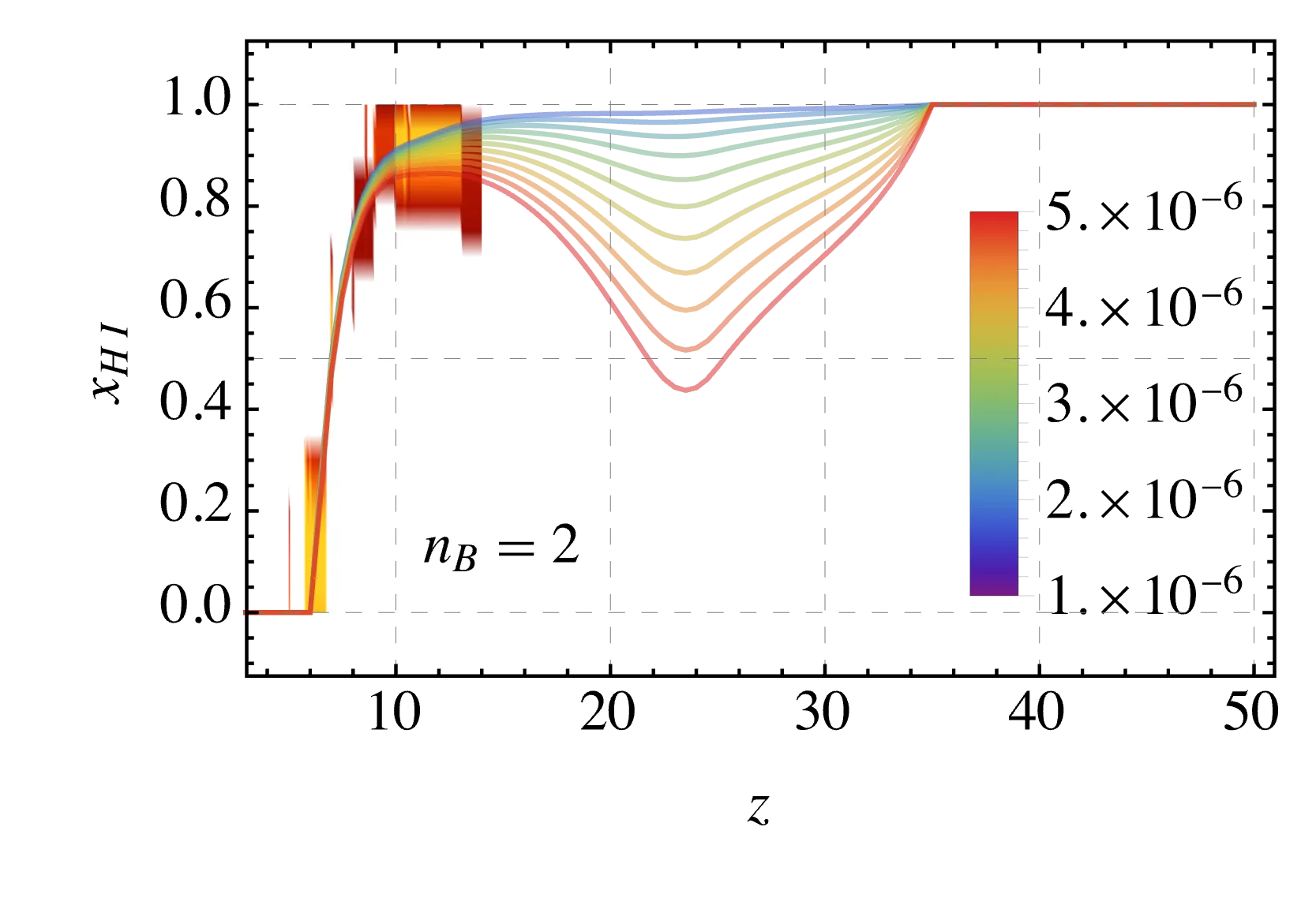
A vast, dark cloud of gas stretched across the young universe. Inside it, like invisible fingers, magnetic field lines left over from the very birth of the cosmos threaded through. These fields act on charged particles, pushing them together, like a gentle breeze gathering fallen leaves into piles. As a result, gas collapses into clumps faster, and from those clumps galaxies eventually grow.
Astronomers have long suspected that such a primordial magnetic field (arising in the first moments after the Big Bang) could have sped up the appearance of small galaxies. But measuring it directly is impossible: it's too far away and too weak. The authors of the new study found a clever workaround: they looked at how the field affects the epoch of reionization — the time when the first stars lit up and their ultraviolet light began to "ignite" neutral hydrogen, making it transparent.
By comparing calculations with data from the Planck satellite (which measures the cosmic microwave background — ancient light that reached us 380,000 years after the Big Bang), the scientists set a strict limit. The magnetic field turned out to be weaker than 0.27 nanogauss for one spectral type and 0.18 nanogauss for another. That's billions of times weaker than a refrigerator magnet, yet its influence on galaxy formation is enormous.
So the light of the first stars, caught in the web of the cosmic background, told us about the invisible magnetic threads that have been weaving through the universe since its infancy.
Original abstract
as written by the authors arXiv:2604.24835
Primordial magnetic fields (PMFs) enhance small-scale structure formation through the Lorentz force acting on baryons, boosting the abundance of low-mass halos and their hosted galaxies. We show that the reionisation history calibrated with the UV luminosity function (UVLF) provides stringent bounds: strong PMFs induce a characteristic double reionisation at $$z \approx 24$$ that is incompatible with CMB measurements of the optical depth, yielding $$\sqrt{\left\langle B^2 \right\rangle} < 0.27\,{\rm nG}$$ and $$< 0.18\,{\rm nG}$$ for $$n_B = -2$$ and $$n_B = 2$$ respectively at $$95\%\,{\rm CL}$$ using Planck priors on $$\tau$$. This establishes early galaxy observables as among the most sensitive probes of PMFs in Gaussian, non-helical scenarios.
A nanogauss is one billionth of a gauss. For comparison: Earth's magnetic field at the surface is about 0.5 gauss, and a typical refrigerator magnet is roughly 50 gauss. That means the primordial field is tens of billions of times weaker than the magnet we use to hold up notes.
In Carl Sagan's novel "Contact," the alien signal contains complex modulation reminiscent of primordial gravitational waves. The magnetic fields of the early universe are another whisper from the Big Bang that we are learning to hear.