The cosmic microwave background (CMB) is the faint, uniform microwave radiation that permeates the universe, a relic of the hot, dense state shortly after the Big Bang. It was emitted about 380,000 years after the Big Bang when the universe cooled enough for protons and electrons to combine into neutral hydrogen, allowing photons to travel freely. The CMB provides a snapshot of the universe's infancy and is a cornerstone of modern cosmology.
History
The CMB was predicted by George Gamow and colleagues in the 1940s and accidentally discovered in 1965 by Arno Penzias and Robert Wilson, who won the Nobel Prize in Physics in 1978. Subsequent satellite missions — COBE, WMAP, and Planck — mapped it with increasing precision.
How it works
The CMB is a nearly perfect blackbody spectrum at 2.725 K, with tiny temperature fluctuations (about one part in 100,000) that reflect density variations in the early universe. These fluctuations, seeded by quantum fluctuations during inflation, grew over time to form galaxies and clusters. By mapping these anisotropies, cosmologists can extract parameters like the universe's age, composition, and curvature.
In practice
CMB measurements constrain cosmological models, including dark energy and dark matter fractions. They also guide searches for primordial gravitational waves and the physics of the early universe.
Fun fact
The CMB is so uniform that its temperature varies by less than 0.001 K across the sky, yet those tiny variations are the seeds of all cosmic structure we see today.
An accountant tallies up all the factories, warehouses, and shops, but the balance doesn't add up — half the inventory seems to have evaporated. That's roughly how astronomers have spent decades searching for ordinary matter in the present-day Universe.
Boiling milk develops a trembling skin. By watching its movements, you can guess the strength of the fire beneath the pot and the fat content of the milk. In a similar way, astrophysicists peer into the ancient microwave radiation — the oldest light that has reached us from an era when the universe was only 380,000 years old.
The universe is a vast, dark ocean. We see only the glowing foam on its surface — stars and galaxies. But hidden in the depths are two invisible forces: dark matter, which with its gravity keeps galaxies from flying apart, and dark energy, which, on the contrary, pushes space itself apart, making the universe expand faster and faster.
A thrown stone sends ripples across water. A gravitational wave is the same kind of ripple, but in spacetime. It is produced, for example, by the merger of two black holes. In classical physics, this ripple is eternal: once created, it travels through the Universe without fading.
380 thousand years after the Big Bang, the universe cooled enough for light to decouple from plasma. That cosmic microwave background still pervades space, like the first chord of a symphony, the echo of a fiery beginning.
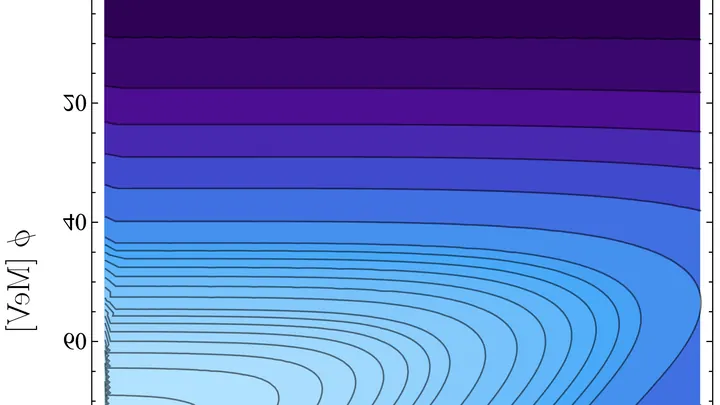
The universe cooled like a giant bathtub after a hot start. At 400 000 years after the Big Bang, hydrogen was ready to recombine — protons capturing electrons to become neutral atoms. But somewhere in this dark water, a tap kept dripping.
The mystery of antimatter in space has long puzzled astrophysicists: where do positrons come from, settling like snowflakes into our detectors? The answer might lurk in the most ubiquitous gamma-ray background. The Universe is soaked in diffuse light — the cosmic photon background (CPB).
The birth of the universe resembles not an explosion, but a traffic jam. At first, a tiny fraction of a second after the Big Bang, space expanded sluggishly, like cars stuck in gridlock. Then came a sharp surge — accelerated expansion, which cosmologists call inflation.
A dust storm that has raged for millions of years is not in a desert but between the stars. There, clouds of tenuous gas drift, threaded by magnetic fields. These fields align dust grains like compass needles along field lines. When such dust emits, its light becomes polarized: it oscillates in a single plane, like a rope shaken only up and down.
A huge pond, with ripples spreading from two heavy stones circling each other. The stones draw closer, the ripples become more frequent and stronger, and soon the stones will collide. Gravitational waves are like those ripples, but not on water — in the very fabric of spacetime.
When the first stars ignited, their ultraviolet light began stripping electrons from hydrogen atoms. The universe transformed from a neutral fog into transparent plasma. This process, cosmic reionization, proceeded unevenly: slowly at first, like a fire catching in damp wood, then faster as the flames spread through dry tinder.
After the Big Bang, the Universe simmered as a fiery 'soup' of fundamental particles. Expanding and cooling, the soup gradually 'solidified' into protons and neutrons — much like crystallization. Had the solidifying been instantaneous, like a lake cracking in a deep freeze, the fabric of spacetime would have convulsed.
Radio waves passing through magnetized gas have their polarization slightly rotated, like a compass needle deflecting near a magnet. This rotation, called the Faraday effect, revealed the invisible environment around the supermassive black hole in galaxy NGC 1275.
When a massive star runs out of fuel, its core collapses and a shock wave races outward. But even before the star tears apart, particles that barely interact with ordinary matter may be born in its depths. If they decay into light, that energy leaks into the dense gas around the star.
This gas, like a blanket, wraps the star.
Light born at the moment of the Big Bang has traveled to us for almost 14 billion years. But along the way, it passed through the gravitational fields of galaxies and clumps of dark matter, which bent its rays. To an observer, this looks like an image stretched and smudged by an old window pane.
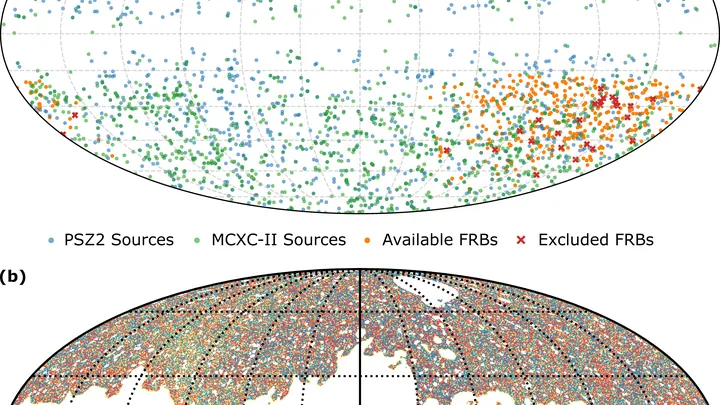
Fast radio bursts are instantaneous radio flashes from deep space. In a thousandth of a second they release as much energy as the Sun emits in a month. One such burst, repeating, allowed scientists to peer into the epicenter of a recent stellar explosion.
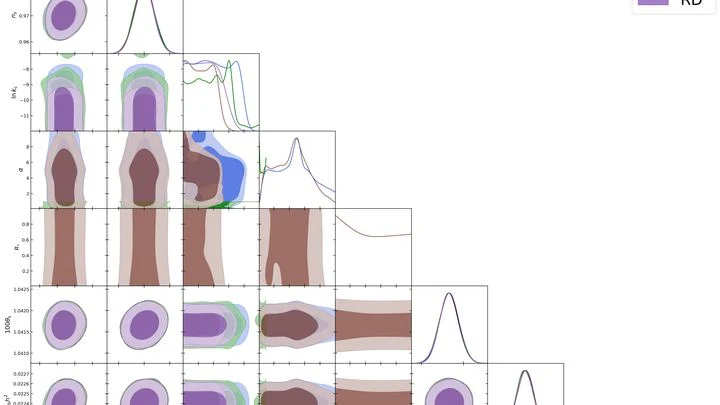
The universe is like an ocean, where waves of different lengths roll onto the shore. The longest waves are the giant fluctuations in the distribution of matter that we see in the cosmic microwave background. Standard theory says such waves should exist on all scales.
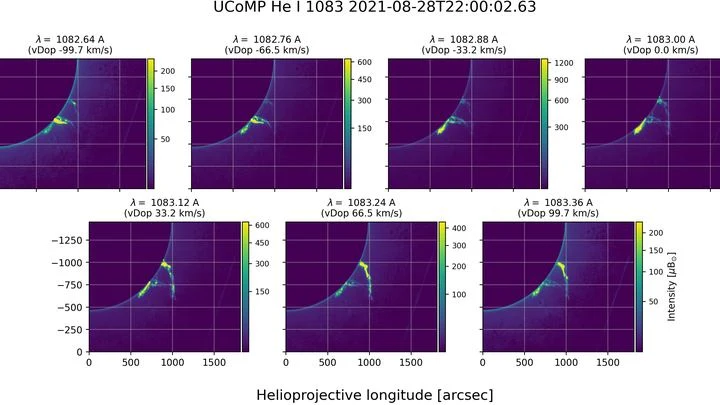
The Sun occasionally hurls enormous clouds of plasma into space — coronal mass ejections. Often tangled within these clouds are prominences: cooler, denser clumps of material. These contain plenty of neutral atoms that shine brightly in specific spectral lines.
The Einstein Probe space telescope detected a celestial storm: after a short (0.4-second) gamma-ray burst — a cosmic lightning bolt — came a long roll of X-ray thunder. It lasted nearly 10 minutes. This is the first direct proof that such explosions leave a lingering X-ray afterglow.
When a massive star exhausts its thermonuclear fuel, its core collapses and the outer layers are blown off in a colossal explosion — a supernova (a term coined by Fritz Zwicky while studying these catastrophes).
The Universe after the Big Bang was almost perfectly homogeneous. Almost, because tiny density perturbations stretched by inflation became the seeds of galaxies. But what if these same perturbations could give birth not only to stars but also to black holes?
The night of March 4, 2024. The MeerKAT radio telescope in South Africa catches a millisecond pulse: a fast radio burst coming from a depth of 17.4 gigaparsecs. This is light that traveled 10.5 billion years to reach Earth.