Why Gravitational Waves Whisper About a Hundred Mega-Electronvolts express
In a vast hall, a hundred tuning forks are set out. Each one is a pulsar — an ultra-dense stellar remnant spinning at a furious rate, sending out radio pulses more precisely than any clock. When a low-frequency sound wave sweeps through the hall, all the tuning forks start to go slightly out of tune at the same moment. That's exactly how pulsars work as detectors: they notice spacetime being gently squeezed and stretched by a passing gravitational wave. Recently, such waves with frequencies in the nanohertz range (one period over years) have been caught, and now scientists are puzzling over what caused them.
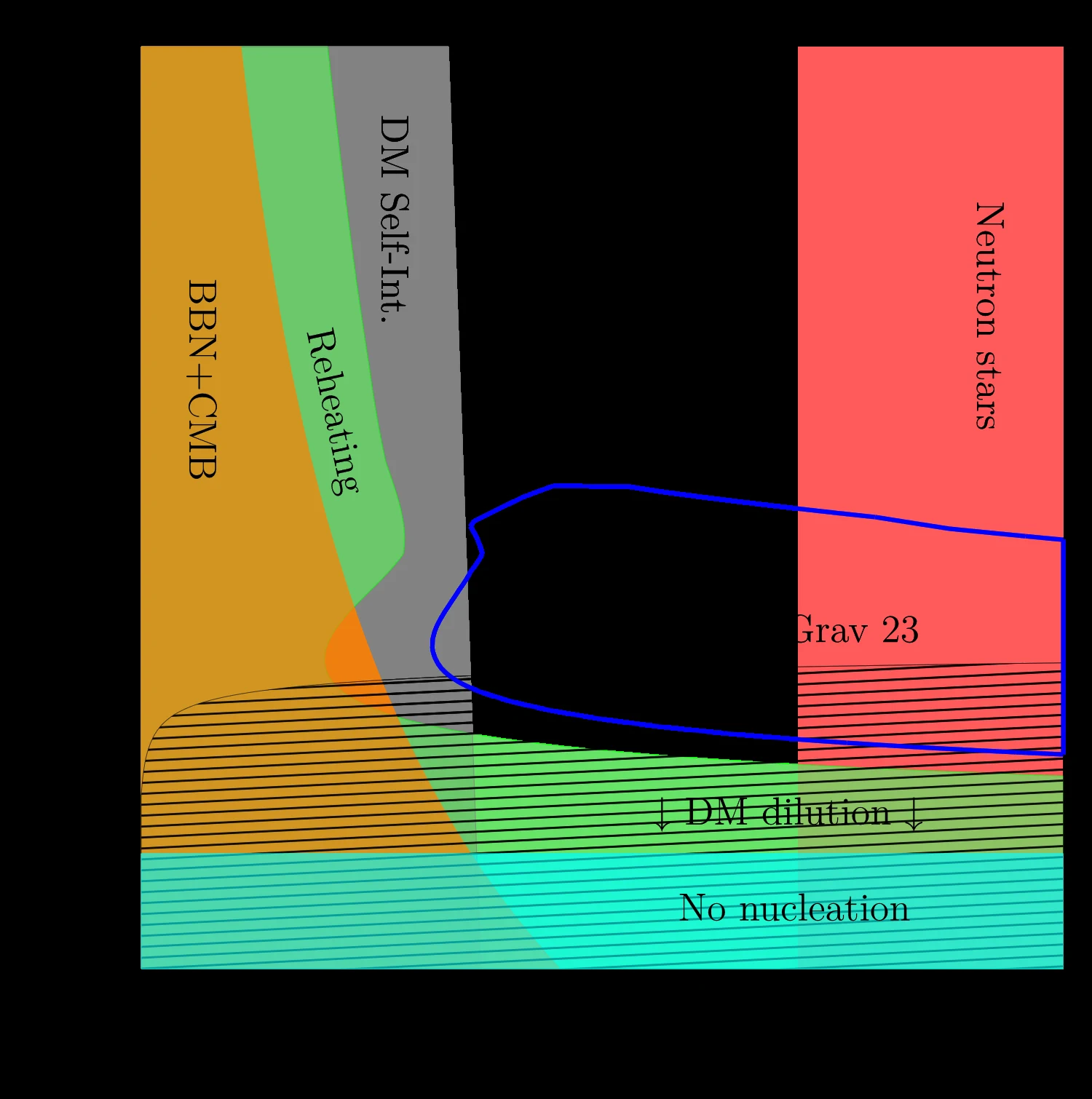
One guess: in the young universe, when it was about ten microseconds old, a phase transition occurred, like water turning to ice, but on a cosmic scale. At a temperature of about a hundred mega-electronvolts (ten thousand times hotter than the Sun's core), bubbles of the new phase boiled, collided, and shook the fabric of spacetime. The authors show that this transition is not accidental: it arises in a model where dark matter and ordinary neutrons exchange particles, like two pendulums connected by a spring. These oscillations give rise to the very excess of matter that makes up everything we are.
The model doesn't just explain the waves. It predicts that dark matter particles should repel each other slightly — almost at the limit allowed by observations. It also introduces new neutral particles lighter than a hundred mega-electronvolts, which could show up in accelerators as missing energy or alter the pattern of neutron decay. Thus, gravitational waves connect the origin of matter, the properties of neutron stars, and the search for new physics in the lab.
The hall with its pulsar tuning forks now does more than register a distant hum. It can tell us why there is matter in the universe at all and how the most elusive substance behaves.
Nanohertz gravitational waves stretch space so weakly that the distance from Earth to the Sun changes by the thickness of a hair over several years, and pulsars can detect that.
In Robert Forward's novel Dragon's Egg, creatures live on a neutron star, their lives dependent on its monstrous gravity; if the star were to contract due to dark matter, their world would be doomed.