Magnetic Field Twists Scorching Matter express
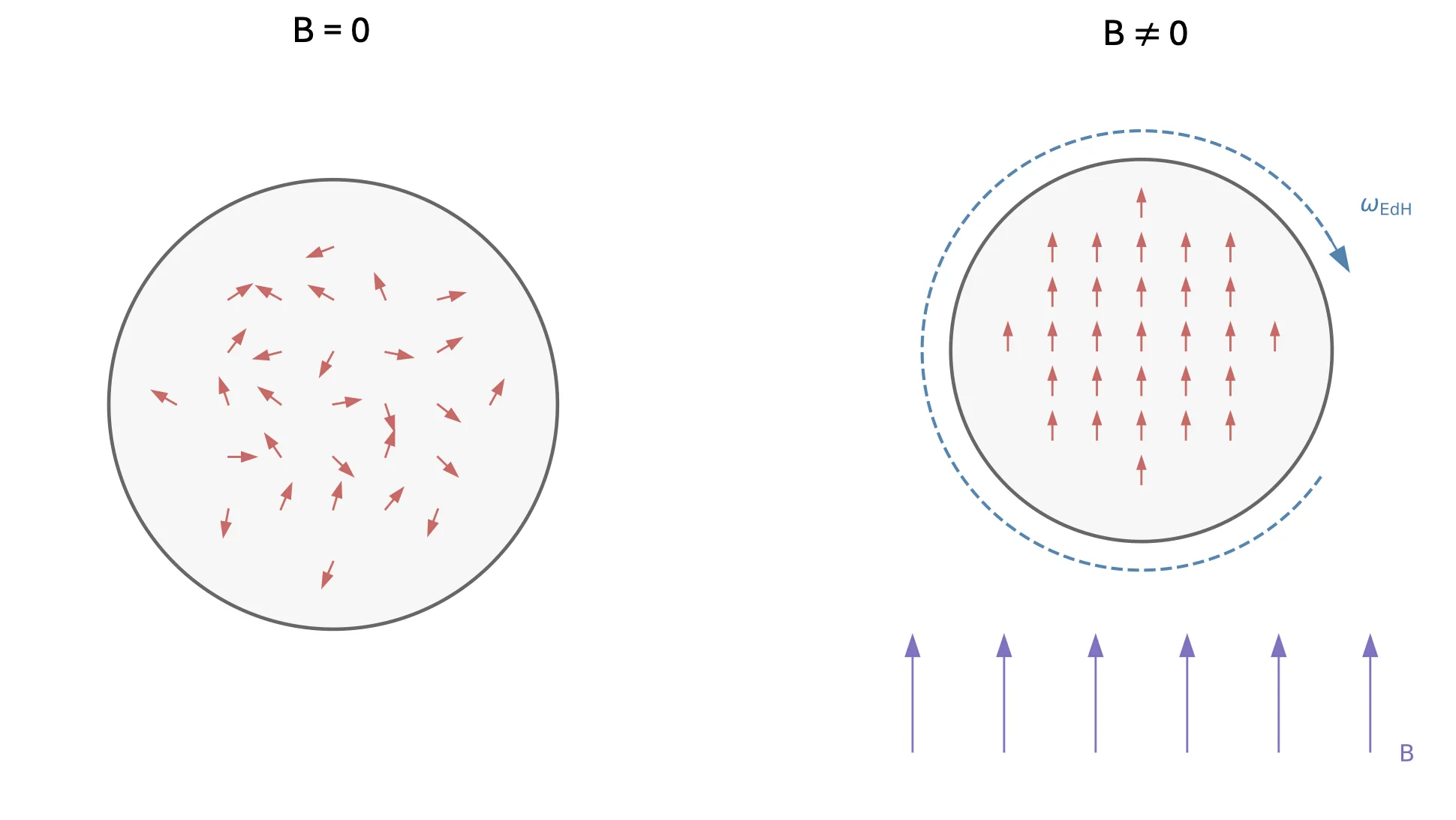
A juggler tosses clubs while sitting on a spinning chair. If he starts spinning the clubs all in one direction, the chair will rotate the opposite way — otherwise, the conservation of angular momentum would be violated. That's roughly how the Einstein–de Haas effect works: in a piece of iron, a magnetic field aligns microscopic spin magnets, and the whole piece turns slightly.
Physicists have now carried this idea into the world of quark-gluon plasma — the scorching matter that is born for a fleeting instant in heavy-ion collisions. Even a residual magnetic field, after the initial flash has died down, can align particle spins. And the compensation for this alignment makes the entire fireball rotate. The resulting rotation speed is comparable to what is measured from the polarization of escaping hyperons.
Previously, it was thought that the swirl arises only from off-center nuclear impacts, like water swirling into a vortex when you stir it with a spoon. Now it turns out that hot nuclear matter can spin itself up without any initial kick. It becomes a self-spinning magnetic fluid — a state in which quantum spins and collective motion are intertwined in a single dance. Such a mechanism could have operated in the early Universe, where magnetic fields and hot plasma also coexisted.
Original abstract
as written by the authors arXiv:2605.03093
In this study, we report the first identification of the Einstein-de Haas (EdH) effect in the QCD matter. The EdH effect is a fundamental magnetomechanical coupling wherein magnetic-field-induced spin alignment generates a compensating collective rotation to conserve the total angular momentum. Using an equilibrium hadron gas under an external magnetic field, we show that even remnant magnetic fields at the freeze-out produce induced rotations ($$\omega_{\mathrm{EdH}}$$) comparable to typical estimates of fluid vorticity in heavy-ion collisions as inferred from final-state hyperon polarization. This rotation emerges from the magnetic field alone, without any initial vorticity as input. The Einstein-de Haas effect thus establishes hot QCD matter as a self-vortical magnetofluid, where collective rotation can be generated purely from spin alignment, and identifies spin-rotation coupling as a potentially important, previously overlooked component of angular momentum dynamics in relativistic nuclear collisions.
The Einstein–de Haas effect was discovered in 1915: Einstein and de Haas suspended an iron cylinder from a thread and switched on a magnetic field — the cylinder indeed rotated, confirming the link between spin and rotation.
In Robert Wilson's novel 'Spin', characters control the rotation of entire planets by manipulating particle spins — vaguely reminiscent of the idea of self-spinning matter.