Why Early Galaxies Shine So Bright: The Secret of Transparent Dust express
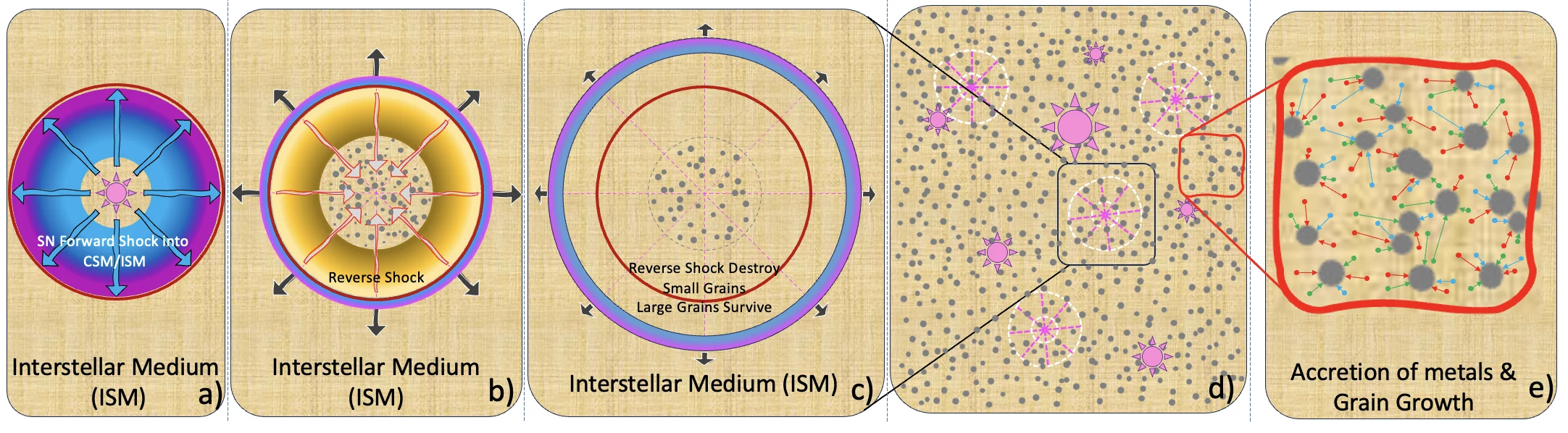
The JWST telescope has spotted a multitude of bright galaxies in the young universe. Their ultraviolet light was barely absorbed by cosmic dust — defying previous expectations. The secret is that in the cosmic dawn, dust was born in supernova explosions and was as transparent as a freshly cleaned window pane.
As galaxies age, dust grains clump together and grow, turning that clear screen into heavy curtains that smother light. That’s why ancient galaxies blaze so intensely — their light traveled freely through unclouded dust. Over time, the same dust becomes opaque, perfectly explaining observations without needing exotic theories.
Original abstract
as written by the authors arXiv:2605.09829
Recent JWST observations suggest that galaxies at z > 9 may be dominated by low-opacity SNe-produced dust before efficient ISM grain growth is established. This transition in dust origin and opacity could explain both the prevalence of galaxies with extremely low dust attenuation and the excess of UV-bright galaxies relative to most pre-JWST predictions. We investigate whether this transition, combined with evolving star-formation efficiency, can reproduce these observed properties. We develop a physically motivated attenuation framework combining (i) extinction laws for reverse-shock-processed SNe dust, (ii) metallicity- and dust-to-metal-dependent opacity scalings, and (iii) porous radiative-transfer geometries allowing partial UV-photon leakage. Unlike outflow-driven scenarios requiring large-scale gas evacuation, our approach preserves gas reservoirs while reducing effective UV opacity through dust composition and geometry. We introduce extinction-based, gas-based, and hybrid attenuation prescriptions linking SNe-dominated and ISM grain-growth dust regimes. We find that the observed A_FUV-M_star relation at z > 9 is best reproduced for an intrinsic FUV dust opacity kappa_UV(dust)=10^3 - 10^4 cm2/g, characteristic of low-opacity SNe dust, naturally producing very low attenuation even in gas-rich galaxies. This regime reproduces galaxies with extremely low dust attenuation (GELDAs), which dominate observed samples at z > 9. Applied to intrinsic UV luminosity function models, our SNe-dominated and hybrid prescriptions mainly suppress the brightest galaxies, bringing predictions into agreement with JWST measurements without requiring extreme star-formation efficiencies or dust-free interstellar media. Our results suggest that the UV-bright galaxy excess at z > 9 reflects a transition in dust origin and opacity during the earliest phases of galaxy evolution.
Dust grains from supernovae are hundreds of times smaller than UV waves: light slips through them like water through a coarse sieve, meeting no resistance.