Simple

Why Early Galaxies Shine So Bright: The Secret of Transparent Dust ⚡ экспресс

Original: "Stardust Galaxies at z>9: A Dust-Origin Transition Behind the Excess of UV-Bright Galaxies"
arXiv:2605.09829 · 2026-05-11 · CC BY 4.0 · ⏱ 1 min · Galaxies Cosmology
The JWST telescope revealed that dust in ancient galaxies barely blocks light — a discovery that reshapes our understanding of cosmic evolution.
Abstract

Scientists have figured out why the most distant galaxies seen by the James Webb Telescope appear so dazzling in ultraviolet. The secret lies in their stardust: after the first stars exploded, that dust was still light and clear, like morning mist that didn’t yet know how to truly hide the light. Could this transparency have opened a window to the universe’s infancy?

Links in the knowledge graph 1

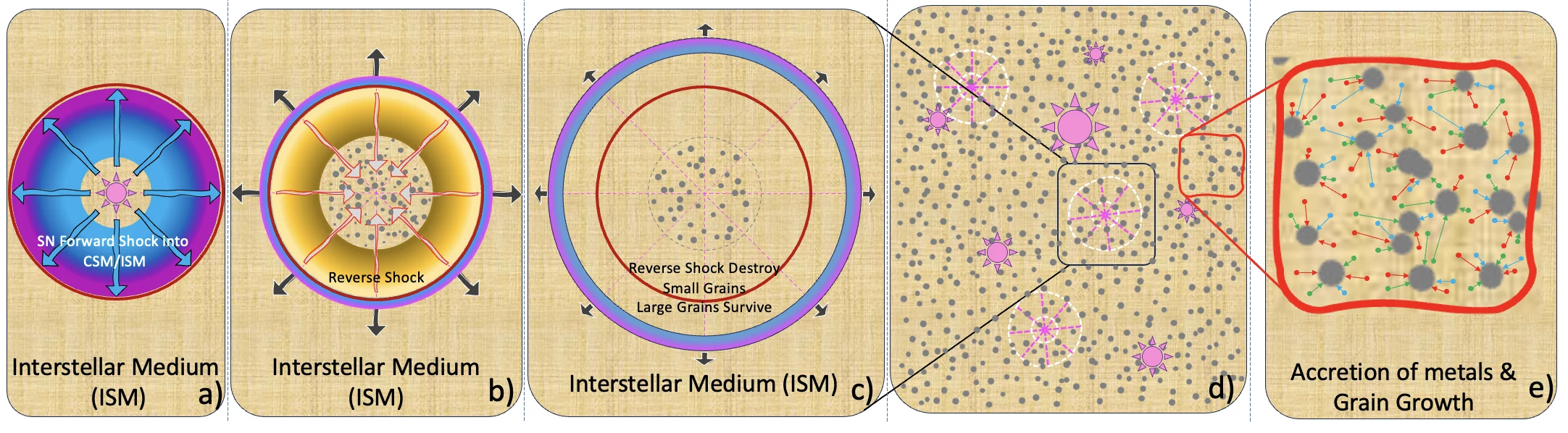
The JWST telescope has spotted a multitude of bright galaxies in the young universe. Their ultraviolet light was barely absorbed by cosmic dust — defying previous expectations. The secret is that in the cosmic dawn, dust was born in supernova explosions and was as transparent as a freshly cleaned window pane.

As galaxies age, dust grains clump together and grow, turning that clear screen into heavy curtains that smother light. That’s why ancient galaxies blaze so intensely — their light traveled freely through unclouded dust. Over time, the same dust becomes opaque, perfectly explaining observations without needing exotic theories.

🎯 Dust grains from supernovae are hundreds of times smaller than UV waves: light slips through them like water through a coarse sieve, meeting no resistance.

Scientists
Albert EinsteinFritz ZwickyVera RubinSubrahmanyan ChandrasekharEnrico FermiJames Jeans
Tags
cosmic dust supernova galaxy JWST
Laws
gravitational lensingvirial theoremChandrasekhar limitFermi accelerationJeans instabilitylaw of conservation of momentum
Original: arXiv:2605.09829 · CC BY 4.0 · bridge42worlds