Cosmic Mixer: How Black Holes Give Birth to Paired Gravitational Waves ✛ ✎ ✦
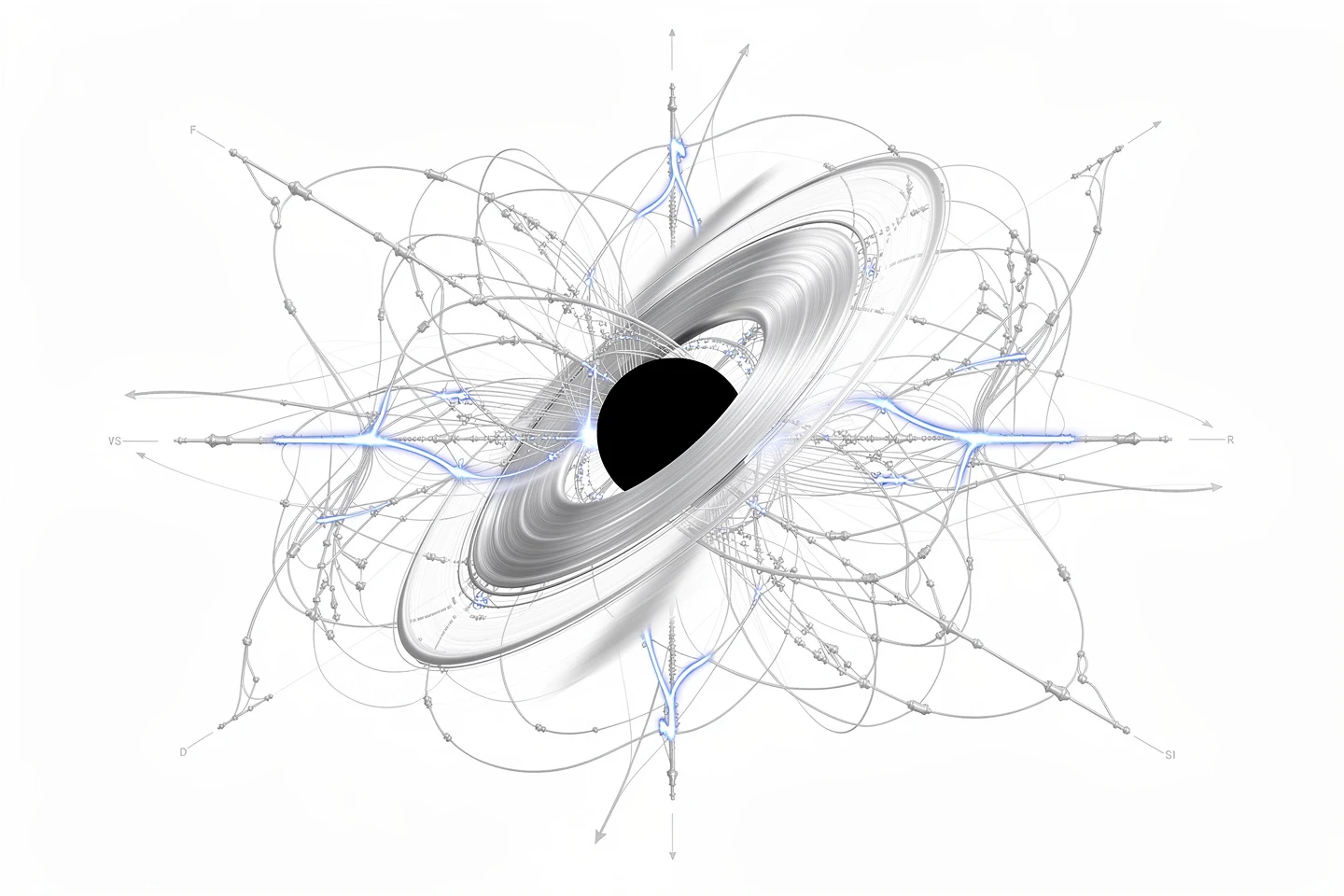
A black hole surrounded by a cloud of invisible dark matter acts like a cosmic mixer. Its rapid rotation, like a whisk, whips up this cloud, forcing it to emit gravitational waves — ripples in space itself. The idea for this mechanism was proposed by Roger Penrose.
But here's the twist: these waves aren't born chaotically, but in ordered pairs, like drops of batter always flying off in opposite directions. Frank Wilczek and colleagues discovered that the black hole squeezes the radiation so that gravity particles (entangled gravitons) appear by the millions at a time, boosting the signal to a detectable level.
If future detectors like an upgraded LIGO (built with the involvement of Rainer Weiss) catch this hum, we will have the first direct proof that gravity obeys quantum laws. And the clouds themselves may consist of axions — particles predicted by string theory that make up dark matter.
In a single burst, a black hole creates up to ten million gravitons — individually unnoticeable, but their coordinated appearance produces a detectable whisper of space.