Gravitons Under Pressure: How Black Holes Create Quantum-Squeezed Radiation ✛ ✎ ✦
Context
The problem of quantum gravity is one of the greatest mysteries in physics. Any effects of spacetime quantization are suppressed by a factor (E/$M_{Pl}$)^n, where $M_{Pl}$ ~ 2.4×$10^{18}$ GeV is the Planck mass. For the detector energies of LIGO, built by Rainer Weiss and colleagues, this suppression is around $10^{-38}$, making direct observation of individual gravitons—quanta of gravitational waves—virtually impossible. Even with exceptional precision in recording gravitational waves, their quantum nature remains hidden unless an amplification mechanism is found. Historically, detecting single gravitons was considered unfeasible due to Planck-scale limitations. However, as shown by Frank Wilczek and his collaborators, collective quantum states like squeezed graviton states can amplify quantum effects to a macroscopic level. This idea transplants methods from quantum optics into the astrophysics of black holes and dark matter.
Methods
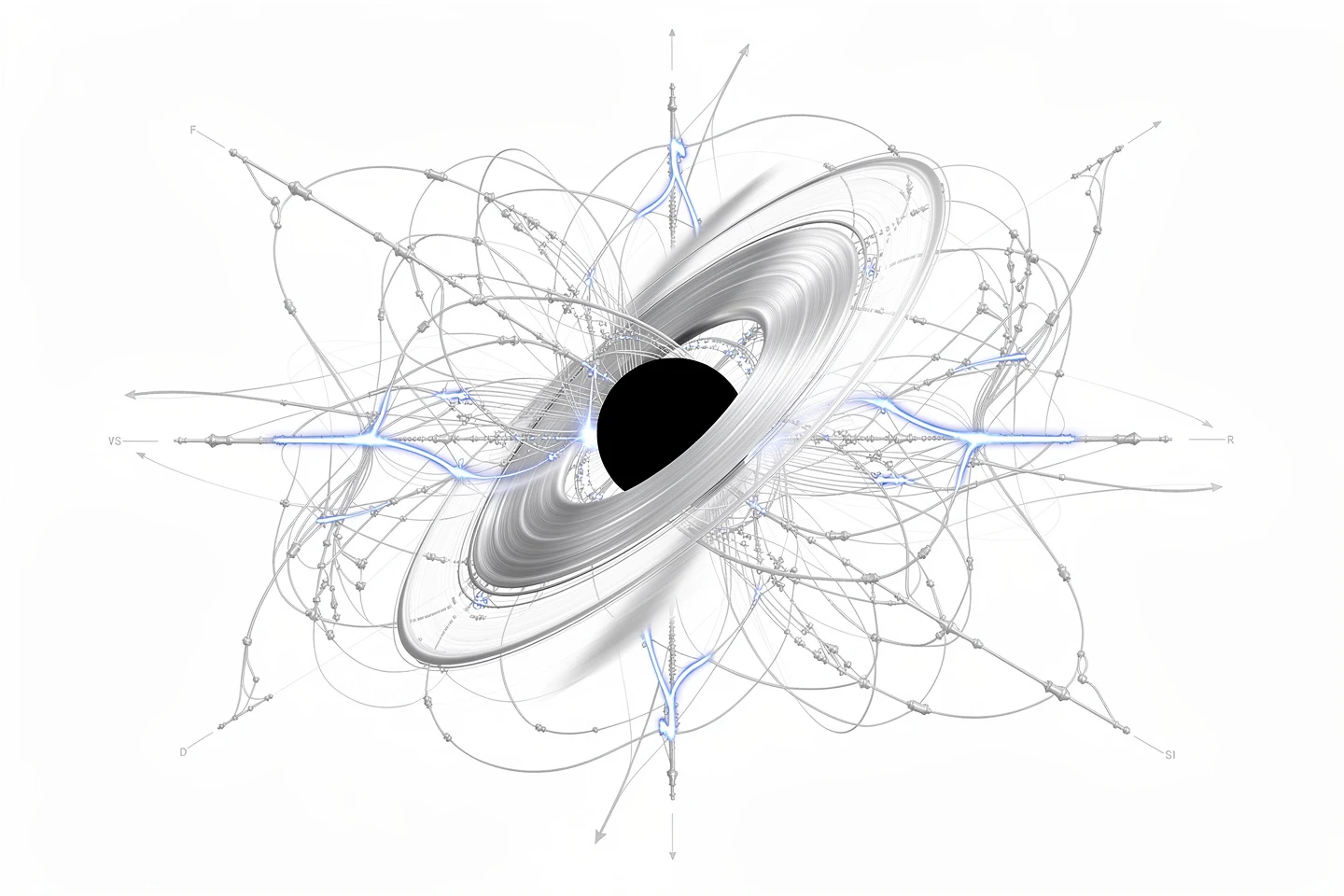
The mechanism relies on superradiance, first described in the works of Roger Penrose, which occurs near spinning black holes (Kerr). In the presence of an ultralight scalar field—a axion-like particle, a candidate for dark matter—a condensate with a macroscopically large occupation number forms around the horizon. Within effective field theory, gravity is treated as a quantum field; its nonlinearities give rise to higher-order graviton interactions. The axion condensate acts as a 'pump', analogous to a laser pump, while gravitational interactions serve as the nonlinear medium. The dominant process is a gravitational analogue of spontaneous four-wave mixing (SFWM), where two condensate axions convert into an entangled pair of gravitons. An additional Chern-Simons term in the action (typical of string theories and parity-violating) allows a single axion to decay into a graviton pair (analogue of parametric down-conversion). Both processes are enhanced by the enormous cloud lifetime (T~$10^{16}$/$μ_b$) and the number of axions ($N_b$), leading to extreme multimode squeezing of gravitational radiation.
Results
Calculations show that the effective squeezing parameter r reaches values of 60–70, corresponding to a mean number of gravitons ⟨N⟩ = sinh²(r) on the order of 10⁶–10⁷. These states are multimode and exhibit Einstein-Podolsky-Rosen-type entanglement between polarizations: predominantly, pairs are born with opposite helicities (L and R), i.e., the configuration |RL⟩+|LR⟩. The Chern-Simons anomaly contribution leads to antisymmetric Bell states |LR⟩−|RL⟩ or |LL⟩−|RR⟩, depending on the projection of spin onto the rotation axis. Such a high number of correlated quanta exceeds estimates for single gravitons and even single-mode squeezed states by many orders of magnitude, significantly boosting detection prospects. Moreover, polarization correlations and sub-Poissonian noise statistics could be distinguished from the classical gravitational-wave background in future interferometers like the Einstein Telescope or Cosmic Explorer.
Implications
Detecting such states would be the first direct proof of the quantum nature of gravitational radiation. It would not only confirm the effective field theory description of general relativity (since GR nonlinearities naturally lead to squeezing), but also enable studies of axion dark matter properties. The absence of expected quantum correlations in LIGO-Virgo data already places an upper limit on the squeezing parameter r < 41, constraining the lifetime of axion clouds. Thus, the method works both ways: either a discovery or stringent constraints on fundamental physics. Moreover, measuring cross-correlations between spatially separated interferometers would allow true quantum noise to be distinguished from thermodynamic noise.
Future development
The topic is advancing rapidly. Methods have already been proposed to distinguish quantum noise from classical using correlations between spatially separated detectors, as well as analysis of third- and fourth-order moments of strain noise. The transition from single-mode to multimode squeezed states opens new possibilities for testing quantum gravity in astrophysical settings. Looking ahead, a global network of third-generation gravitational-wave observatories could map the sky in search of quantum signatures from numerous black hole systems with axion clouds.
Impact
The results will impact quantum cosmology, black hole astrophysics, dark matter physics, and quantum optics, building a bridge between laboratory squeezed-light experiments and observations of gravitational waves from space.
Next steps
Next steps include theoretical modeling of relativistic corrections to squeezing for more precise predictions, as well as developing quantum tomography protocols to extract nonclassical noise in the data of future interferometers.
Key open problems
This approach directly connects three fundamental problems: quantizing gravity, the nature of dark matter, and the unification of interactions within string theory, where axions arise naturally. It also touches on the applicability of effective field theories in strong gravitational fields and may shed light on the horizon problem in black holes.
The knowledge machine's view
This section is addressed to the author of the paper and their colleagues. Neighbouring works were found by meaning-based search across our archive, not by word overlap. We do not review: we show the field around the work.
What the work does
The paper examines a mechanism for amplifying quantum effects of gravitational radiation via a superradiant axion condensate around a rotating black hole. Calculations show the emergence of multimode squeezed states of gravitons with a squeezing parameter r~60–70 and a mean graviton number of ~10^6–10^7. The potential detectability of such radiation by future gravitational-wave observatories is demonstrated.
Where its strength is
The strength lies in transferring quantum optics methods (squeezing, parametric amplification) to an astrophysical context, providing a concrete mechanism for generating macroscopic quantum states of the gravitational field. This paves the way for testing the quantum nature of gravity without direct access to Planck-scale energies.
Where it could go next
- It might be interesting to compare the proposed mechanism with other approaches to amplifying quantum gravitational effects, such as the ideas from the work on the quantum whisper of gravity.based on: How to Hear the Quantum Whisper of Gravity arXiv:2608.08803v1
- Closely related is the work on gravitational atoms of axions in black hole binaries; their dynamics might provide an additional channel for generating squeezed states.based on: Gravitational atoms of axions sing in black hole pairs arXiv:2606.28161
- One could explore how higher dimensions or modified gravity affect superradiance and squeezing parameters, building on relevant works.based on: How Higher Dimensions Change the Gravitational Chorus · Gravitational Waves with a Space-Time Correction arXiv:2606.07070 arXiv:2607.17431
Worth trying
- Assess the impact of higher-order nonlinearities on the degree of squeezing and the radiation statistics.
- Check whether multimode entanglement persists when dissipation of the condensate is taken into account.
- Consider black hole mergers with axion clouds as sources of transient squeezed signals.
Why this may matter
If such a signal is detected, it would be the first direct evidence of the quantum nature of gravity and would open a new field—quantum gravitational astronomy. Even the absence of a signal would impose constraints on the properties of ultralight fields and refine dark matter models.
Nearby works in our archive
- How Higher Dimensions Change the Gravitational Chorussimilarity 0.71
- Gravitational Waves with a Space-Time Correctionsimilarity 0.70
- Gravitational atoms of axions sing in black hole pairssimilarity 0.70
- How to Hear the Quantum Whisper of Gravitysimilarity 0.70
- A Black Hole in an Invisible Cocoonsimilarity 0.69
- Black Holes Evaporate, but Gravitational Waves Remembersimilarity 0.69
The archive is crowded around this work: 9 reviews nearby, closest at 0.71. This ground is well walked — and there is plenty to compare against.
In quantum optics, squeezed light is used to boost interferometer precision: LIGO already employs squeezing to enhance sensitivity! Now we're looking for squeezing of the gravitational waves themselves, born in the vicinity of black holes.
Key numbers
- squeezing parameter r: up to 60–70
- number of correlated gravitons: 10⁶ – 10⁷
- suppression of quantum gravity effects in LIGO (E/M_Pl): ~10⁻³⁸
- product of axion cloud lifetime and axion mass Tμ_b: ~10¹⁶