Superconductivity without pressure: nickelates caught the gap express
A packed stadium: fans mill about chaotically, creating jostling and resistance. That's how electrons behave in an ordinary conductor. In superconductivity, they pair up and move in sync, like spectators holding hands and calmly leaving the stands, without losing energy. For a long time, it was thought that such discipline required extreme cold and special materials like cuprates. Recently, superconductivity was found in nickelates, nickel compounds with a structure like a layered cake, but it required high pressure. Now, researchers have grown a thin film of nickelate (La,Pr)₃Ni₂O₇ on a SrLaAlO₄ substrate and achieved superconductivity at ordinary atmospheric pressure.
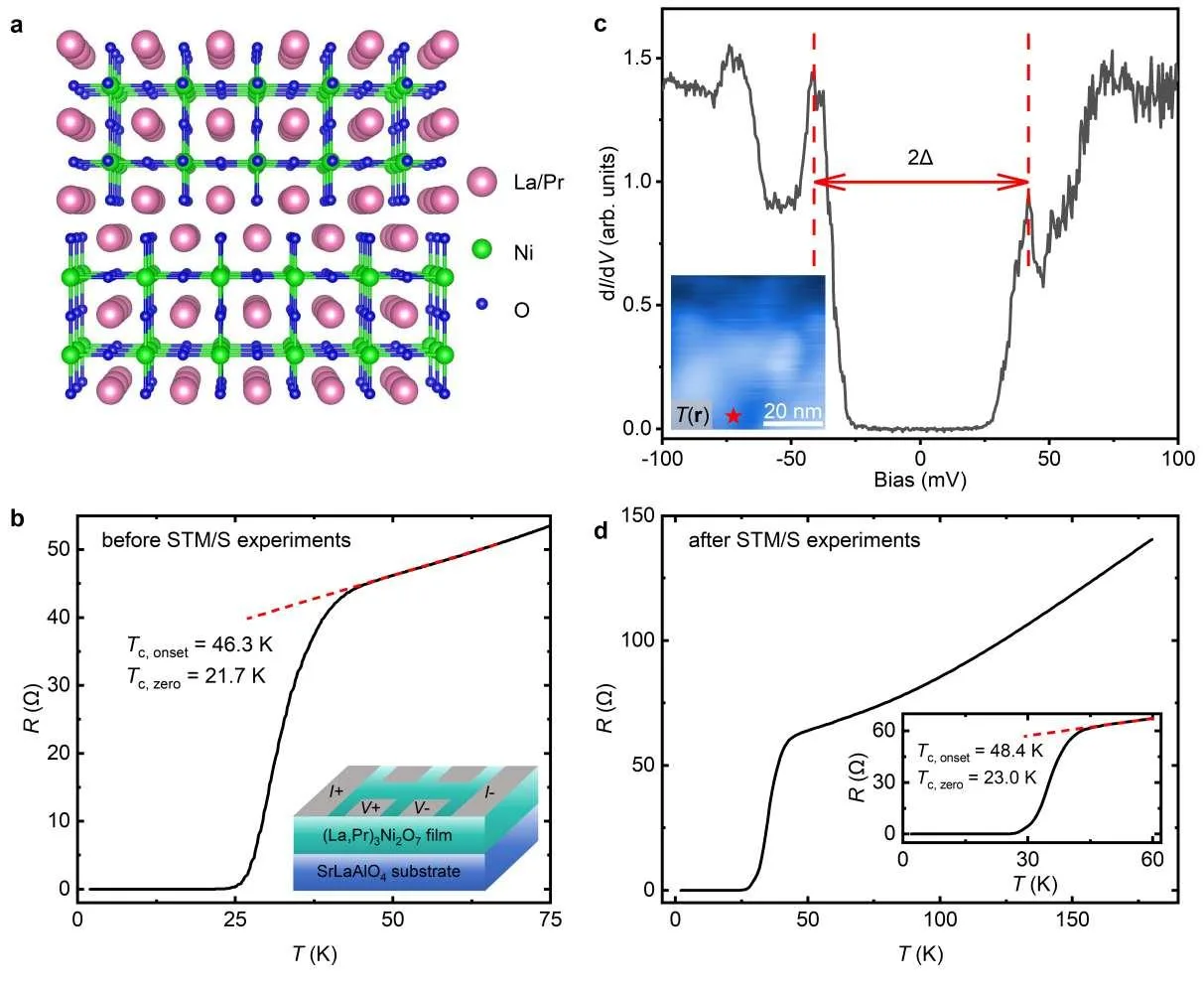
A scanning tunneling microscope (a device that probes the surface with an ultra-sharp needle, mapping electronic states) allowed a look into the heart of the phenomenon. At temperatures below 40 Kelvin (minus 233 °C), a characteristic U-shaped gap with a flat bottom appeared in the electron spectrum — an energy dip with no residual density of states. In the crowd of fans, an empty corridor suddenly formed, through which pairs of electrons glide without hindrance. The gap's shape shows that pairing occurs without nodes — the energy gap is the same in all directions, like a circular plaza free of obstacles.
Upon heating, the U-shaped gap gradually filled and turned V-shaped — electrons slowly returned to a chaotic state. A magnetic field of 14 Tesla (about 300,000 times stronger than a refrigerator magnet) narrowed the gap, confirming its superconducting nature. Resistance measurements on the same sample showed zero resistance below 20 K, with the onset of the transition above 40 K. Thus, for the first time, the energy gap in a nickelate superconductor was directly observed without high pressure. It turned out to be remarkably symmetric and robust. This discovery sheds light on the nature of high-temperature superconductivity and hints at the possibility of local superconductivity at temperatures comparable to liquid nitrogen in nickelates under ordinary conditions.
Original abstract
as written by the authors arXiv:2605.15703
The discovery of high transition temperature (high-Tc) superconductivity in Ruddlesden-Popper (R-P) bilayer nickelates under high pressure has stimulated extensive work to understand the underlying mechanism and search for superconductors with higher Tc. The recent realization of superconductivity in R-P bilayer nickelate thin films with onset Tc above 40 K at ambient-pressure enables the use of a wide array of powerful experimental tools to investigate the unconventional high-Tc superconductivity in bilayer nickelates. Here, using ultra-low temperature scanning tunneling microscopy/spectroscopy (STM/S) and electrical transport study, we report the first successful observation of an energy-symmetric, flat-bottom U-shaped gap with zero residual density of states around the Fermi level in the high-Tc nickelate (La,Pr)3Ni2O7 thin film grown on SrLaAlO4 substrate. Before and after STM/S studies, transport measurements on the same sample reveal consistent superconducting behaviors showing zero resistance, with an onset Tc above 40 K and zero resistance Tc above 20 K. The tunneling spectra exhibit highly unconventional temperature evolution, characterized by a rapid filling of the U-shaped energy gap to a V-shaped gap as the temperature increases. Furthermore, the U-shaped energy gap is reduced under a c-axis magnetic field of 14 T. The energy-symmetric U-shaped gap, taken together with its dependence on magnetic field and temperature, is consistent with the behavior of a superconducting gap, suggesting a nodeless gap function at ultra-low temperatures. Our findings shed new lights on the nature of high-Tc superconductivity and provide an encouraging and thought-provoking hint for a local superconductivity with Tc above liquid nitrogen boiling temperature in nickelate superconductors at ambient or zero pressure.
A scanning tunneling microscope can 'see' individual atoms: its needle is so sharp that only one atom sits at the tip, and the tunneling current between the needle and the sample changes as it passes over each surface atom.
In Arthur C. Clarke's novel 'The Fountains of Paradise,' superconducting cables support a space elevator — if nickelates become superconductors at room temperature, such a structure would no longer be science fiction.