Heat Turns into Electricity Even in Ordinary Glass express
Heat a nail in a fire, and it will lengthen — everyone knows that. But heat only the tip and leave the other end cold, and the nail doesn't just get longer: it bends, because hot metal expands more than cold metal. It's this very bending, but at the atomic level, that physicists have turned into electricity.
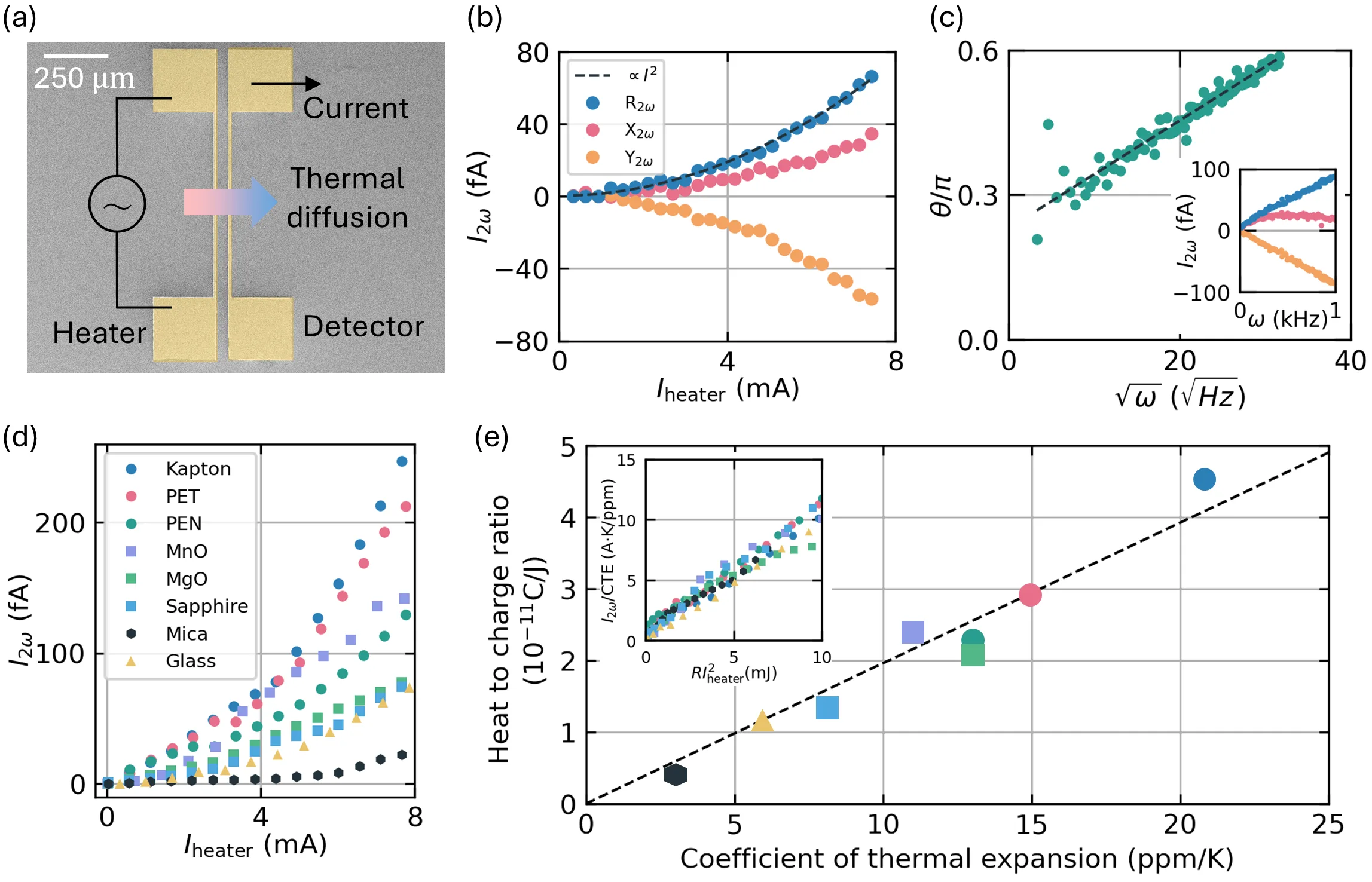
In insulators (glass, plastic, ceramics) there are almost no free electrons, so the usual thermoelectric effect doesn't work there. The authors made heat create voltage differently: the temperature difference caused uneven thermal expansion, the atomic lattice bent, and any bending in an insulator generates a weak electric field. This phenomenon is called flexoelectricity (from Latin for "to bend"). The chain is: heat → lattice bending → electric charge.
The strongest response came from thin samples — after all, a thin plate is easier to bend than a thick one. But the real surprise was near phase transitions: when glass softened or a magnetic material lost its magnetic properties, thermal expansion sharply increased. The electrical signal jumped by more than ten times.
This mechanism doesn't depend on crystal symmetry, so it works in any insulator. That means waste heat from a processor or an exhaust pipe could be turned into electricity right inside the device's casing — without metals or complex semiconductor structures.
Original abstract
as written by the authors arXiv:2605.17224
Heat-to-charge conversion has traditionally been realized via the Seebeck effect in conductors and pyroelectricity in polar insulators. Here, we demonstrate that temperature gradients generate electrical polarization, namely thermopolarization, in a wide range of insulators through a thermomechanical pathway. We identify a mechanism where thermal expansion under a temperature gradient produces strain gradients that induce polarization via the flexoelectric effect. Using a device with an on-chip heater, we detect the heat-induced polarization in crystalline, polymeric, and amorphous systems, including MgO, Al$$_2$$O$$_3$$, MnO, mica, PET, PEN, polyimide, and soda-lime glass. The magnitude of the response exhibits a robust scaling with the coefficient of thermal expansion, which is reproduced by finite-element simulations. Furthermore, we identify two routes to enhance the response: reducing the sample thickness and exploiting structural instabilities such as glass and antiferromagnetic phase transitions, where more than an order-of-magnitude enhancement is observed. These results establish a symmetry-independent route for heat-to-charge conversion in insulators and provide a device-compatible platform for electrically probing lattice responses, with potential for enhancement in nanoscale systems such as two-dimensional materials.
Ordinary window glass, if one edge is heated just a couple of degrees hotter than the other, produces an electric voltage — tiny but quite measurable. Previously, it was thought that glass couldn't do this.