Cosmic Lens Reveals Invisible Clump of Dark Matter express
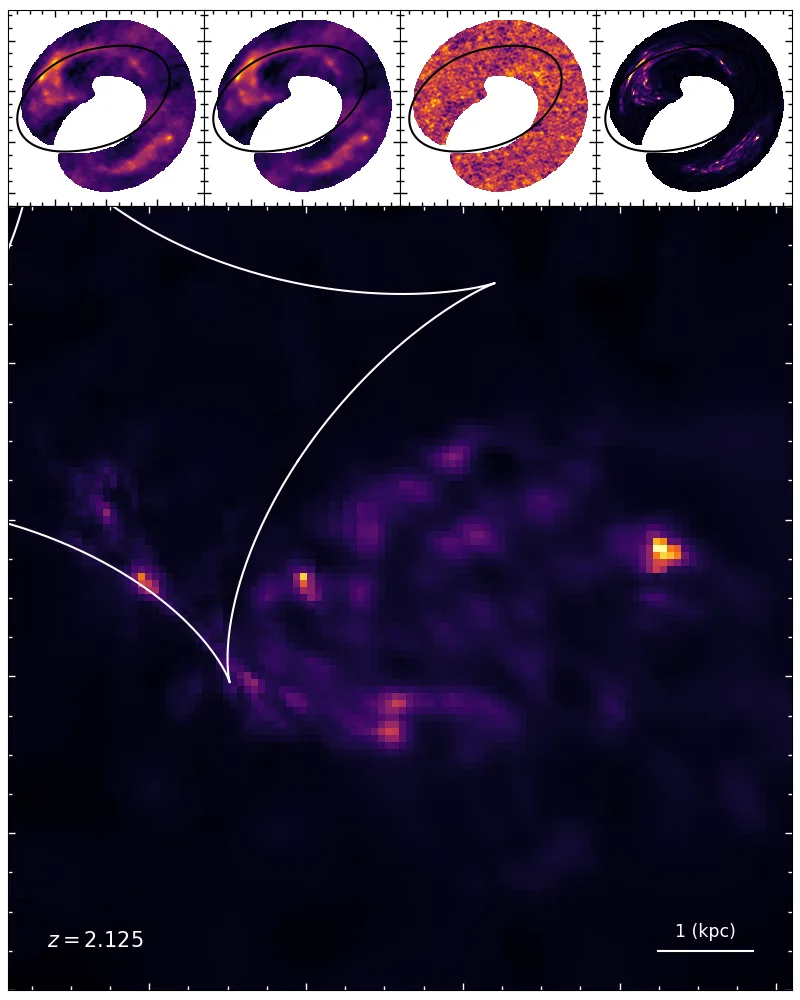
A magnifying glass focuses sunlight into a bright point. If the glass has a tiny flaw, the spot of light becomes distorted. Gravitational lensing works in a similar way: a massive galaxy bends light rays from a more distant source, creating an enlarged and sometimes distorted image. In the system PJ011646, astronomers used the ALMA telescope to look through a cosmic lens, an elliptical galaxy, at an even more distant galaxy visible in the millimeter range.
In the image of the lensed galaxy, scientists noticed subtle kinks and shifts that cannot be explained by the shape of the lensing galaxy alone. Such distortions occur when an invisible massive object — a clump of dark matter (a mysterious substance that neither emits nor absorbs light but reveals itself through gravity)—lies in the path of the light. Analysis showed that this clump weighs as much as about 28 billion Suns but is concentrated in a region only a few thousand light-years across. For comparison: if our Sun were the size of a pea, this clump would be like a soccer ball made of millions of such peas.
The most interesting part is that the mass of this object, about 28 billion solar masses, falls in the range where theories of cold and warm dark matter predict different numbers of such clumps. Cold dark matter (composed of slow, heavy particles) allows many small clumps, while warm dark matter (lighter, faster particles) predicts far fewer. This finding confirms that high-resolution gravitational lensing can probe this critical mass range and, in the future, help choose between competing hypotheses.
Dark matter makes up about five times more of the universe than ordinary matter — the stuff that stars, planets, and we are made of. Yet we still don't know what particles it consists of.
In Liu Cixin's novel 'The Dark Forest,' dark matter is used as a weapon — invisible clumps can destroy entire fleets. Reality may be less dramatic, but just as mysterious.