Gravitational waves measure the expansion rate of the universe express
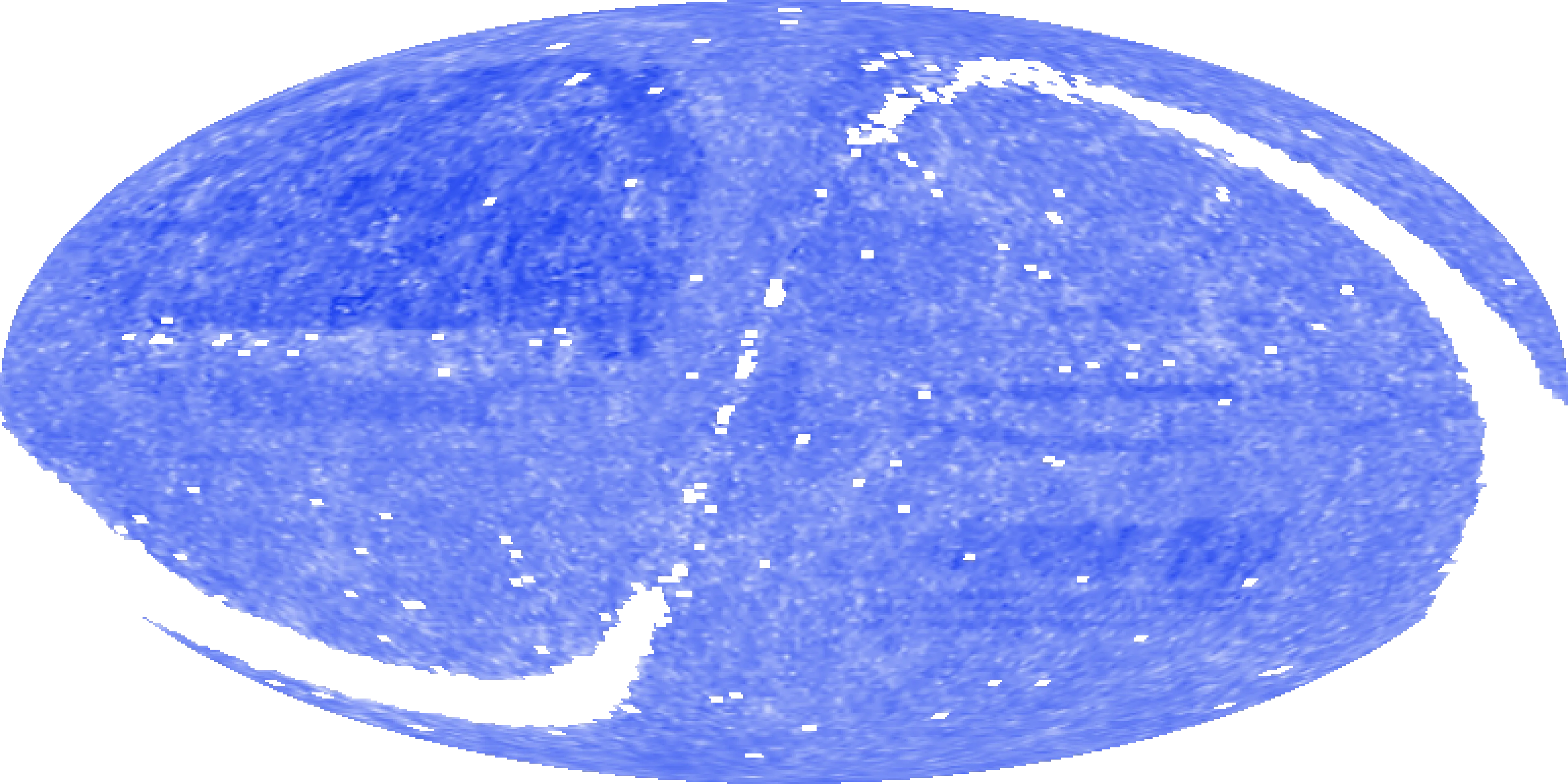
Imagine a giant inflatable balloon with galaxies painted on it. As it inflates, the pattern stretches and neighboring dots move apart. The rate of that stretching is the Hubble constant. Astronomers usually catch light from distant stars and see how much it has reddened due to the stretching of space. Now gravitational waves have joined the effort: these are tremors in spacetime itself, produced, for example, by merging black holes.
In the new study, researchers took 236 such 'tremor bursts' from the catalog GWTC-5.0. Each burst is like a hammer blow on a stretched rubber sheet: the strength of the vibrations tells you how far away the hammer was. And the way the wave's frequency changes reveals how fast that patch of rubber was receding from us. Previously, this was done with a dozen or two events; now it's done with hundreds. This allowed them to refine the Hubble constant: they got about 71.7 km/s per megaparsec of distance. In everyday terms: a galaxy 3.26 million light-years away is receding from us at about 72 meters per second — faster than a race car.
But that's not all. Gravitational waves are an ideal tool to test whether space itself gets distorted over vast distances. The authors looked for deviations from the usual geometry — for example, whether waves 'get tired' along the way, changing their loudness differently than theory predicts. It turned out everything is clean: space behaves like a stretchy sheet without holes, at least on the scales accessible to current detectors. This is an important step toward someday understanding why the balloon started inflating in the first place, and what is making it inflate faster and faster.
Original abstract
as written by the authors arXiv:2605.27227
We employ 236 gravitational-wave (GW) sources in the fifth LIGO--Virgo--KAGRA Collaboration (LVK) Gravitational-Wave Transient Catalog (GWTC-5.0) to estimate the Hubble constant $$H_0$$. We compare the luminosity distance measured from GWs to the redshift inferred i) using features in the mass spectrum, and ii) using statistical host galaxy association. Probing the relationship between source luminosity distances and redshifts obtained in this way yields constraints on cosmological parameters. We estimate $$H_0 = {71.7}_{-7.5}^{+9.4}\,{\text{km}\,\text{s}^{-1}\,\text{Mpc}^{-1}}$$ (median with $$68\%$$ symmetric credible interval). This combines information from the source-frame mass distribution with the $$H_0$$ measurement from GW170817 and its electromagnetic counterpart as well as galaxy catalog information from Dark Energy Survey Year 6 (DES-Y6). We improve over the GWTC-4.0 measurement by using more GW sources, some with significantly smaller sky localization volumes, which leads to a reduction by $$22.0\%$$ of the $$H_0$$ uncertainty and a reconstructed mass distribution with lower uncertainties. We also constrain deviations from general relativity (GR) which affect GW propagation, specifically that modify the luminosity distance inferred from the GW signal. We find no departures from GR in parameterized tests of GW propagation.
The Hubble constant is one of the most contentious numbers in astrophysics: the early universe, measured via the cosmic microwave background, gives about 67 km/s/Mpc, while the late universe, via supernovae, gives about 73. Gravitational waves offer a third, independent path, and so far their estimate sits right in between.
In Carl Sagan's novel 'Contact,' a signal from space contains instructions for building a machine that uses gravitational waves for travel — essentially, controlled ripples in spacetime, which here are studied as a natural phenomenon.