G. Bruno

7 articles · 30 co-authors · latest: 2026-07-21
3,719 citations · h-index 25 · 86 papersData: Semantic Scholar

We have retold 7 papers by this author. 1 of them with a full read. most often about: black hole merger, dark matter, dark photon. 30 co-authors across our retellings.

Links in the knowledge graph
HEP Experiment2026-01-161 minarXiv:2601.11296express
Hunting Dark Matter: A New Frontier
Dark matter is the invisible glue that keeps galaxies from falling apart. Back in the 1930s, Fritz Zwicky suspected its existence, and in the 1970s Vera Rubin proved that without it, stars would fly apart.
Neural Network Cleans Up Noise to Catch Xenon Decay
In a dark mine under the Italian Alps, a tank holds three tons of liquid xenon. When a particle hits it, it knocks faint flashes of light and electron clouds out of the atoms. Following these tracks, physicists hope to see an ultra-rare decay: a xenon-136 nucleus turning into barium-136, emitting two electrons and no neutrinos.
General Relativity2026-03-261 minarXiv:2603.25938express
Tuning Into the Hum of Spinning Stars
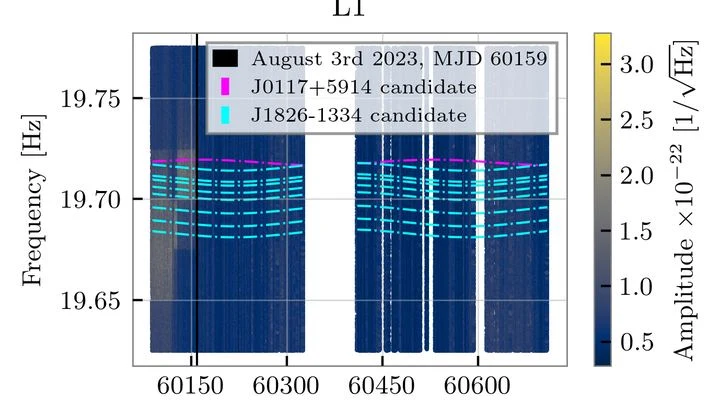
After a supernova explosion, a neutron star neutron star remains: a city-sized ball of unimaginably dense matter, spinning hundreds of times per second. Any tiny bump on its surface would make it wobble like an off-balance spinning top, humming faintly through the fabric of space.
General Relativity2026-05-261 minarXiv:2605.27225express
Cosmology2026-05-262 minarXiv:2605.27227express
Gravitational waves measure the expansion rate of the universe
Imagine a giant inflatable balloon with galaxies painted on it. As it inflates, the pattern stretches and neighboring dots move apart. The rate of that stretching is the Hubble constant. Astronomers usually catch light from distant stars and see how much it has reddened due to the stretching of space.
General Relativity2026-07-212 minarXiv:2607.19293express
Gravity Passes Another Test: 168 Mergers Confirm Einstein
A huge bowl of water. Drop a stone into it — ripples spread across the surface. The fabric of spacetime works much the same way: when two massive stars merge, they create ripples — gravitational waves. These waves travel to Earth and are picked up by giant detectors like LIGO and Virgo.