How to See the Invisible Web of the Cosmos express
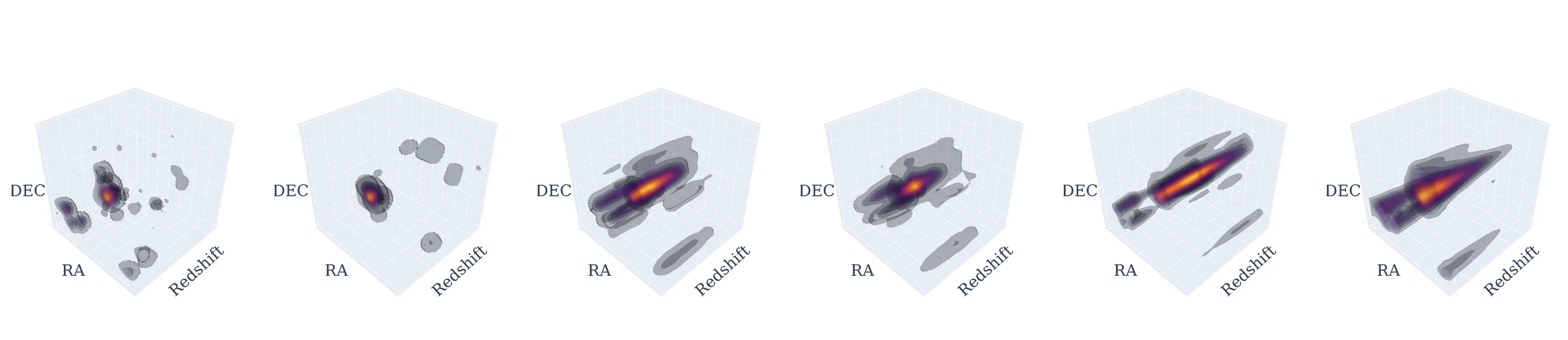
Through the ripples on the water, pebbles at the bottom of a pool look shifted and warped. In a similar way, the gravity of invisible dark matter bends the light of distant galaxies — a phenomenon known as weak lensing.
But ripples in a pool live only on the surface, while dark matter is spread through a volume, at different depths. We see only a flat projection, like a single photograph of the sky. Reconstructing a three-dimensional picture from it is like guessing the shape of waves from a single snapshot of the bottom. Previously, researchers came up with simplified rules, such as “waves are usually smooth.” However, the real cosmic web is far more complex: it consists of filaments and clumps, resembling a giant sponge.
The authors of the study took a different approach. They used a detailed computer simulation of the universe — a kind of “training ground” that honestly calculates how matter gathers into knots and filaments under gravity. They trained a neural network on these simulations, and it learned the characteristic three-dimensional patterns. Now, when looking at distorted galaxy images, the network fills in the depth based on learned patterns rather than crude assumptions.
This approach doesn't just give one answer. It produces a whole set of plausible maps. That's important because the problem inherently has no single solution: different three-dimensional structures can produce the same flat picture. The set of options shows the range of possibilities and allows us to assess the reliability of the result. In tests, the new method significantly outperformed previous ones in accuracy and better captured the filamentary structure of the cosmic web.
If dark matter emitted light, the night sky would shine brighter than on a cloudy day: that's how much of it there is.