Simple

Light Cones Melt in Quantum Haze

Original: "Probabilistic Causality from Graviton Fluctuations"
arXiv:2606.02729v2 · 2026-06-01 · CC BY 4.0 · ⏱ 1 min · HEP Theory Cosmology General Relativity
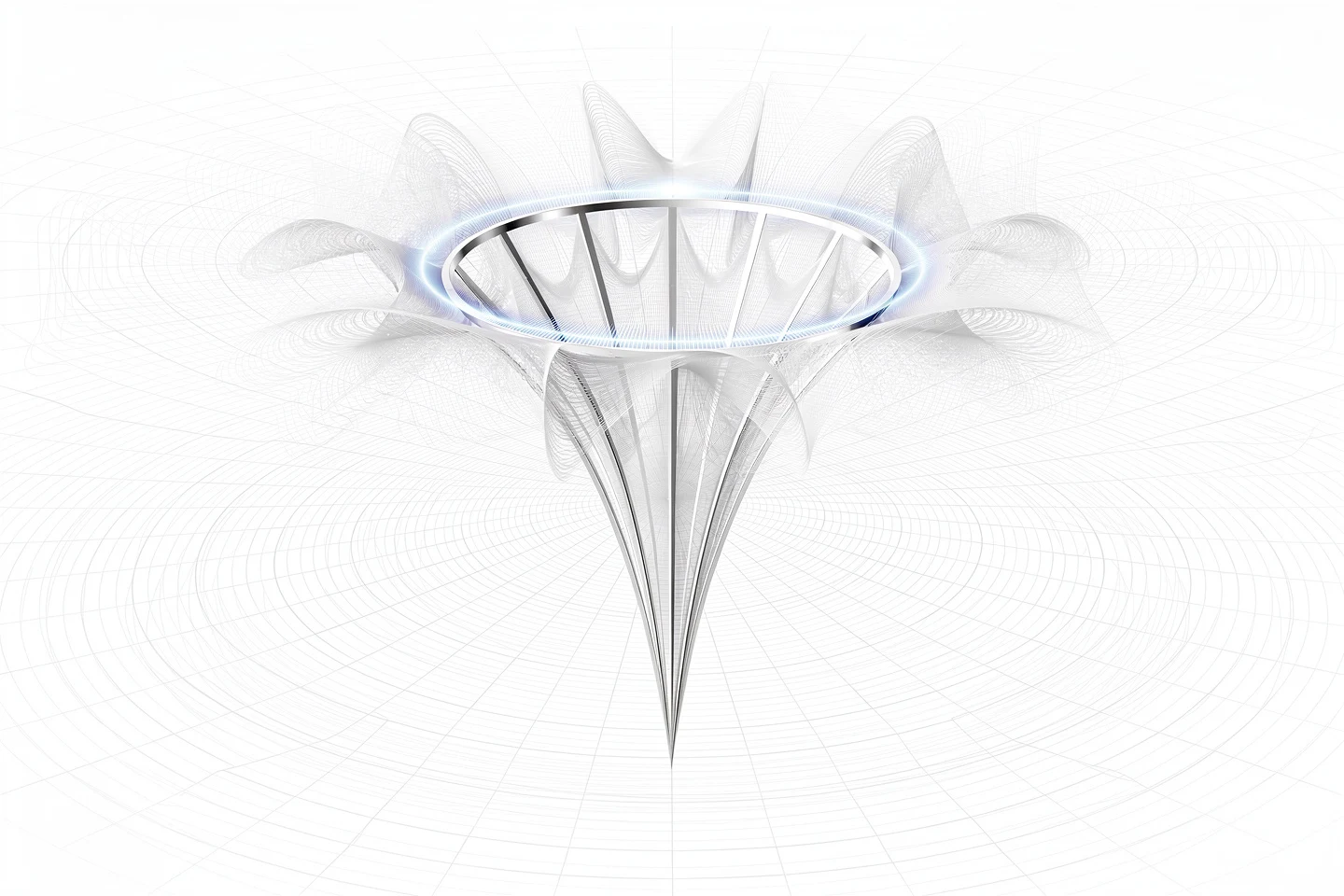
Quantum tremors of gravity, like a shimmering heat haze, turn sharp light cones into blurred clouds of probability.
Abstract

Scientists have shown that the thermal jitter of gravitons—quanta of spacetime—blurs the light cone, like fog blurring a flashlight beam. This fuzziness in the boundary between past and future grows over time. Could it be that at the micro level, cause and effect aren't so strictly separated?

Links in the knowledge graph 1

The light cone is a boundary beyond which nothing, not even light, can travel. Events on opposite sides remain disconnected. Yet spacetime itself is subject to quantum jitter: gravitational waves — quanta of quantum fields — ripple ceaselessly within it. This trembling acts like a desert heat haze, blurring the sharp edge of the light cone. Over millennia, the uncertainty builds up to entire meters.

Near a black hole, the haze thickens. Stephen Hawking and Jacob Bekenstein discovered that holes possess entropy — a measure of hidden complexity — and thus warm their surroundings. This robs the event horizon of its crispness: it is smeared by quantum uncertainty, and the near-hole space exists in a mix of geometries. If spacetime had Planck-scale temperature (10³² degrees), the haze would become so dense that light cones would lose all definition almost instantly — within 10⁻⁴³ seconds.

🎯 At room temperature, blurring the light cone by a meter would take 10,000 years; at Planck temperature, just 10⁻⁴³ seconds.

\mathrm{Var}(\vec{x}^2) = \frac{16 G_N T t^3}{3}
The uncertainty in the squared distance to the light cone is proportional to Newton's constant, temperature, and the cube of time.
P([\phi(x),\phi(0)]\neq 0) \propto \exp\left(-\frac{3(\vec{x}^2-t^2)^2}{32 G_N t^3 T}\right)
Gaussian probability that field causality is violated at a distance x from the origin.
Scientists
Christian DopplerD. B. McLaughlinDidier QuelozMichel MayorR. A. RossiterNiels Bohr
Tags
speed of light gravitational waves Quantum Field spacetime curvature black hole entropy uncertainty principle Quantum superposition
Laws
second law of thermodynamicsDoppler effectHeisenberg uncertainty principleHawking radiationgravitational lensingprinciple of constancy of the speed of light
Original: arXiv:2606.02729v2 · CC BY 4.0 · bridge42worlds