Quantum fluctuations of light: how gravitons blur causality ✛ ✦
Context
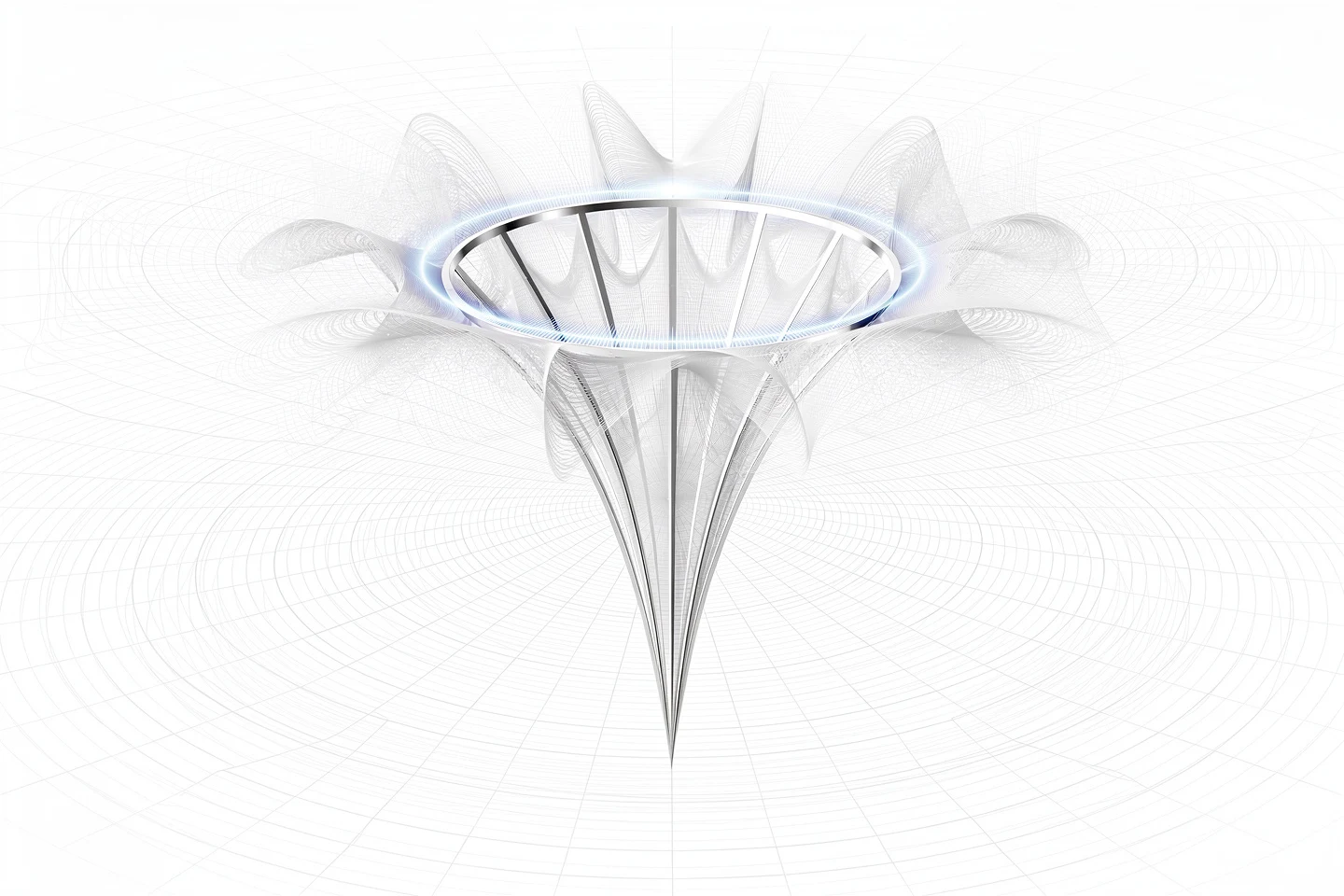
The principle of microcausality in quantum field theory states that commutators of local observables must vanish at spacelike separations. This is the bedrock of causality and the notion that no signal can travel faster than light. In quantum gravity, this classical picture gives way to uncertainty: graviton fluctuations make the light cone waver, turning causal connections into probabilistic ones. Grasping this effect is crucial for constructing a quantum theory of gravity and resolving the black hole information paradox.
Methods
For the analysis, the authors used a scalar field minimally coupled to Einstein gravity in synchronous gauge, where time is the proper time of freely falling observers. Using perturbation theory in the gravitational coupling constant $G_N$, an operator expression for the field commutator was obtained. The calculations were performed in the interaction picture, and gravitons — quanta of gravitational waves — were considered in a thermal state at temperature T. This approach allowed isolating the finite-temperature part of the graviton two-point function and computing the variance of the operator responsible for shifting the light cone.
Results
It turned out that the term proportional to the derivative of the delta function can be naturally interpreted as a shift of the classical light cone by an amount of order $G_N$. The key result: for a thermal state of gravitons, this shift is an operator with zero mean but non-zero variance. Physically, this means that spacetime is in a quantum superposition of geometries. The probability that the commutator is non-zero at a given point is described by a Gaussian distribution. For the spatial distance squared $x^2$, the variance is Var($x^2$) = (16 $G_N$ T $t^3$)/3, where t is time. This means the uncertainty in the light cone's position grows as t^(1/2), i.e., slower than the cone itself, but accumulates secularly. At room temperature, achieving a meter-scale blurring would take around $10^4$ years.
Implications
The obtained result shows that classical spacetime can lose meaning not only near Planck scales but also at large distances due to cumulative quantum effects. Particularly intriguing is that near a black hole, where gravitons have a temperature predicted by Hawking and Bekenstein, the time for the light cone uncertainty to become comparable to the hole's size turns out to be parametrically less than the evaporation time: t ~ $T^{-1}$ $S^{1/3}$, where S is the entropy of the black hole. This indicates that the semi-classical description may break down long before the information paradox kicks in, and the very notion of a horizon could be blurred by quantum fluctuations.
Future development
In the future, it is planned to generalize the calculations to realistic anisotropic states of Hawking radiation and also include the backreaction of the metric. An intriguing possibility is to investigate how light cone uncertainty affects the dynamics of black hole evaporation and the structure of singularities. It is also important to understand whether such 'jitter' of cones could be detected in cosmological observations or in data from gravitational-wave interferometers.
Impact
The results significantly alter the view on the applicability of classical geometry in quantum gravity, impacting areas such as black hole physics, quantum field theory in curved spacetime, and early universe cosmology.
Next steps
An important next step will be to compute the effect for exact solutions of Einstein's equations, such as the Schwarzschild or Friedmann metrics, taking into account graviton fluctuations. It is also necessary to investigate how the choice of gauge (the method of physically assigning coordinates) affects the observable quantities.
Key open problems
The discovered probabilistic causality is directly linked to the fundamental problem of quantizing gravity and the information paradox. The growing uncertainty of light cones could mean that classical geometry, on which thought experiments with event horizons are formulated, ceases to be a good approximation earlier than previously thought, possibly resolving the paradox through quantum blurring of the horizon.
The knowledge machine's view
This section is addressed to the author of the paper and their colleagues. Neighbouring works were found by meaning-based search across our archive, not by word overlap. We do not review: we show the field around the work.
What the work does
The paper examines how quantum fluctuations of gravitons in a thermal state blur the light cone and, as a result, break microcausality on macroscopic scales. The authors computed the variance of the light-cone shift for a scalar field in synchronous gauge and showed that it grows secularly with time, becoming significant near a black hole well before evaporation.
Where its strength is
The strong point is the explicit calculation of the accumulation effect of quantum spacetime fluctuations, demonstrating that classical geometry can lose meaning not only at Planck scales but also over large distances due to thermal gravitons.
Where it could go next
- It might be interesting to compare the obtained picture of light-cone blurring with the approach where quantum metric fluctuations are modeled via interaction with the environment, leading to decoherence of geometry. Nearby on arXiv there is a paper on how a quantum particle blurs causality, using similar logic but possibly a different formalism.based on: When a Quantum Particle Blurs Causality arXiv:2606.03671
- Since the paper mentions that near a black hole the effect becomes significant well before evaporation, it is natural to check how this aligns with models where the event horizon is smeared by quantum corrections. There is an arXiv analysis where a black hole loses its quantum compass, which may provide additional context for discussing the fate of the horizon.based on: Black Hole Loses Its Quantum Compass arXiv:2604.20922
- The thermal state of gravitons used in the paper resembles the situation with Hawking radiation, so it may be useful to compare the results with an analysis of quantum ripples around a black hole, which also considers metric fluctuations near the horizon.based on: Quantum Ripples Around a Black Hole arXiv:2606.29307
Worth trying
- Try applying the same method for computing the light-cone variance to other background geometries, such as de Sitter space, where thermal gravitons are also present.
- Consider how light-cone uncertainty affects the propagation of entanglement and whether it could limit the precision of quantum clocks in curved spacetime.
- Check whether the Gaussian form of the shift distribution survives when higher orders of perturbation theory are included.
Why this may matter
If the blurring of causality indeed accumulates over long times, it could have observational consequences for astrophysics and cosmology, and also affect the formulation of quantum field theory in curved spacetime.
Nearby works in our archive
- How the graviton stops blowing upsimilarity 0.68
- When a Quantum Particle Blurs Causalitysimilarity 0.68
- Black Hole Loses Its Quantum Compasssimilarity 0.67
- Quantum Ripples Around a Black Holesimilarity 0.67
- Black Hole Without a Singularity: Particles Dancing to Quantum Musicsimilarity 0.67
- How Black Holes Play Strings of Invisible Particlessimilarity 0.66
The closest work in the archive sits at 0.68 by meaning — the usual level for our corpus.
Original abstract
as written by the authors arXiv:2606.02729v2
We compute the commutator of a scalar field minimally coupled to gravity at leading order in $$G_N$$. The commutator is operator-valued, with terms involving derivatives of Dirac deltas supported on the Minkowski light cone. When evaluated on classical/coherent graviton states, these terms ``bend" the support of the commutator in precisely the way required to recover standard causality on a classical curved spacetime. However, these terms are also associated with a variance and are thus a source of uncertainty in the causal relations between events. We quantify this effect for a thermal state of gravitons at temperature $$T$$ by computing the probability that $$[\phi(t,\vec x),\phi(0)] eq0$$. We find that the probability distribution for $$\vec x^{\,2}$$ is Gaussian, centered on the classical light cone, with a time-growing variance $$$$ {\rm Var}(\vec x^{\, 2})=\frac{16G_NTt^3}{3}. $$$$ This result is obtained after subtracting a universal vacuum contribution, which is logarithmically UV divergent and subleading at late times.
At room temperature, blurring the light cone to a meter scale would take about 10,000 years. But if we lived in a world with Planck temperature (~$10^{32}$ K), the required time would shrink to $10^{-43}$ seconds — the Planck time!
Key numbers
- Time to achieve 1-meter blurring at room temperature: ~104 years
- Variance at t=1 s, T=300 K: ~10-30 m^2
- Characteristic time for a black hole with Hawking temperature: t ~ T^{-1} S^{1/3}
- Exponent of variance growth with time: t^3
- Ratio of variance to the square of the classical cone size: decreases as 1/t