Graviton Fog: How Quanta Blur Light Cones ✛ ✦
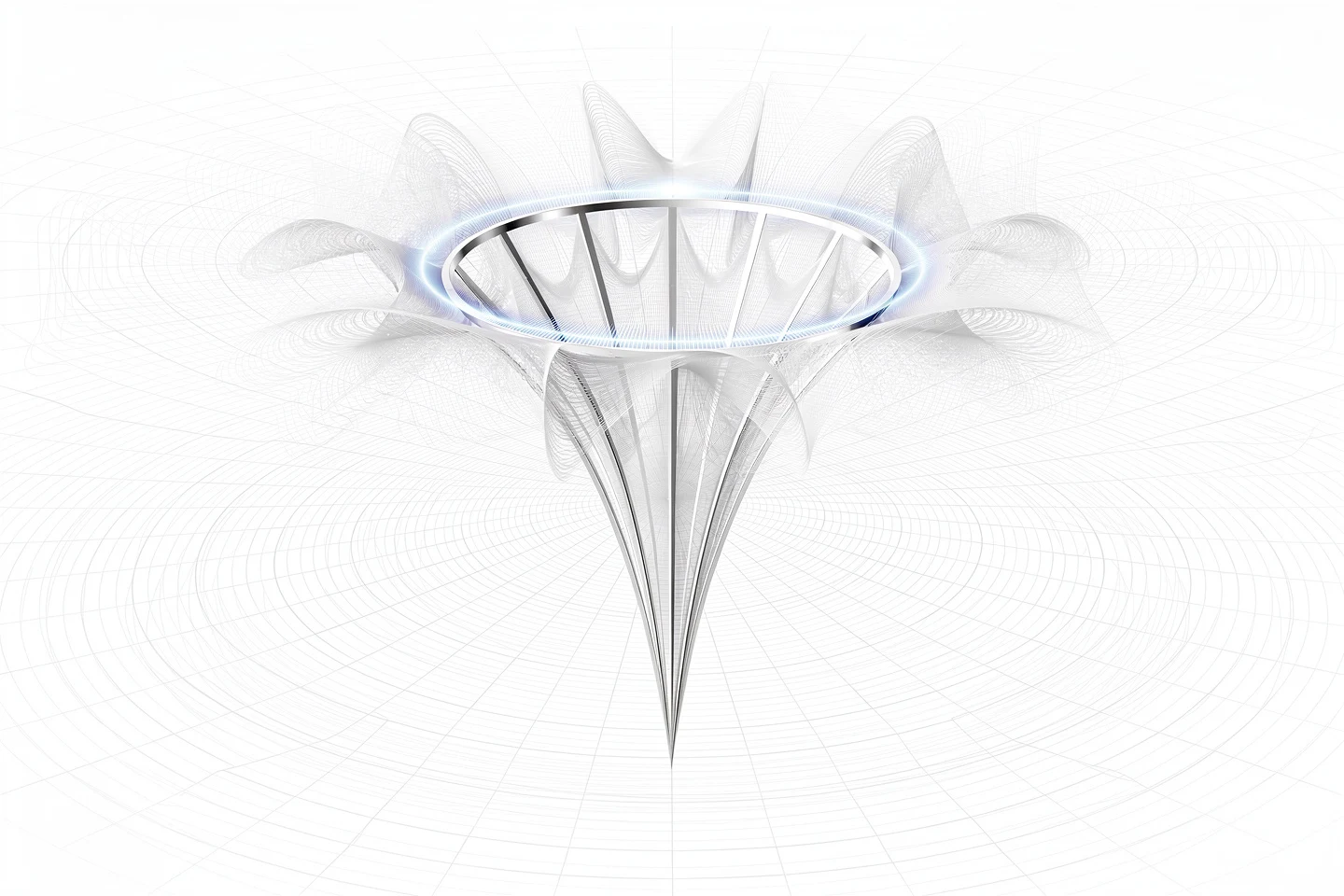
The light cone is a blueprint of causality, laser-cut onto the fabric of the universe. In classical physics, it is as sharp as a scalpel: events inside are linked by invisible threads of influence, while outside lies eternal isolation, sealed by the ultimate speed limit. But add quantum uncertainty, and the blueprint shimmers like a reflection in rippling water. Gravitons, the quanta of gravitational waves, introduce an unceasing tremor into the geometry of spacetime. This is not mere ripples on a pond: it is more like a viscous fog enveloping every temporal boundary, turning a crisp edge into a hazy mirage of probabilities.
Physicists calculated the commutator of a scalar field living in such a trembling geometry. It turned out that the classical term, a delta function drawing a sharp boundary, acquires an additional piece, which can be interpreted as a shift of the cone itself by an amount on the order of Newton's constant. But the true revelation is that this shift is not a number but an operator with zero mean and nonzero variance. In other words, spacetime exists in a quantum superposition of geometries, and the cone's position fluctuates. The variance of the squared distance to it grows as the cube of time: for a thermal graviton gas, Var(𝑥⃗²) = (16 𝐺_𝑁 𝑇 𝑡³)/3. The probability of finding the commutator nonzero beyond the expected boundary takes the form of a Gaussian peak whose width slowly expands with each tick.
Near a black hole, this quantum haze thickens into a stormy fog. The radiation discovered by Hawking and Bekenstein creates a thermal bath of gravitons with a temperature inversely proportional to the mass. Then the time it takes for the light cone uncertainty to become comparable to the size of the horizon turns out to be parametrically smaller than the evaporation time: 𝑡 ~ 𝑇⁻¹ 𝑆¹ᐟ³. The classical geometry on which the collapse picture was built comes apart at the seams long before the final Hawking outburst. Perhaps the event horizon is not a sharp membrane at all, but an extended probabilistic structure, and this fundamentally changes the way we frame the information paradox.
This result is far from a mathematical amusement. It exposes a deep connection between quantum uncertainty and the fabric of spacetime, reminding us that classical geometry is always an approximation. Looking ahead, scientists want to include the backreaction of the metric and examine realistic anisotropic radiation states. And beyond the horizon, even bolder questions loom: can we detect the “trembling” of light cones in cosmological data or in the signals of gravitational-wave observatories? And if causality is no longer a tablet of stone but a cloud of probabilities, then perhaps this is how the Universe covers its tracks of singularities — not by crushing matter into a point, but by blurring the very fabric where such a point could exist. Perhaps the very notion of “now” is merely the most probable among temporal clouds, and our reality is constantly being revised by the quantum erasers of gravity.
At room temperature, blurring the light cone to the scale of a meter would take about 10,000 years. But if we lived in a world with Planck temperature (~10³² K), the required interval would shrink to 10⁻⁴³ seconds — Planck time!