Simple

Sweet Discovery: Sugar from a Cosmic Cloud

Original: "Detection of a four-carbon sugar in interstellar space"
arXiv:2606.03313v1 · 2026-06-02 · CC BY 4.0 · ⏱ 1 min · Galaxies Exoplanets Stellar
For the first time, simple sugar erythrulose has been found in the center of the Galaxy — right in a cold interstellar cloud.
Abstract

Sugar is one of the building blocks of life, but how did it appear on Earth? Scientists have found a sugar molecule (erythrulose) in an interstellar cloud for the first time, as if they've discovered a missing ingredient in the cosmic kitchen. This sugar could have arrived on Earth via meteorites and kick-started the chemistry of life. What other recipes do the stars hold?

Links in the knowledge graph 1

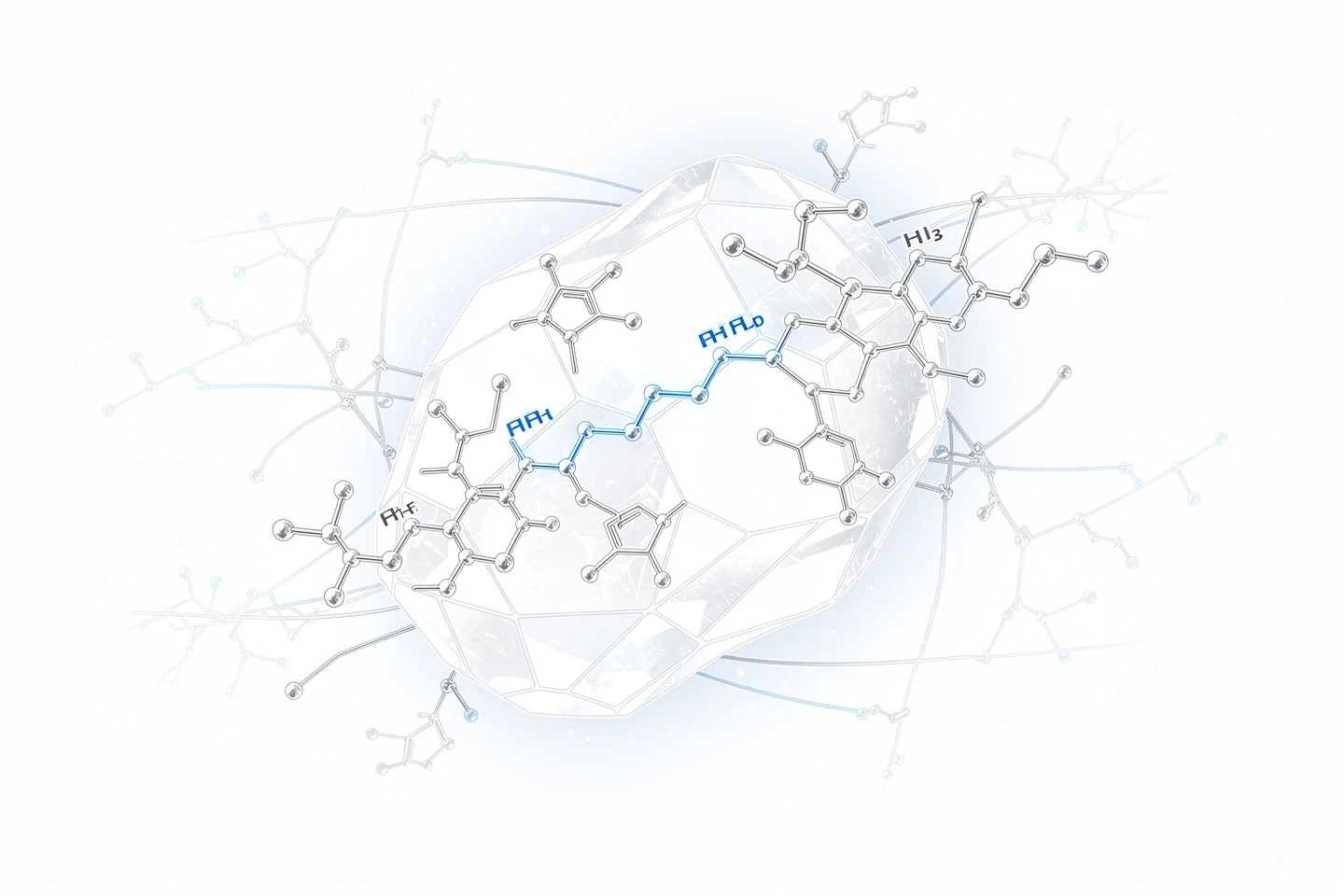
In the icy haze of the cloud at the center of the Galaxy, on tiny dust grains, a fragile crust of water ice grows. It's a miniature confectionery: atoms of carbon, hydrogen, and oxygen, the simplest building blocks, spontaneously combine into sweet molecules. Thus, 27,000 light-years from Earth, astronomers 'heard' the signal of erythrulose — the sugar added to self-tanning creams.

Erythrulose is a self-tanning component that gives skin a bronze hue. It has now been found in space.

Spectroscopy — a technique pioneered by Fraunhofer and transformed by Townes into a sensitive tool — made it possible to distinguish the chemical 'voice' of this substance. The idea that space synthesizes sugars without the involvement of planets was championed by Hoyle. Now confirmed: asteroids and comets can spread this sweetness to young exoplanets, perhaps nourishing future life.

🎯 Erythrulose, which gives a bronze tint in self-tanners, floats in an icy cloud 27,000 light-years from Earth.

🎬 Fred Hoyle, in his novel 'The Black Cloud', described a living interstellar cloud; the discovery of real sugars inside it adds scientific credence to this fantasy.

\text{C}_4\text{H}_8\text{O}_4
Molecular formula of erythrulose—a simple sugar detected in space for the first time.
\frac{N_u}{N_{\text{tot}}} = \frac{g_u}{Q} e^{-E_u/kT}
Boltzmann distribution: at 11 K, almost all molecules freeze into the ground state, simplifying spectral decoding.
Scientists
Christian DopplerD. B. McLaughlinDidier QuelozMichel MayorR. A. RossiterDavid Charbonneau
Tags
spectroscopy cosmic dust Water carbon oxygen exoplanet asteroid comet hydrogen galaxy
Laws
Doppler effectKepler's third lawCoulomb's lawMaxwell's equationsPlanck's lawPlanck–Einstein relation
Original: arXiv:2606.03313v1 · CC BY 4.0 · bridge42worlds